


This is the way the world ends
Not with a bang but a whimper.
—T.S. Eliot, The Hollow Men
 TThere's a thin line between comedy and tragedy; it's why the symbols of the theater are the laughing mask and the crying mask, Thalia and Melpomene: always together, two sides of the same coin.
It's true, though, that you'd be hard-pressed to find much comedy in these stories, although the absurdity of what we've allowed ourselves to be subjected to would be laughable if it weren't so tragic. So perhaps it's well that this final story—the only one to deal with the actual end of the world—is a comedy. One with strings attached, however, because it ends with mankind being given another chance—a last chance.
 The Chief of the Department of Small Planet Management in Heaven (Lester Matthews) has just received a directive from the Front Office regarding Planet 33974. For too long, that "nasty little globe," a place where power and plunder has become more important than gentleness and humanity, has been the source of nothing but headache. They've been warned enough—war every 20 years, two million crimes per annum, greed, intolerance, and persecution. The order is simple and to the point: Planet 33974 must be destroyed. The Chief's assistant, Elizabeth (Dorothy Malone) hands him the file on Planet 33974: Earth.
The destruction of the planet will be simple enough: an angel must travel to Earth—the top floor of the Waldorf Biltmore Hotel in New York City, to be precise—at exactly 12:00 midnight, blow five notes on a special trumpet, and voila! no more Earth. Elizabeth suggests her boyfriend Athaneal for the job, but The Chief groans; he considers Athaniel to be a nincompoop who's failed in every assignment, but Elizabeth insists he can do it—after all, he's a trumpet player in the Heavenly orchestra ("The Sweetest Music the Other Side of Heaven.")
When the call comes, Athaneal (Jack Benny), Angel Junior Grade, 3rd Phalanx, 15th Cohort, is in the process of being thrown out of the orchestra by Beethoven, who is tired of Athaneal always botching the opening measure to his Fifth Symphony. Upon being told of the assignment, Athaneal pauses—Earth is his home planet, where he died 300 years ago—but he assures The Chief that he can carry out the mission. The Chief hands him the precious trumpet, and reminds him that it must be blown exactly at midnight: 11:59 p.m. won't do, 12:01 a.m. won't do. If Athaneal is successful, The Chief promises him a promotion to Angel Senior Grade.
Upon arriving in New York City, Athaneal overhears a young couple quarreling. Danny is a young trumpet player in a radio orchestra. His girlfriend Helen wants him to give it up for a real job so they can get married, but Danny refuses: being a musician is "what I know, it's what I do." This touches Athaneal, as it mirrors a conversation he and Elizabeth had before he left for earth. He urges the couple to set aside their differences and enjoy their time together, but Danny storms off, taking Athaneal's trumpet case by mistake.
After realizing what has happened, Athaneal hails a cab and races to the Waldorf, where Danny's orchestra plays. On the way there, he listens as the driver recites the world's various woes. I've already gone through one war, he tells Athaneal, and my kid went through another. "Einstein says the next war will be fought with atomic bombs, and then the next war after that will be fought with rocks."
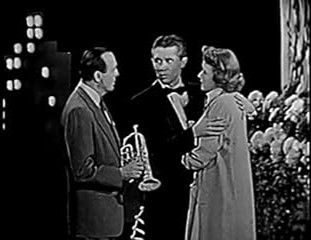 As the midnight hour approaches, Athaneal, Danny, and Helen all converge at the rooftop garden of the Waldorf. After retrieving his trumpet from Danny, Athaneal reveals to them his true identity, and that in four minutes he will blow his trumpet and destroy the Earth. "You only have four minutes to live. Are you going to spend those four minutes just fighting with each other?" They finally get the idea. Danny is skeptical, but Helen tells him that with the world as it is, anything could happen at any minute. "Suppose we did have only four more minutes to live," she asks him. "We've wasted all our precious time." If only they knew in advance when the world would end, they could make every second a happy one. "Holding each other close would be the most important in all the world." Realizing the truth of what Athaneal has said, they return inside arm-in-arm, leaving the angel alone in the garden, holding his trumpet as the minute hand moves toward midnight. And here he pauses.
At every act of kindness he has encountered, Athaneal's doubts about his mission have increased, leaving him to wonder if The Chief realizes the true nature of the situation. Now, speaking directly to him, Athaneal pleads for the lives of those on Earth. Take Danny and Helen—"They're not bad people, and they're so much in love—how can they be bad? They shouldn't be destroyed." He thinks back to the others he's met along the way: two young shoeshine boys he met upon his arrival, who were so nice to him; the friendly news dealer who helped him find Danny; the little old lady he sat next to in the hotel lobby, planning a trip around the world after winning a contest. There are millions like them all over the world, just looking for a little happiness; don't they all deserve another chance? Moved by Athaneal's plea, The Chief relents, giving the planet and its people that one—final?—chance.
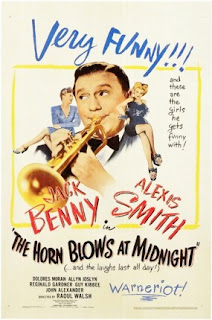 One of Jack Benny's greatest running gags (along with his stinginess and being eternally 39) was the movie The Horn Blows at Midnight. It had not been particularly successful in its theater run in 1945, underperforming at the box office and receiving lukewarm reviews by the press. Several reasons were proffered for its failure: President Roosevelt had died just eight days before the film's release, and the Rodgers and Hammerstein musical Carousel, which dealt much more successfully with the theme of the spirit world, had just opened on Broadway. Mostly, though, it just didn't quite have it; as New York Post critic Winston Archer wrote, "the comic fantasy doesn't come off as planned. The big build-up remains an architectural and overworked effort."
The movie had one great post hoc promoter, though: Jack Benny. Benny quickly made "The Horn Blows at Midnight" a continuing joke that would run through the remainder of his career. (One of my favorite Benny bits comes from a 1957 episode of his TV show: Benny is driving to 20th Century Fox to discuss a movie based on his life. At the front gate, he casually asks the guard (played by Benny regular Mel Blanc) if he ever saw the movie. "Saw it?", cried Blanc. "I directed it!") His jokes, of course, gave the movie far more publicity than it would have gotten otherwise, burnishing Benny's reputation for self-deprecating humor, and helping the movie recoup its investment. Although it was Benny's final starring role in a movie—"When the horn blew at midnight," he once said, "it blew taps for my movie career"—it also became one of his best-known, even for people who never saw it.
A radio version of The Horn Blows at Midnight was produced for Ford Theater on March 4, 1949 with Benny starring once again as Athaneal. It wasn't quite the same version of the story as that seen in the movie theaters, though; the movie had a running time of 78 minutes, while Ford Theater had a one-hour (minus commercials) timeslot; obviously, cuts to the story would have to be made. Those cuts, however, produced a subtle but marked difference, not only in the telling and the tone of the story, but in the conclusions to be drawn from it.
The first and most obvious change was the dropping of a framing device with which the movie began and ended. It presented Benny as a musician named Athaneal, a trumpet player in a studio orchestra performing for a radio program. Athaneal falls asleep during a commercial for the show's sponsor, Paradise Coffee (the coffee "that makes you sleep"), and dreams that he is an angel, playing the trumpet for the Heavenly Orchestra, who is then selected by The Chief (God? St. Peter? Edward Platt?) to bring down the curtain on Earth by blowing his trumpet at midnight.
The story then proceeds apace, leading to the movie's climax, but this too is different: after several false starts and misadventures, Athaneal finally has the trumpet in his hands, but in the process of warding off those trying to stop him from blowing the fatal notes, he falls off the roof of the building and wakes up to discover that it was all just a dream. As dreams go, it doesn't quite rise to the level of Pam finding Bobby in the shower; after all, thanks to the framing device, we already knew that this was just a dream. (Also, The Chief is a poor substitute for Victoria Principal.) This knowledge means that the movie essentially acts as its own spoiler, ruining whatever suspense might have existed and turning everything into a whimsical warning to the world to shape up or risk blowing it all (up).
 This revision, plus the toning down of some of the movie's comedic set pieces, adds a level of genuine poignancy to the story, not to mention providing us with a threat we can actually identify with. And when the story makes its way to television four years later, it is this version, not the one seen in theaters, that forms the basis for the teleplay, broadcast live on CBS's Sunday afternoon cultural variety show Omnibus and introduced by host Alistair Cooke, three days after Thanksgiving, 1953.
That's not to say "The Horn Blows at Midnight" has become a straight drama; to the contrary, there are several funny moments, most of them centered around Benny's reputation for stinginess. For instance, while waiting in the lobby of the Waldorf for Danny to appear, a bellboy walks through the lobby "paging Jack Benny." The old woman sitting next to Athaneal comments that she always watches Benny's show (this is television after all, rather than radio) and adds that he must be "the sweetest, kindest, most generous man in the whole world." Athaneal also turns out to be a big tipper, giving the two shoeshine boys (one of them played by Harry Shearer!) a dollar each; "It's such a wonderful feeling to give money away," Benny says, with his trademark pause as he looks at the audience. And then there's the scene when a little girl at the Waldorf asks Athaneal how old he is; 357, he replies, but adds "I tell everybody up there that I'm 339," a play on Benny's perennially being 39.
These scenes ensure that "The Horn Blows at Midnight" maintains a lightheartedness that keeps it from ever becoming preachy, and makes maximum use of Benny's comedic talent. But the slapstick and the broad comedy of the movie have now been replaced with a humor that is at once both gentle and very human, underlining man's foibles while at the same time looking at him with a patient affection.
It also makes possible the story's most dramatic moment, the one that provides its moral center: Athaneal's plea for mercy on behalf of the people of Earth.
The eighteenth chapter of Genesis consists entirely of a conversation between God and Abraham, during which God expresses his anger toward the cities of Sodom and Gomorrah. "The outcry against Sodom and Gomorrah is so great and their sin so grievous that I will go down and see if what they have done is as bad as the outcry that has reached me," He tells Abraham. "If not, I will know."
 Abraham's response, demonstrating the closeness of his relationship with God, is revealing. “Will you sweep away the righteous with the wicked?" he asks. "What if there are fifty righteous people in the city? Will you really sweep it away and not spare the place for the sake of the fifty righteous people in it? Far be it from you to do such a thing—to kill the righteous with the wicked, treating the righteous and the wicked alike. Far be it from you!"
In the face of this plea, God relents. "If I find fifty righteous people in the city of Sodom," He tells Abraham, "I will spare the whole place for their sake."
But Abraham doesn't stop there; "Now that I have been so bold as to speak wo the Lord, though I am nothing but dust and ashes, what if the number of the righteous is five less than fifty? Will you destroy the whole city for lack of five people?"
Again, God relents; if He finds forty-five, he will not destroy the city.
And so it goes, with Abraham continuing to bargain, reducing the number of the righteous first to forty, then thirty, then twenty; each time, God agrees to Abraham's pleas. Finally, Abraham dares to ask, "What if only ten can be found there?"
And God replies, "For the sake of ten, I will not destroy it."
The parallel between Abraham's imploration on behalf of Sodom and Gomorrah and Athaneal's appeal for the residents of Earth is obvious, and striking. Central to each is the plea on behalf of the innocent; just as Abraham asks if God intends to punish the righteous as well as the wicked, Athaneal looks at the suffering residents of Earth, many of whom bear no responsibility for the atrocities of the global war, and confronts the implicit moral dilemma as to whether they should pay this price without even having had a chance to build a world of their own.
He tells The Chief of the good, decent people he's met—not just Danny and Helen, but all the others: the shoeshine boys, the news dealer, the little old lady. "There are millions of others just like them, just hoping and praying for a better world," Athaneal pleads. "If you'd just give them a little more time. You've waited so long, thousands and thousands of years, suppose you wait just a little while longer, and then maybe everything can straighten itself out and be exactly the way you want it to be." At each invocation, a rumble of thunder greets Athaneal in reply, a sign of The Chief's determination to carry out the plan, but as the angel continues, the rumbles begin to diminish in intensity.
Finally, reflecting on his conversation with the taxi driver about the next war, Athanael plays his trump card. "If there's another war, the whole world would destroy itself and then there'd be no more Earth." He then appeals to The Chief's sense of justice, as well as his practicality: "Remember Chief, if that happened, then the responsibility wouldn't be yours. You wouldn't be to blame." Won over by Athaneal's argument, The Chief agrees to stay his hand—for now. Relieved that The Chief has granted his plea for mercy, Athaneal tells him, "I'd like to come home now."
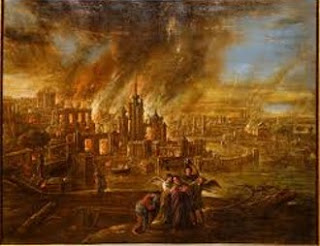 Before we get too comfortable with this bucolic scene, however, we should consider the warning implicit within, for it promises only the potential for a long-term happy ending. The implication is that the Earth is being given one final chance Give them one more chance, Athaneal pleads, allowing for the possibility that the Earth will even blow itself up and relieve The Chief from having to do it himself.—after all, in the very next chapter of Genesis, God's angels carry out the promised visit to Sodom and, after finding not even ten righteous men, warn Lot and his family to leave the town at once, after which the cities are laid waste, with "dense smoke rising from the land, like smoke from a furnace."
The television programs we've looked at in this series have portrayed a world that might well have been thought unthinkable to viewers when they watched them; we know from contemporary reviews that more than a few critics thought them improbable, unrealistic, heavy-handed. And in a dramatic sense that may well have been true. But what about in a prophetic sense? The writers of these stories were clearly providing us with warnings, For some, as in "Dialogues of the Carmelites" or "Murder in the Cathedral," it was using the past not merely as a historical detail but as a reminder that the unthinkable was once all-too possible. In other cases—"The Year of the Sex Olympics," "They," "A Sound of Different Drummers"—it was a logical extension of a future that had already been glimpsed, a preview of what could happen if events continued in that progression without being altered. In fact, in one way or another, to one degree or another, they all seem to have come to pass.
The signature themes we've seen throughout these stories are, for the most part, missing or in altered form in "The Horn Blows at Midnight." The New York in which Athaneal finds himself is not one of oppression or totalitarianism, and people are not being called upon to sacrifice their lives—consciously, that is. The only outward fear we encounter is a generalized sense, based on the experiences of the war and the Bomb, of man's inhumanity to man, but we don't see any dramatic examples of it. We didn't need to—everyone was already familiar with it. The world portrayed here is neither futuristic nor an echo of the distant past; for those watching it in real time, it was their world, a world they not only had experienced, but were experiencing even as they watched the show. That threat of nuclear war, voiced by the cab driver on Athaneal's frantic ride to the hotel, was something that was very real. And in that way it makes it a world more disturbing, more frightening, than any other that we've experienced.
We've seen, throughout this series, examples of sacrifice, of courage, of nobility and sacrificial love. But in "The Horn Blows at Midnight" we see something different, something overwhelming and essential: a deeply felt expression of compassion. Not sympathy, not pity, but compassion. Someone once described compassion as love put into action, and it's hard to find a better description for the feeling Athaneal comes to have for these humans and their planet.
Ever since receiving his assignment, Athaneal has been warned about the "nasty little globe" he's about to help obliterate. Upon his arrival on Earth, he sees the headlines of Investigations, wars, murders—even smog! But during this brief time, he also learns a great deal about its residents, observes them in various situations, listens to them as they shared their thoughts and fears, their hopes and dreams for the future. And he begins to have doubts, to even wonder if The Chief knows what he's doing.
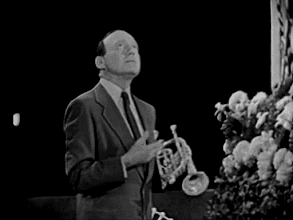 It is that compassion that emboldens him to speak so frankly with The Chief, to intercede with him on behalf of all those who will die without even having had a chance to build a world of their own. This ending—quite unlike that of the original movie—is what gives "The Horn Blows at Midnight" its gravitas, its moral weight. Having once seen it, it becomes more and more difficult to imagine the story without it, and perhaps that's one reason why the movie doesn't fare so well.
It is also that compassion that seems to be in such short supply nowadays. We've become a world in which it's one strike and you're out, leaving no room for forgiveness, for understanding, for rehabilitation and reclamation—for humanity. The world seems to be caught in the grasp of a sickness today, one greater than that which existed in the time of "The Horn Blows at Midnight." Depending on the day, we have the potential to look at the news and read of some new moral depravity, something that might have been thought unthinkable a few years ago, but now has become accepted as the new normal. We see screaming mobs consumed by hatred—hatred for others, which ultimately traces its roots back to hatred for themselves. One need only to look at reactions to the Israel-Hamas war to see this, but in reality it has been growing steadily in the past few years, and if the growth now seems to be exponential, I'm sure there's a mathematical explanation for that.
In our headlong rush toward iconoclasm and nihilism—creating a world that only tangentially bears resemblance to the world that many of us have known, tearing down beliefs and codes that have sustained our existence for millennia, creating alternative realities that render reality itself to be nothing more than an objective observation, denying biology itself--we seem, quite literally, hell bent on self-destruction. And so, we should be hoping that The Chief shows as much patience with us as he did in 1953. Either that, or we have someone as eloquent as Jack Benny pleading our case for us. Meanwhile, night falls, and the clock continues to go tick, tick, tick . . . TV
It's true, though, that you'd be hard-pressed to find much comedy in these stories, although the absurdity of what we've allowed ourselves to be subjected to would be laughable if it weren't so tragic. So perhaps it's well that this final story—the only one to deal with the actual end of the world—is a comedy. One with strings attached, however, because it ends with mankind being given another chance—a last chance.
I

The destruction of the planet will be simple enough: an angel must travel to Earth—the top floor of the Waldorf Biltmore Hotel in New York City, to be precise—at exactly 12:00 midnight, blow five notes on a special trumpet, and voila! no more Earth. Elizabeth suggests her boyfriend Athaneal for the job, but The Chief groans; he considers Athaniel to be a nincompoop who's failed in every assignment, but Elizabeth insists he can do it—after all, he's a trumpet player in the Heavenly orchestra ("The Sweetest Music the Other Side of Heaven.")
When the call comes, Athaneal (Jack Benny), Angel Junior Grade, 3rd Phalanx, 15th Cohort, is in the process of being thrown out of the orchestra by Beethoven, who is tired of Athaneal always botching the opening measure to his Fifth Symphony. Upon being told of the assignment, Athaneal pauses—Earth is his home planet, where he died 300 years ago—but he assures The Chief that he can carry out the mission. The Chief hands him the precious trumpet, and reminds him that it must be blown exactly at midnight: 11:59 p.m. won't do, 12:01 a.m. won't do. If Athaneal is successful, The Chief promises him a promotion to Angel Senior Grade.
Upon arriving in New York City, Athaneal overhears a young couple quarreling. Danny is a young trumpet player in a radio orchestra. His girlfriend Helen wants him to give it up for a real job so they can get married, but Danny refuses: being a musician is "what I know, it's what I do." This touches Athaneal, as it mirrors a conversation he and Elizabeth had before he left for earth. He urges the couple to set aside their differences and enjoy their time together, but Danny storms off, taking Athaneal's trumpet case by mistake.
After realizing what has happened, Athaneal hails a cab and races to the Waldorf, where Danny's orchestra plays. On the way there, he listens as the driver recites the world's various woes. I've already gone through one war, he tells Athaneal, and my kid went through another. "Einstein says the next war will be fought with atomic bombs, and then the next war after that will be fought with rocks."

At every act of kindness he has encountered, Athaneal's doubts about his mission have increased, leaving him to wonder if The Chief realizes the true nature of the situation. Now, speaking directly to him, Athaneal pleads for the lives of those on Earth. Take Danny and Helen—"They're not bad people, and they're so much in love—how can they be bad? They shouldn't be destroyed." He thinks back to the others he's met along the way: two young shoeshine boys he met upon his arrival, who were so nice to him; the friendly news dealer who helped him find Danny; the little old lady he sat next to in the hotel lobby, planning a trip around the world after winning a contest. There are millions like them all over the world, just looking for a little happiness; don't they all deserve another chance? Moved by Athaneal's plea, The Chief relents, giving the planet and its people that one—final?—chance.
II

The movie had one great post hoc promoter, though: Jack Benny. Benny quickly made "The Horn Blows at Midnight" a continuing joke that would run through the remainder of his career. (One of my favorite Benny bits comes from a 1957 episode of his TV show: Benny is driving to 20th Century Fox to discuss a movie based on his life. At the front gate, he casually asks the guard (played by Benny regular Mel Blanc) if he ever saw the movie. "Saw it?", cried Blanc. "I directed it!") His jokes, of course, gave the movie far more publicity than it would have gotten otherwise, burnishing Benny's reputation for self-deprecating humor, and helping the movie recoup its investment. Although it was Benny's final starring role in a movie—"When the horn blew at midnight," he once said, "it blew taps for my movie career"—it also became one of his best-known, even for people who never saw it.
A radio version of The Horn Blows at Midnight was produced for Ford Theater on March 4, 1949 with Benny starring once again as Athaneal. It wasn't quite the same version of the story as that seen in the movie theaters, though; the movie had a running time of 78 minutes, while Ford Theater had a one-hour (minus commercials) timeslot; obviously, cuts to the story would have to be made. Those cuts, however, produced a subtle but marked difference, not only in the telling and the tone of the story, but in the conclusions to be drawn from it.
The first and most obvious change was the dropping of a framing device with which the movie began and ended. It presented Benny as a musician named Athaneal, a trumpet player in a studio orchestra performing for a radio program. Athaneal falls asleep during a commercial for the show's sponsor, Paradise Coffee (the coffee "that makes you sleep"), and dreams that he is an angel, playing the trumpet for the Heavenly Orchestra, who is then selected by The Chief (God? St. Peter? Edward Platt?) to bring down the curtain on Earth by blowing his trumpet at midnight.
The story then proceeds apace, leading to the movie's climax, but this too is different: after several false starts and misadventures, Athaneal finally has the trumpet in his hands, but in the process of warding off those trying to stop him from blowing the fatal notes, he falls off the roof of the building and wakes up to discover that it was all just a dream. As dreams go, it doesn't quite rise to the level of Pam finding Bobby in the shower; after all, thanks to the framing device, we already knew that this was just a dream. (Also, The Chief is a poor substitute for Victoria Principal.) This knowledge means that the movie essentially acts as its own spoiler, ruining whatever suspense might have existed and turning everything into a whimsical warning to the world to shape up or risk blowing it all (up).

That's not to say "The Horn Blows at Midnight" has become a straight drama; to the contrary, there are several funny moments, most of them centered around Benny's reputation for stinginess. For instance, while waiting in the lobby of the Waldorf for Danny to appear, a bellboy walks through the lobby "paging Jack Benny." The old woman sitting next to Athaneal comments that she always watches Benny's show (this is television after all, rather than radio) and adds that he must be "the sweetest, kindest, most generous man in the whole world." Athaneal also turns out to be a big tipper, giving the two shoeshine boys (one of them played by Harry Shearer!) a dollar each; "It's such a wonderful feeling to give money away," Benny says, with his trademark pause as he looks at the audience. And then there's the scene when a little girl at the Waldorf asks Athaneal how old he is; 357, he replies, but adds "I tell everybody up there that I'm 339," a play on Benny's perennially being 39.
These scenes ensure that "The Horn Blows at Midnight" maintains a lightheartedness that keeps it from ever becoming preachy, and makes maximum use of Benny's comedic talent. But the slapstick and the broad comedy of the movie have now been replaced with a humor that is at once both gentle and very human, underlining man's foibles while at the same time looking at him with a patient affection.
It also makes possible the story's most dramatic moment, the one that provides its moral center: Athaneal's plea for mercy on behalf of the people of Earth.
III
The eighteenth chapter of Genesis consists entirely of a conversation between God and Abraham, during which God expresses his anger toward the cities of Sodom and Gomorrah. "The outcry against Sodom and Gomorrah is so great and their sin so grievous that I will go down and see if what they have done is as bad as the outcry that has reached me," He tells Abraham. "If not, I will know."

In the face of this plea, God relents. "If I find fifty righteous people in the city of Sodom," He tells Abraham, "I will spare the whole place for their sake."
But Abraham doesn't stop there; "Now that I have been so bold as to speak wo the Lord, though I am nothing but dust and ashes, what if the number of the righteous is five less than fifty? Will you destroy the whole city for lack of five people?"
Again, God relents; if He finds forty-five, he will not destroy the city.
And so it goes, with Abraham continuing to bargain, reducing the number of the righteous first to forty, then thirty, then twenty; each time, God agrees to Abraham's pleas. Finally, Abraham dares to ask, "What if only ten can be found there?"
And God replies, "For the sake of ten, I will not destroy it."
The parallel between Abraham's imploration on behalf of Sodom and Gomorrah and Athaneal's appeal for the residents of Earth is obvious, and striking. Central to each is the plea on behalf of the innocent; just as Abraham asks if God intends to punish the righteous as well as the wicked, Athaneal looks at the suffering residents of Earth, many of whom bear no responsibility for the atrocities of the global war, and confronts the implicit moral dilemma as to whether they should pay this price without even having had a chance to build a world of their own.
He tells The Chief of the good, decent people he's met—not just Danny and Helen, but all the others: the shoeshine boys, the news dealer, the little old lady. "There are millions of others just like them, just hoping and praying for a better world," Athaneal pleads. "If you'd just give them a little more time. You've waited so long, thousands and thousands of years, suppose you wait just a little while longer, and then maybe everything can straighten itself out and be exactly the way you want it to be." At each invocation, a rumble of thunder greets Athaneal in reply, a sign of The Chief's determination to carry out the plan, but as the angel continues, the rumbles begin to diminish in intensity.
Finally, reflecting on his conversation with the taxi driver about the next war, Athanael plays his trump card. "If there's another war, the whole world would destroy itself and then there'd be no more Earth." He then appeals to The Chief's sense of justice, as well as his practicality: "Remember Chief, if that happened, then the responsibility wouldn't be yours. You wouldn't be to blame." Won over by Athaneal's argument, The Chief agrees to stay his hand—for now. Relieved that The Chief has granted his plea for mercy, Athaneal tells him, "I'd like to come home now."

IV
The television programs we've looked at in this series have portrayed a world that might well have been thought unthinkable to viewers when they watched them; we know from contemporary reviews that more than a few critics thought them improbable, unrealistic, heavy-handed. And in a dramatic sense that may well have been true. But what about in a prophetic sense? The writers of these stories were clearly providing us with warnings, For some, as in "Dialogues of the Carmelites" or "Murder in the Cathedral," it was using the past not merely as a historical detail but as a reminder that the unthinkable was once all-too possible. In other cases—"The Year of the Sex Olympics," "They," "A Sound of Different Drummers"—it was a logical extension of a future that had already been glimpsed, a preview of what could happen if events continued in that progression without being altered. In fact, in one way or another, to one degree or another, they all seem to have come to pass.
The signature themes we've seen throughout these stories are, for the most part, missing or in altered form in "The Horn Blows at Midnight." The New York in which Athaneal finds himself is not one of oppression or totalitarianism, and people are not being called upon to sacrifice their lives—consciously, that is. The only outward fear we encounter is a generalized sense, based on the experiences of the war and the Bomb, of man's inhumanity to man, but we don't see any dramatic examples of it. We didn't need to—everyone was already familiar with it. The world portrayed here is neither futuristic nor an echo of the distant past; for those watching it in real time, it was their world, a world they not only had experienced, but were experiencing even as they watched the show. That threat of nuclear war, voiced by the cab driver on Athaneal's frantic ride to the hotel, was something that was very real. And in that way it makes it a world more disturbing, more frightening, than any other that we've experienced.
We've seen, throughout this series, examples of sacrifice, of courage, of nobility and sacrificial love. But in "The Horn Blows at Midnight" we see something different, something overwhelming and essential: a deeply felt expression of compassion. Not sympathy, not pity, but compassion. Someone once described compassion as love put into action, and it's hard to find a better description for the feeling Athaneal comes to have for these humans and their planet.
Ever since receiving his assignment, Athaneal has been warned about the "nasty little globe" he's about to help obliterate. Upon his arrival on Earth, he sees the headlines of Investigations, wars, murders—even smog! But during this brief time, he also learns a great deal about its residents, observes them in various situations, listens to them as they shared their thoughts and fears, their hopes and dreams for the future. And he begins to have doubts, to even wonder if The Chief knows what he's doing.

It is also that compassion that seems to be in such short supply nowadays. We've become a world in which it's one strike and you're out, leaving no room for forgiveness, for understanding, for rehabilitation and reclamation—for humanity. The world seems to be caught in the grasp of a sickness today, one greater than that which existed in the time of "The Horn Blows at Midnight." Depending on the day, we have the potential to look at the news and read of some new moral depravity, something that might have been thought unthinkable a few years ago, but now has become accepted as the new normal. We see screaming mobs consumed by hatred—hatred for others, which ultimately traces its roots back to hatred for themselves. One need only to look at reactions to the Israel-Hamas war to see this, but in reality it has been growing steadily in the past few years, and if the growth now seems to be exponential, I'm sure there's a mathematical explanation for that.
In our headlong rush toward iconoclasm and nihilism—creating a world that only tangentially bears resemblance to the world that many of us have known, tearing down beliefs and codes that have sustained our existence for millennia, creating alternative realities that render reality itself to be nothing more than an objective observation, denying biology itself--we seem, quite literally, hell bent on self-destruction. And so, we should be hoping that The Chief shows as much patience with us as he did in 1953. Either that, or we have someone as eloquent as Jack Benny pleading our case for us. Meanwhile, night falls, and the clock continues to go tick, tick, tick . . . TV


