July 18, 2022

What's on TV? Thursday, July 21, 1955


You'll notice that KEYD, the Minneapolis channel that will eventually become KMSP, is shown as a DuMont affiliate. but that isn't saying much anymore. It's the last season for DuMont, and their only remaining scheduled program is Monday night's Boxing from St. Nicholas Arena (you'll remember, that's the crummy matchup I mentioned on Saturday). So Channel 9 is, for all practical purposes, an independent, and will remain so until they take the ABC affiliation from WTCN in 1961. You can also see that some stations, such as Rochester's KROC, have gaps in their programming (unless, that is, their version of Feather Your Nest runs for four hours). It could be that they've signed off temporarily (although that was more prevalent earlier in the decade), but it's also possible that TV Guide got things wrong; there have been occasions when they've listed two different programs at the same time for one channel. The very imperfection, though, is what makes it that much more interesting than the newer editions, isn't it? This is a very early version of the Minnesota State Edition, in case you hadn't figured it out.

July 16, 2022

This week in TV Guide: July 16, 1955


When last we visited the Olympic Club in San Francisco, Jack Fleck was in the process of executing a shocking upset victory over Ben Hogan at the U.S. Open Golf Championship—only NBC, as you'll recall, signed off before the final round concluded, proclaiming Hogan the probable winner, and in the process missing Fleck's tying birdie on 18. Having declined the option to cover the playoff the following day, the network also failed to bring us Fleck's improbable victory. 

This didn't escape the notice of Merrill Panitt, who chose to use the broadcast as an example of the pros and cons of "subscription television"—what today we'd call pay-per-view, and which Panitt calls "Tollvision." Suppose, Panitt mused, the Open had been carried on such an arrangement: "We'd have seen all of the tournament, there would have been no commercials at crucial times, and we'd have really seen Fleck win, instead of being cut off in the middle of the thing." 

On the other hand—and there always is another hand—Panitt looks at another major sporting event held a few days later, the light-heavyweight championship bout between champion Archie Moore and challenger Bobo Olson, which lasted a mere three rounds (less than 10 minutes) before Moore left Olson sprawled on the canvas. What, Panitt wondered, if that had been on pay TV? "Three rounds of the championship and four rounds of a couple of guys named 'Joe' is all we'd have had for our money. Tollvision? No, thanks."

Meanwhile, in the New York Teletype, Bob Stahl has his mind on "pay-as-you-see TV" as well, with news that NBC plans to televise the American premieres of two recent British movies before they hit American movie theaters: The Constant Husband, with Rex Harrison, had its world premiere in London on April 21 and is planned to debut on the network October 9; and Sir Laurence Olivier's Richard III, which is scheduled for a January 1 broadcast.* Says the network's program chief Richard Pinkham, "Here's what we can offer viewers for free. Let's see the pay-TV crowd top this."

*Richard III had its world premiere on December 13; its American TV debut, on Sunday afternoon, March 11, 1956 (the same date it opens in American theaters, a first), is credited with having "done more to popularise [sic] Shakespeare than any other single work."

In retrospect, we can take a couple of things from these two stories. First, we see how early the development of pay-TV comes in the history of the medium. Less than five years since it's become a popular form of entertainment in America (the first home pay-per-view system had been developed by Zenith in 1951), with many homes still without a set, and already they're trying to figure out how to make a buck.  

Speaking of which is the second lesson, one we should all know by now. When it comes to pay-per-view, whether sports or movies or anything else, you pays your money and you takes your chances.

l  l  l

The must-see event of the week is unquestionably Sunday's tour of Walt Disney's brand-new theme park Disneyland, which is unveiled to television viewers in a live 90-minute spectacular co-hosted by Art Linkletter, with appearances by Danny Thomas, Irene Dunne, Fess Parker, and Buddy Ebsen (and an unlisted appearance by Ronald Reagan). (5:30 p.m. CT, ABC) According to Neal Gabler, a television audience estimated at 70 million (in a country of 165 million) tuned in to see the show.* One would have to say ABC's investment in the construction of Disneyland paid off.

Side note: I wonder if that was the largest audience ever to see a show on ABC up to that time?

As is so often the case, the story behind the scenes is at least as interesting as the main event. This article from the History Channel tells about the various glitches, some small and some not-so-small, that plagued the park's opening, and The Atlantic notes that "the 17th, a Sunday, was intended to be an 'international press preview,' limited to selected invitees who could ride the attractions, witness the parades, and take part in the televised dedication of the park. However, many counterfeit invitations were distributed, and more than 20,000 eager guests showed up, overwhelming many areas of the 160-acre park." The official opening took place on Monday, and within a few weeks, Disney reported that more than a million people had already visited.

There are some wonderful pictures at that Atlantic article, but if you want to see the actual show, you can watch it here

l  l  l

I don't know if you still see local festivals on national television, but when Dave Garroway hosted Today, one of the things I think he was committed to was taking the show on the road to give viewers a slice of what live is like in these Unted States. And this Monday (5:00 a.m., NBC), even though Dave is on vacation, Today is in Minneapolis to cover the Aquatennial festival. Jack Lescoulie and J. Fred Muggs appear at Theodore Wirth Park, with highlights of Saturday's Grande Day parade, an interview with Minnesota governor Orville Freeman, an appearance by the Navy's Blue Angels precision flying team, and more.

And that's not all; CBS's The Big Payoff quiz show will be broadcasting from Minneapolis all week (1:00 p.m.), with hometown boy Randy Merriman (who got his start at KSTP, and will return to the Twin Cities in 1958 with WCCO radio) and Bess Myerson. They're also on Saturday night at 8:00 p.m., choosing the five "Payoff Princesses*" that will model various items on the show during the week.  As far as local coverage goes, both KSTP and KEYD have live coverage of the parade (9:00 a.m.). There's also the Torchlight parade on Wednesday night, but the technology isn't there for live nighttime coverage yet; it will be on TV in the 1960s, though.

*Also referred to as the "Curvy Quintet."

I've written about the Aquatennial before; celebrities like Bob Hope, Arthur Godfrey, Colonel Sanders, and even Isaac Hayes (!) used to appear in the parade, and it served as the backdrop for an episode of Route 66 in its final season. Today, however, things are different. The festival has been cut from nine days to four, the Grande Day parade is no longer, nor is the milk carton boat race (don't ask), and this year the block party has been cancelled. The Torchlight parade isn't on commercial television (it might be on public access), and it's been reduced in length from 40 blocks to just over a mile. Frankly, considering the combat zone that downtown Minneapolis has been the last couple of years, I'd be afraid to go down there at night, parade or not. The Aquatennial is a mere shadow of what it once was, but then, so is the Twin Cities. Unfortunately, neither one is likely to change.

l  l  l

It was a special night indeed when Marilyn Monroe made a rare television appearance April 8 on Edward R. Murrow's Person to Person. You can see the video of that interview here, but what made it an even more special night, according to TV Guide, was what happened after the show. 

As you can tell from the video, the premise of Person to Person is that Murrow, sitting in an easy chair in his studio, interviews his subject via a remote hookup in their home; the Monroe interview took place in the Connecticut home of Monroe's associate Milton Greene. When the red light blinked off for the last time, the crew asked if it might be possible to take some pictures for their own collection. So, for the next two hours, Marilyn assumed "a succession of beguiling poses" and told them to click away.

While the article features some of the pictures taken by various crew members, I rather like this photo from Bobby Ellerbee's Eyes of a Generation site, which shows Marilyn and the entire crew. I really don't know how good an actress she was, but she looks as if she's enjoying the effect she has on them, doesn't she?


l  l  l

Some quick hits from the rest of the week:

On Saturday, And Here's the Show (8:00 p.m., NBC), billed as an "off-beat variety show," features "veteran humorist" Ransom Sherman, paired up with an "upcoming comedian" named Jonathan Winters. I had to look up who Ransom Sherman was; I didn't have to do the same with Jonathan Winters.

Toast of the Town (Sunday, 6:00 p.m., CBS), which we all know and love as The Ed Sullivan Show, has Ethel Merman subbing for the vacationing Ed; in addition to some songs from the Merm, her guests are Russell Nype (her partner from Call Me Madam); operatic singer Gloria Lane, who starred on Broadway in Gian-CarIo Menotti's The Saint of Bleecker Street; "Prof. Backwards," Jimmy Edmondson; the Peiro Brothers, jugglers; and the Rhythmettes, a precision-dance group.

One of the reasons given for the decline of boxing on prime-time network television (there were once as many as four fights a week) is that oversaturation eventually led to inferior fighters being pushed into the spotlight. This Monday's Boxing from St. Nicholas Arena     (7:00 p.m., DuMont) might be an example: a fight between two unranked welterweights, Milo Savage (record: 34 wins, 30 losses, 8 draws) and Sammy Walker (36 wins, 34 losses, 4 draws). I've always enjoyed boxing, but this is a hard, hard sell.
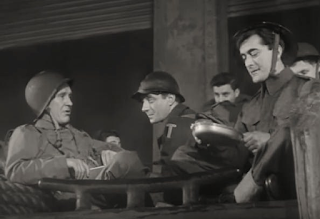
Here's Claude Dauphin with Burgess Meredith (L)   
and Philip Bourneuf (R) in
A Salute to France   
Erle Stanley Gardner wrote more than just Perry Mason books. Ellery Queen wrote stories that didn't feature a character named Ellery Queen, and Sir Arthur Conan Doyle wrote about characters other than Sherlock Holmes. One of those stories, "How the Brigadier Won His Medal," starring Claude Dauphin, is tonight's story on Koda Request Performance (Tuesday, 6:30 p.m., NBC). If this encourages anyone to broaden their reading horizons by checking out this story, then I've done my job.

The award for most convoluted description of the week goes to Wednesday's I've Got a Secret (7:30 p.m., CBS), which goes as follows: "Henry Morgan is off on vacation and Jayne Meadows and Faye Emerson have returned from the West Coast. Bill Cullen is still on hand, but not for long. He'll be off the show next week when Henry returns." It may not be important, but it amused me.

Thursday's Ford Theatre (7:30 p.m., NBC) stars Donna Reed in "Portrait of Lydia." When you talk classic television and Donna Reed, your first thought is The Donna Reed Show, but. of course, she'd already proven her dramatic chops on the big screen, winning hearts in It's a Wonderful Life and an Academy Award for From Here to Eternity, and she'd go on to do a season on Dallas, so we shouldn't be surprised.

Speaking of actors and Oscars, Oscar-winner Dean Jagger is on Playhouse of Stars (Friday, 7:00 p.m., CBS). I always liked Dean Jagger, whether in 12 O'clock High (the movie for which he won his Oscar), White Christmas, or Mr. Novak. Whether he was opposite Gregory Peck, Bing Crosby, or James Franciscus, he always seemed to steal the scene. And speaking of boxing, we've got a better fight on NBC's Cavalcade of Sports (8:00 p.m.), with the great Sugar Ray Robinson continuing his comeback, this time against #2 ranked Rocky Castellani. Sugar Ray wins a decision over Castellain; he'll regain the middleweight title by the end of the year.

l  l  l

Finally, we sometimes forget that many famous brands started out as names of actual people, and the aforementioned Walt Disney is a prime example of that. Here's another one, perhaps less well-known as a name than a brand: "Channel 4's Arle Haeberle introduces gastronomic guru, Duncan Hines, to her Around the Town audience July 22."

There are more recent logos, but the one at the right is the one that I remember best. And there may be more famous names that became famous brands, but this one was pretty delicious. TV  

July 15, 2022

Around the dial


It's often been said that to grab people's attention you need a good hook, and, at least around here, you're not going to get a better hook than the one David has at Comfort TV: "Terrible Shows I Like." In this case the show in question is The Governor and J.J. with Dan Dailey and Julie Sommars, and while I didn't love it, I do remember it being enjoyable, and as David points out, it's very hard not to like Dan Dailey in anything.

At bare-bones e-zine, Jack's Hitchcock Project continues with the works of Victor Wolfson, and this week we've got the second-season episode Toby, with the very recognizable character actor Robert H. Harris and Jessica Tandy in a strange little tale that is unsettling but effective. 

In honor of the late Larry Storch, Hal has a special edition of "F Troop Fridays" at The Horn Section. "The Ballot of Corporal Agarn" gives us Storch's Agarn, who holds the critical absentee ballot that will determine the next mayor of his hometown of Passaic, New Jersey. The candidates come to woo him, but they'll have to deal with Sgt. O'Rourke. 

Larry Storch is also the subject of this obituary from Terence at A Shroud of Thoughts, who reminds us that Storch was also the voice of Phineas J. Whoopee on Tennessee Tuxedo and His Tales, and no matter how many times I watch it, I can still never quite hear him in that role, which is, of course, a compliment to him, since so many of today's voiceovers are too obviously linked with the actor playing them. Terence also has a nice tribute to the great character actor L.Q. Jones, who died this week as well. There's 193 years between those two actors; not bad at all.

Wednesday was Dave Garroway's birthday, and also the fifth anniversary of Garroway at Large, Jodie's great website devoted to the Master Communicator. Some great pictures, and also an update on the status of Jodie's bio on Dave.

It's Fake Mediums Week at Cult TV Blog, and John kicks things off with a look at "But What a Sweet Little Room," a murder-strewn episode of Randall and Hopkirk (Deceased). After you've finished this, you'll want to continue on to the rest of the week's entries.

At Shadow & Substance, Paul has a poll on Charles Beaumont's best Twilight Zone script, and even though we all know what a terrific writer Beaumont was, and what good work he did for TZ, it's still a little overwhelming to read the list of the great episodes he wrote. That kind of talent—it just doesn't come along that often, does it? TV  

July 13, 2022

Television and the Id


It occurs to me that I haven't written anything serious in a while, and I probably ought to do so. And since quizzes are always popular (except in school, and especially when you haven't studied for it), let's start this somewhat-serious thought with one of those who-said-it quizzes—or, in this case, who wrote it, and when. The quote is a bit lengthy, but I hope you agree it's worth it. I've removed a couple of words that would help you to identify the writer and the context of the quote because I think it's one of the most interesting things about this excerpt. As you read it, consider what it says not only about our culture today, but also the world of entertainment, television in particular. As usual, I'll identify the speaker and the context at the end.

We live today in a world that is as deeply devoted to material things as was [theirs]. For example, [they] were obsessed by health, diet, and exercise. They spent more time in baths and health clubs than in churches, temples, libraries, and law courts. They were devoted to consumption. A man could make a reputation by spending more than his neighbor, even if he had to borrow the money to do it. And if he never paid back his creditors, he was honored for having made a noble attempt to cut a fine figure in the world.

They were excited by travel, news, and entertainment. The most important cultural productions [...], from books to extravaganzas in the theaters and circuses that occupied a central place in every [...] city or town, dealt with amusing fictions about faraway peoples and with a fantasy peace and happiness that did not exist in their real lives. They were fascinated by fame and did not care how it was acquired. If you were famous enough, the fact that you might be a rascal or worse was ignored or forgiven.

[They] cared most about success, which they interpreted as being ahead for today, and let tomorrow take care of itself. They were proud, greedy, and vain. In short, they were much like ourselves.

A pretty good description of the world today, don't you think?

The only difference is that it was written over 30 years ago, in 1991, and it was written about a people living in the fourth century, near the end of their empire—the Romans. The late Roman world and all its decadence was, indeed, much like ours.

And the author? If you're a classic television fan, you'll probably recognize his name: Charles Van Doren. Yes, the same Charles Van Doren of the quiz show scandals in the late 1950s. Following his disgrace, Van Doren went into a self-imposed public exile, eventually returning to a life of writing (at first under a pseudonym) and becoming an editor at Encyclopaedia Britannica. He authored a number of philosophical and scholastic books (some with his friend Mortimer Adler), the best known of which is probably A History of Knowledge. from which the above excerpt came. 

The relationship of this to television? Well, I can't imagine a better description of the celebrity-infused culture of TMZ, the world of "reality" programming that has little relation to reality, knows almost no bounds, and seems to consist primarily of people who've become famous for being famous. Can you say "Kardashians"? "Real Housewives"? Take your pick, you're not limited to them; choose whatever witless soul you prefer to name. And if Van Doren's description of reality stars and viewers hits the mark, he's no less accurate in describing the world of consumption in which television dwells, not only in how advertising dominates the medium, but in how so much of the programming—not only reality but scripted—glorifies such consumption.

If there's anything optimistic to be taken from this, it's in how it shows that there is truly nothing new under the sun. Van Doren obviously felt that this series of paragraphs was fairly descriptive of the cultural world of the 1980s and '90s, even as it was written about a society that existed some 1500 years before that, and could doubtlessly be used similarly to describe countless societies and cultures in between.

On the other hand, we have to recall that the Roman Empire crumbled, not at the hands of a military enemy, but from internal decay. The historian Arnold Toynbee, himself a writer in the pages of TV Guide, posited that "the Roman Empire itself was a rotten system from its inception, and that the entire Imperial era was one of steady decay of institutions founded in Republican times." I'm afraid that if you're looking for reassuring sentiments in that statement, you're going to have to look elsewhere.

The id of Sigmund Freud has been described as the devil on the shoulder of the super-ego, an inflated sense of self-worth, "a mass of instinctive drives and impulses [that] needs immediate satisfaction." It is to the id that television thus appeals, in its ability to satisfy the insatiable desire for fame that consumes so many of its participants, and its ability to transmit that to viewers who consume it voraciously and live it vicariously. Something, in fact, that Charles Van Doren himself fell victim to at the pivotal moment in his life.

All this is not to lay the blame solely at the feet of television. I persist in my defense of TV as a medium which is morally neutral—it's how you use the technology that counts—but I confess that over the years, even since I started this website, I've been finding that defense more and more challenging to maintain. My fear has always been that the technology is not being used very well, nor has it been for some time, but even there one can suggest that it is at least as much of a reflection of our culture as it is the source of our dilemmas. And while it's true that television does satisfy that voracious appetite for what Van Doren called "amusing fictions about faraway peoples," the people and the appetite had to exist in the first place—television merely exploited it and expanded it, but it has been a part of the human condition since Original Sin. Sic semper erat, et sic semper erit.

But that begs the question: what if television isn't neutral, can't be neutral? Perhaps, like social media or the U.S. Constitution, television is a medium that doesn't work unless those involved are good and true. Absent that, it will inevitably take on the characteristics of those who create it and those who watch it. I don't find that a particularly pleasing thought, because it implies that television was doomed to fail from the start, to become a toxic, corrupting force in society, and what does that say about us?  The Christian knows that good will ultimately triumph over evil, but that won't happen universally until the end of the world, and you can bet television won't be around to cover that

I'm not quite sure I like that thought, even in a serious piece, and because I'm also not entirely sure it has an answer, I'm not going to try to provide one. Of course, what you watch matters, and I suppose that has an effect on the level of corruption you experience. But must it inevitably corrupt, even a little? Remember what the man said about power corrupting, and remember that television, as the most intimate of media, is also the most powerful. TV  


Image: Detail, The Romans of the Decadence, 1847

July 11, 2022

What's on TV? Tuesday, July 13, 1982


This week we're looking at the Los Angeles edition, which, needless to say, is much bigger than the Minneapolis-St. Paul edition. It would be hard even back in 1982 to think of how one could possibly come up with enough TV to fill up all these stations, and this doesn't include the cable and superstations, or those from just outside of Los Angeles. But they do. When I was writing on Saturday about this week's fantastic movie lineup, one of the movies I neglected was Our Man Flint, the wonderful James Coburn spoof of secret agent movies, which pretty much guaranteed Coburn a permanent place in the All-Time All-Cool Hall of Fame. You'll also notice Bret Maverick, James Garner's attempt to resurrect his most famous Western character. It didn't work for a variety of reasons, one of which being that the new series had Maverick settling down rather than drifting from place to place. It was also said that there were too many anachronisms, such as hairstyles, in the new series. Maybe you just can't get lightning to strike twice. Not to worry, though; Garner's place next to Coburn in that All-Time All-Cool Hall of Fame is secure.