Showing posts with label Music. Show all posts

December 13, 2025

This week in TV Guide: December 11, 1954


As you know, we're always on the lookout around here for significant moments in television history, and this week we've got evidence of its growing influence on pop culture. Our story takes place on November 15, 1954, although it actually begins much earlier than that. But on that Monday evening, CBS's Studio One presented a mystery about payola in the music industry called "Let Me Go, Lover." Before the evening was out—in fact, before the show had even ended—the switchboard at CBS was flooded with calls about a song that was being performed throughout the episode. What is the name of that song, people wanted to know, and who's the girl singing it? 

And now, as Paul Harvey would say, the rest of the story.

The song, which had originally been titled "Let Me Go, Devil," had been written three years earlier by Jennie Lou Carson. It had made little impact in the industry and was soon forgotten. And then, producer Felix Jackson came over to see the head of recording for the network's subsidiary, Columbia Records—none other than Mitch Miller—requesting a song he might use in an upcoming drama. Miller gave Jackson the song, which was retitled "Let Me Go, Lover," complete with new lyrics. When Studio One's press agent, Murray Martin, suggested that an unknown, rather than a name singer, be used to vocalize the song, Miller came up with 19-year-old Joan Miller, the wife of an electrician in Paulsboro, New Jersey. Cannily, Miller then saw to it that record stores across the nation were well-stocked with copies of her recording a week before the broadcast, and sent copies of the record to 2,000 radio DJs. 

Within five days of the broadcast, the song had sold 500,000 copies. (Yes, five hundred thousand. Talk about a viral hit!) Stores were besieged with customers asking for copies of "that song that was on TV last night." Such was the demand that distributors were sending their own trucks to Columbia’s Bridgeport factory to pick up additional copies. It made the Billboard charts on December 4, and by January, 1955, it would reach #1 on all three Billboard charts; it eventually sold a million copies and was awarded a gold record. Patti Page and Peggy Lee, among others, were preparing to record their own covers of the song. Miller, basking in the acclaim and well pleased with his foresight, predicted the record would sell three million copies. 

Miller would go on to become a household name as host of Sing Along With Mitch, and Studio One would continue as one of television's premier dramatic anthologies until 1958. Joan Weber, whose face was never shown during the program to heighten the mystery, would never again approach the success she achieved with "Let Me Go, Lover," and died of heart failure in 1981 at the age of 45. 

But in the wake of "Let Me Go, Lover," never again would anyone question the ability of television in promoting a song. And if you're interested, here's a link to her recording of the song.

l  l  l

Speaking of television, which is our job around here, this week's As We See It editorial takes on the case of singer Gordon MacRae, whose songs were recently banned from radio station WPEN in Philadelphia. What was Gordon's (husband of Sheila MacRae, father of Petticoat Junction's Meredith MacRae) sin? Were the lyrics too explicit for the day? Did he commit some kind of crime? 

As it turns out, MacRae's grave offense happened on an appearance on NBC's Comedy Hour. Singer Dorothy Kirsten asked Gordon to sing a duet with him, "as they did in the old days of radio," to which MacRae quipped, "You remember radio, don't you?" The assistant manager of WPEN was outraged by MacRae's remark. "If these artists think so little of radio, I see no reason why we should lend our facilities to promote and publicize them via their recordings." Whereupon he ordered the station's DJs to stop playing MacRae's records. 

And this brings up a very interesting point, as the editor says. "Well, now, if the radio station is paying the assistant manager to eat and clothe himself and provide for his family, and he is therefore grateful to radio to the extent of being touchy about jokes at radio’s expense —why was the assistant manager watching television? Why wasn’t he sitting with his ear glued to his radio set, demonstrating, at least for his family’s edification, that he loves radio above all other media of entertainment, even that upstart television?" Good question. Furthermore, why was it the assistant manager, and not the general manager, who took such offense? "Was the manager, perchance, tuned to Toast of the Town and therefore in no position to hear and take umbrage at the crack?" Good point again.

Of course people remember radio, the editorial conludes. "It’s the medium that popularized comics' like Bob Hope and Red Skelton who made cracks about the movies. Can’t recall that they were ever banned from films because of their wisecracks, though."  

l  l  l

The NFL regular season ends this weekend (with the exception of a single game played next weekend), and Saturday's game features the Baltimore Colts and San Francisco 49ers, from Kezar Stadium in San Francisco (4:00 p.m. CT, DuMont). Elsewhere, the Honeymooneres are in trouble when Ralph decides he can make an easy fortune as a songwriter on The Jackie Gleason Show (7:00 p.m., CBS), and Your Hit Parade gives us the number one song of the week! (9:30 p.m., NBC)

Can you imagine a Sunday with no sports whatsoever, except for Roller Derby (4:00 p.m., WGN)? Welcome to this Sunday, where movies, educational programs, and cultural broadcasts dominate. On Omnibus (4:00 p.m., CBS), it's Gore Vidal's adaptation of Royall Tyler's 1787 comedy "The Contrast," the first American comedy produced professionally. That goes up against Hallmark Hall of Fame's presentation of "Royal Physician" (4:00 p.m., NBC), the story of Dr. William Harvey, who introduced the theory that blood circulates from the heart to the brain and the rest of the body as the doctor to King Charles I. Prime time offers the Colgate Comedy Hour (7:00 p.m., NBC), this week hosted by Gordon MacRae, whose special guests include Jeff Chandler, Tony Curtis, and Rock Hudson. He bests Ed Sullivan on Toast of the Town (7:00 p.m., CBS), who can only counter with Sophie Tucker, opera tenor David Whitfield, dance impressionist Angna Enters; actress Virginia Mayo, who introduces a film scene from The Silver Chalice, and The Rudells, acrobats.

Producers' Showcase
, where we've become accustomed to seeing such spectaculars as Peter Pan and Darkness at Noon, presents a change of pace on Monday night (7:00 p.m., NBC): the dedication of the Overseas Press Club Memorial Building in Manhattan. John Daly hosts the 90-minute tribute , with entertainment by Bob Hope, Sid Caesar and Carl Reiner, Marian Anderson, Perry Como, Martha Raye, and Eddie Fisher, as well as appearances by Carl Sandburg and Robert Sherwood, and Music conducted by Richard Rodgers. That's followed by Robert Montgomery Presents (8:30 p.m., NBC), starring Leslie Nielsen as a World War II deserter who decides to give himself up after a decade. THe only catch: he also has to give up the wife he married during his years as a deserter.

Milton Berle dresses up as Santa on Tuesday's Buick-Berle Show (7:00 p.m., NBC), with Uncle Miltie, dressed as Santa himself, heading to a local department store to greet the kids. Meanwhile, on Fireside Theater (8:00 p.m., NBC), a priest in France to help rebuild a church faces an ethical dilemma when he recognizes that the church's murals are the work of an artist who is a fugitive in the United States. Oh, dear!

On Wednesday, Disneyland presents the debut of "Davy Crockett, Indian Fighter" (6:30 p.m., ABC), a three-part "Frontierland" series starring Fess Parker as the legendary frontiersman, with Buddy Ebsen as his sidekick, George Russell. It's difficult to overestimate the impact of this program; historians Randy Roberts and James Olson would later write that "by the end of the three shows, Fess Parker was very well known, the power of television was fully recognized, and Davy Crockett was the most famous frontiersman in American history." By the end of 1955, Americans had purchased over $300 million worth of Davy Crockett merchandise, including the famous coonskin hat that would be a major seller by Christmas of next year. Parker would later portray Daniel Boone for six seasons in the 1960s; any resemblance between Crockett and Boone is purely intentional.

Ronald Reagan, host of G.E. Theater, writes elsewhere in this week's issue about the growing presence of movie stars on television (money brings them in, working on film rather than live clinches the deal), and we see evidence of this on Thursday night as Claudette Colbert stars on Climax! (7:30 p.m., CBS) in the story "The White Carnations." Colbert turned down a million-dollar offer from NBC earlier in 1954, but signed with CBS to do multiple guest appearances, such as this one. Later on, we get to see a pre-Donna Reed Show Donna Reed in "Portrait of Lydia" on Ford Theatre (8:30 p.m., NBC); Reed won an Oscar earlier in 1954 for her performance in From Here to Eternity.

The week wraps up with Friday's Person to Person (9:30 p.m., CBS), and this week Edward R. Murrow visits with the Metropolitan Opera's Rise Stevens, one of the best-known and most popular American opera stars of the 1940s and 1950s (you might remember her as the opera star friend of Fr. O'Malley in Going My Way), and religious leader Dr. Norman Vincent Peale, who is probably positive you'll enjoy this week's show.

l  l  l

With Christmas only two weeks away, the networks continue to roll out holiday entertainment, and this week's centerpiece is Arthur Godfrey and His Friends (Wednesday, 7:00 p.m. CBS), as the Old Redhead takes viewers on a tour of "Christmas in New York." The tour leads viewers past shop windows on treelined Park Avenue, decorated Fifth Avenue stores, and the angels leading up to the Rockefeller Plaza tree. Meanwhile, on Friday, President Eisenhower delivers his Christmas message to the nation and lights the national Christmas Tree (4:00 p.m., CBS, NBC, and ABC). 

On the NBC religious series Frontiers of Faith (Sunday, 12:30 p.m.), singer John Raitt and the Columbus Boychoir present a program of Christmas carols from the Episcopal Cathedral of St. John the Divine in New York City; the soon-to-be infamous Bishop James Pike delivers a Christmas message. Later that day, Jack Benny's annual Christmas episode (6:30 p.m., CBS) sees Jack deciding that Rochester lacks the proper knack for shopping for Christmas delicacies, and decides to do the shopping himself. Thursday night's Dinah Shore Show (6:30 p.m., NBC) features Dinah and guest Eddie Fisher singing "Silver Bells" and "The Christmas Song." 

Something else you notice in this particular issue is the number of local programs offering tips on holiday entertainment. As an example, Weekend Workshop (Saturday, 11:00 a.m., WMAQ) presents ideas and construction details for exterior Christmas decorations, The Beulah Donohoe Show (1:30 p.m., WTMJ) discusses care of your poinsettias, Creative Cookery (Tuesday, 10:00 a.m., WBKB) features recipes for Christmas cookies (one of many cooking shows with similar themes this week), and the Dorsey Connors Show (Tuesday, 10:10 p.m., WNBQ) offers "color schemes for a Christmas decor." Nice touch, don't you think?

l  l  l

The first doll to feature a tie-in to a television show, we are told, was based on the CBS children's puppet show Foodini the Great, which appeared in stores for Christmas, 1949. Foodini was followed shortly by Howdy Doody, and today the sky's the limit. Here we have a picture of the various dolls on the market for Christmas, 1954, along with a helpful key to show who's who, given that many of these dolls are based on actual TV stars of the time who have since faded into the memory banks of history. From Rickey Jr. to Donald Duck, it just goes to show that television and advertising were made for each other.


l  l  l

We'd also be remiss if we didn't share this feature on how local television stations used to celebrate various occasions with unique station identification slides. (To show you how little current television I watch nowadays, I don't even know if stations do these anymore. If not, it's just one more thing that we've lost over the years.) Here are a couple featured in this week's issue:


And to show how these weren't limited to holidays such as Christmas and New Year's, here are a pair of additional slides from other times during the year. WBAL in Baltimore even did one welcoming Daylight Saving Time! One can only wonder how colorful these would have been if they'd been seen in color.


l
  l  l

MST3K alert: The Mad Monster (1942) A scientist, ousted from his university, develops a method for transplanting wolf's blood into a man. Johnny Downs, George Zucco, Anne Neagle, and Glenn Strange. (Friday, 3:00 p.m., WGN) OK, this is a really bad movie; it makes it to MST3K on merit. We do have the consolation of another episode of Radar Men from the Moon, however. And don't feel too sorry for Glenn Strange as Petro, the monster: he'll go on to play Sam, the bartender of the Long Branch Saloon, in 222 episodes of Gunsmoke from 1961 to 1973. Now that calls for a drink! TV


If you enjoy the content here and want to support my broader creative work, please consider making a donation at my Ko-fi page. Any amount you contribute helps me continue writing, researching, and sharing these articles and projects. Thank you!

October 18, 2025

This week in TV Guide: October 16, 1965


As anyone who watches television knows, sponsorship is the lifeblood of the medium. Commercials on TV are, by and large, annoying, infuriating, stupid, loud, and wind up telling you very little about the products they're supposedly advertising. There are too many of them, they last too long, and they're so intrusive that they can leave a viewer running for cover just to escape. Even public television has them, although they're not called such. There was a time when a television series couldn't even make it to the airwaves without already having sponsors lined up.  

Which leads us to this week's question: just how do programs go about getting sponsorship? Here to provide the answers, in a very funny article that contains more truth than I suspect we might think, is Robert Leonard. Leonard is a man who should know, having spent ten years as Vice President in Charge of Television at one of Madison Avenue’s biggest ad agencies. It was his job to sell prospective programs to sponsors looking to finance the season's next big thing, which would just so happen to provide the sponsor's product with the best possible platform for exposure to the millions of viewers who, until this very moment, had no idea that said product was so essential to their quality of life. There are, Leonard says, four basic types of pitches known to the industry, one to cover each type of program the agency might encounter; in the right hands, each of these pitches guarantees sure-fire results every time.

The safest kind of program to pitch, according to Leonard, is the "Likewise, I'm sure" kind of show. You know the kind: a show that"carbon-copies some other well-rated program as closely as the laws of infringement permit." Imagine, if you will, a show starring "an outspoken housemaid." You can't call it Hazel, of course, but what about Ethel? It's the perfect response for the sponsor who demands something on the order of, say, Bonanza. "You might come right back at him with a drama called Briganza that takes place on a big Oregon ranch called The Sequoia, which is owned by Bill Wheelwright who has four sons. ('A real switcheroo, eh, Harry?')" I'm sure we've all seen an example or two of this kind of program over the years, haven't we, Dick Wolf? 

Speaking of whom, the second kind of show, Leonard says, is the one with the sterling "credit rating." This is something everyone who watches television today ought to be familiar with; Dick Wolf has made a career out of selling concepts based on the simple fact that they were created by one Dick Wolf. You can, in fact, make this kind of pitch all the way down the line, "through scriptwriters, film editor and wardrobe mistress." With this kind of credit in the bank, you can push for extra star power in the casting, in something called a "fresh format." Think of "something like combining Willie Mays and Chet. Huntley in a psychological Western, or Lawrence Spivak playing the role of a kindly football coach." Why, the pitch practically writes itself: "Believe me, Louie, the rating services will Top-10 this baby! It’s got everything going for it!"

Then, there's something called "integrated programming." In this kind of program, the commercial is practically a part of the show; imagine, Leonard proposes, a series called D.S.C., featuring the brave men of the "Department of Street Cleaning." Sounds exciting, right? Well, maybe not to you or me, but what if you were in charge of ad buying for a company famous for its detergent products. See where we're going here? Each week, "exciting episode after episode takes us into the everyday lives of the men who preserve our sanitation; their hopes and fears, their home life; the things they have inside their homes that they’ve collected in line of duty." All brought to you by the company that makes their uniforms sparkle! 

What if, however, your program lacks that certain je ne sais quoi? The kind of show that "Doesn’t aim very high, so it can’t fall very far." It's still on the market, even though it's been on the air for a few weeks. "The network is desperate. The packager is frantic. The price is slashed! And the concessions you get! Quick-escape clauses! Extra commercial positions!" Sounds good—but, you might be wondering, why hasn't someone bought it up yet? "Maybe it's a real stinker. Maybe everyone who saw the pilot threw up." In that case, it's not that the's show's bad; it's just offbeat, not for everyone, victim of a bad timeslot. Don't look at it as a bad show; think of it as a good bargain.
 
And so there you have it, the concise explanation for how your favorite (or least-favorite) show got its sponsor. There's only one last detail remaining: the Return on Investment, here expressed as the CPM: cost per thousand homes per minute of commercial. You arrive at this by taking the weekly average audience from last season, and add 25 percent "to prove you have confidence in the new vehicle you picked." Divide that by the sponsor's cost per episode, and then again by the number of commercial minutes per episode. And that is your magic number, the one that enables you to close the deal. However, Leonard offers this warning in conclusion: "Don’t dare put the CPM in writing. Because when your television turkey is staggering around next spring just asking to be slaughtered, the CPM can get your neck, too."

l  l  l

During the 60s, the Ed Sullivan Show and The Hollywood Palace were the premiere variety shows on television. Whenever they appear in TV Guide together, we'll match them up and see who has the best lineup..

Sullivan: In Hollywood, Ed's scheduled guests are Sid Caesar; actor Sean Connery; the singing McGuire Sisters; singer Pat Boone; the rock 'n' rolling Animals; comics Guy Marks and Totie Fields; and the Fiji Military Band. (Note that according to the episode guide, Connery was a no-show, while Caesar was joined by Joyce Jameson (who also sings) in a sketch, and musical group Sam the Sham and the Pharaohs and tumbling group The Gimma Brothers also appeared.)

Palace: Host Frank Sinatra welcomes Count Basie; comic Jack E. Leonard; dancer Peter Gennaro, choreographer for Perry Como and the recent Andy Griffith special; West German singer-dancers Alice and Ellen Kessler; and Colombian high-wire acrobat Murillo.

What I enjoy about this week's matchup is that it shows off the extremes of my own musical tastes: The Animals (singing "The Work Song") and Pat Boone ("Night and Day" among other selections) on Sullivan, and Frank Sinatra and Count Basie on the Palace. And despite the temptation to push it, I'm going for The Palace, but in this pre-DVD era watch for Sullivan on reruns.

l  l  l

From 1963 to 1976, TV Guide's weekly reviews were written by the witty and acerbic Cleveland Amory. Whenever they appear, we'll look at Cleve's latest take on the shows of the era

This week Cleveland Amory demonstrates that there was, in fact, such a thing as life before Columbo for Peter Falk. Falk, of course, knew this well; prior to donning the lieutenant's rumpled raincoat, he'd received two Academy Award nominations for Best Supporting Actor, won an Emmy for "The Price of Tomatoes," and had starred in the subject of this week's review, a series which he's called his favorite, Trials of O'Brien. And Cleve has some news for you: "If you think that Peter Falk is an overrated young man who looks like the late John Garfield and acts like a road-company James Cagney—and that, furthermore, he is inclined to make a federal case out of saying 'hello' and yet plays a big scene as if it should have been handled in small-claims court—then you are not going to like this show." On the other hand, if you think he is the coolest, hippest, In-est actor to come along since The Birth of a Nation, then you are going to love it. For, make no mistake about it, this is Falk’s show."

And what this is is a legal drama laced with a liberal dose of comedy; in fact, it might not be a stretch to view Danny O'Brien, Falk's character, as a distant relative of Columbo, one of those familial characters that keep popping up in the stories the lieutenant tells suspects as he's luring them into his trap. He is, as the American Bar Association disparingly described him in a complaint to CBS, a man who "(1) plays the horses, (2) parks his car in a no-parking zone, (3) throws his brief case, crammed with important papers, into the back of his open convertible and (4) is divorced and, apparently worst of all, is behind on his alimony payments." In addition, they don't like his habits, manners, and dress. All of this, the ABA claims, combines to bring the legal profession into disrepute and suspicion. (As if they weren't capable of that on their own.)

To all this, Amory replies, the network should "throw the American Bar Association out of court." Yes, make him pay his parking fines, but the back alimony points to one of the strongest parts of the series, O'Brien's relationship with his ex-wife Katie, played by Joanna Barnes, whom Amory calls "the brightest new spot of the new season." "[E]ven if the writers make her act mean, she doesn’t really mean to be mean—she’s not all on the side of the Bar Association." Falk, in fact, is surrounded by a strong supporting cast; in addition to Barnes, there's Elaine Stritch, Ilka Chase, and David Burns, and guest-starring appearances by Herschel Bernardi, Robert Blake, Buddy Hackett and Cloris Leachman. But, as will be the case with Columbo, the center of gravity at all times is Falk, who is on screen 90 percent of the time and can "tough-guy it and hard-heart it with anybody but the Supreme Court." And the network itself; despite a positive reception (even from critics not named Cleveland Amory), the series ends after a run of 22 episodes.

l  l  l

For political junkies, the Sunday interview shows are a feast. With the death of President Kennedy last year, former President Dwight Eisenhower is seen even more as the elder statesman of the presidency (along with Harry Truman, to a lesser extent), and on Issues and Answers (1:30 p.m., ABC), he sits down for a one-on-one interview with White House correspondent Bill Lawrence from the Civil War battlefield at Gettysburg. General Eisenhower* analyzes military tactics in the Vietnam War, discusses the final volume in his memoirs, and talks politics, including "a plan for limiting Senate and Congressional terms of office." Ah, Ike always was a man ahead of his time.

*As a five-star general, Eisenhower was given the choice as to what title he wished to use following his presidency. He always chose to be referred to as "General" rather than "President."

From left: Beame, Lindsay, Buckley
Meanwhile, Meet the Press (4:30 p.m., NBC) interviews the three major candidates for mayor of New York City: Republican John Lindsay, Democrat Abe Beame, and Conservative William F. Buckley, Jr. Buckley's stated reason for entering the race is an attempt to deny victory to the liberal Lindsay (indeed, Beame may well be less liberal than Lindsay), and although he fails (Lindsay wins with 43% to Beame's 39% and Buckley's 13%), WFB does get off the best line of the campaign: declining his rebuttal time during a debate, he remarks that "I am satisfied to sit back and contemplate my own former eloquence."* Would that there was even one candidate of this caliber running today.

*I've used this line many times over the years myself. Although there are those who would have preferred I stop with "I am satisfied to sit back."

There's no guest listed for Face the Nation (9:30 a.m., CBS), but a quick Google search reveals that it was Alabama Attorney General Richmond Flowers, who's there to discuss the trial of KKK member Collie Leroy Wilkins for the murder of civil rights worker Viola Liuzzo following the march from Montgomery to Selma. Wilkins' first trial ended in a hung jury, and the moderate Flowers, a proponent of civil rights legislation, has announced that he will personally take over the prosecution of the retrial because, as state AG, he won't be subject to the pressures that local prosecutors might face. The sensational case has drawn worldwide attention, as well as a move to have the KKK investigated by the House Un-American Activities Committee. Wilkins is never convicted by an Alabama court (thus escaping the electric chair), but is found guilty of civil rights violations in a subsequent Federal trial.

*Fun fact: Flowers' son, Richmond Jr., was a football player at Tennessee and went on to play in the NFL for the Dallas Cowboys and the New York Giants. (He chose Tennessee over Alabama because of his father's controversial politics.) He was also a star hurdler, a contender to make the 1968 Olympic team (a torn hamstring prevented him from qualifying), and was known at the time as "the fastest white boy alive."

l  l  l

Let's continue with the sports theme for a moment. The World Series has ended, and now the spotlight turns fully to football. (Another sign of how the times have changed; today, it's the World Series that fights for a place in the spotlight.) The college game of the week on Saturday features a Southwestern Conference showdown between two of the nation's top teams, #1 Texas and #3 Arkansas (1:00 p.m., NBC). Arkansas, after blowing a 20-0 lead, rallies to defeat Texas 27-24. Four years later, the two teams will play "The Game of the Century" for the national championship; once again, Arkansas jumps out to a lead, but Texas rallies in the fourth quarter to win the game and the national title, 15-14. Today, the SWC is but a distant memory, while the two teams compete in the Southeastern Conference.

I discussed musical tastes earlier in the "Sullivan vs. The Palace" feature; Monday night offers us plenty of the same, beginning with Hullabaloo (7:30 p.m., NBC), where host Paul Anka welcomes the Supremes, Leslie Uggams, the Back Porch Majority, and jazz dancer David Winters. Later, it's the 18th  season premiere of Perry Como's Kraft Music Hall (9:00 p.m., NBC), with Perry joining singer Nancy Ames in a look back at the radio days of Kraft Music Hall, beginning with the Bing Crosby and Al Jolson days of the Thirties and Forties, and through the Fifties, when Perry himself took over. And I'll bet you get plenty of fall recipes during the commercial breaks.

On Tuesday, CBS presents master documentarian David L. Wolper's adaptation of Theodore White's best-seller The Making of the President 1964 (9:30 p.m.). Neither the book nor the documentary have quite the cachet of White's original 1960 book (and subsequent documentary), but it's still a valuable portrait of the tumultuous 1964 campaign, as LBJ tries to step out of the shadow of JFK. As with the previous documentary, stage actor (and frequent What's My Line? guest panelist) Martin Gabel provides the dignified narration.*

*Elsewhere in this week's issue is this ad for the John F. Kennedy half-dollar coin set, a valuable collectors item as silver is being phased out of coin-making. Is the placement a coincidence?  And what about that Dallas mailing address?

Barbra Streisand burst onto the television scene in April 1965 with her special "My Name Is Barbra," and CBS repeats the Emmy-winning show on Wednesday night (10:00 p.m.) It tops off a night of great variety that started with the 15th season opener of Hallmark Hall of Fame (7:30 p.m., NBC) and its original drama "Eagle in a Cage," the story of Napoleon's exile to the island of St. Helena and his plot to return to France, starring Trevor Howard and James Daly. (Admit it: can you see Hall of Fame showing something like that today? Not enough of a chick flick, I'd say.) That's followed by a Bob Hope Special (9:00 p.m., NBC), with Bob and his guests James Garner, We Five, Carol Lawrence, and Phyllis Diller. 

I couldn't possibly get through this week's music programs without stopping on Thursday to see the unexpecdted spectacle of Hedy Lamarr hosting Shindig (7:30 p.m., ABC), with the Dave Clark Five, the Kingsmen, Joe Tex, Brenda Holloway, and Lulu and the Luvvers. Over on NBC, Dean Martin (10:00 p.m.) has a stellar lineup with Louis Armstrong and his combo, Robert Goulet, Lainie Kazan, the Kirby Stone Four, the dance team of Brascia and Tybee, and the comic contortionists Trio Leema. And if you didn't get enough Frank Sinatra on The Hollywood Palace, there's more, with the network TV premiere of the original Ocean's 11 (9:00 p.m.), the Rat Pack romp co-starring the aforementioned Dean Martin, Sammy Davis Jr., Peter Lawford, Joey Bishop, Angie Dickinson, and a movie-stealing Cesar Romero.

Awards shows haven't quite progressed to the point where they're stand-alone programs. The Golden Globes, for example, were a feature for several years on The Andy Williams Show, and on Friday night the Country Western Music Awards are handed out on The Jimmy Dean Show (10:00 p.m., ABC). Buck Owens, Merle Haggard, Norma Jean Beasler, Del Reeves, and the team of Roy Drusky and Priscilla Mitchell are among the performers, and Tex Ritter and Roy Acuff are on hand as presenters. The show runs the typical one hour; nowadays, it seems as if there's a Country music awards show every other week. What's that? You say there is?

l  l  l

Some interesting feedback in the Letters to the Editor section regarding a writer's roundtable featured in an issue that I wrote about many years ago. There's an interesting response from Howard Bell, the NAB Code Authority Director, who takes issue with the idea that the Code is responsible for the decline in TV drama. "[T]he TV code is not designed to stifle creativity in writers, nor does it do so in actual practice," Bell writes, quoting extensively from Section 1 of the Code: "It is in the interest of television as a vital medium to encourage and promote the broadcast of programs presenting genuine artistic or literary material, valid moral and social issues, significant controversial and challenging adult themes." While the Code isn't responsible for television's premier dramas, Bell writes, neither has it been a deterrent. If there has been a decline in the quality of television drama, there are undoubtedly reasons for it, but "from the Code Authority point of view, the excuse of censorship through the TV Code is misleading."

Leo Monaghan of Springfield, Massachusetts, also sees the issue of censorship as a straw man, pointing out that "Movies, paperbacks and magazines have amply shown that elimination of censorship is not the answer to mediocrity, but merely an invitation to degradation." According to Monaghan, the answer is not license, but talent. And while Maureen Bendich of Saratoga, Colorado, says that the article was "appalling and stimulating," suggesting that she sympathizes with the writers, she says it also "confirms my impressions that there is no room left for creativity." Finally, Robert Shaw, a "visiting Briton" writing from Jamaica, New York (the Robert Shaw, perhaps?), finds the whole thing ironic, having "been lectured on the 'evils' of government-controlled TV [i.e. the BBC] compared to the free enterprise system, as practiced here where 'no censorship exists.'" It's not clear whether Shaw finds the complaining or the assertion of no censorship to be the most humorous.

l  l  l

The networks lost a combined $10,000,000 in revenue during their coverage of Pope Paul VI's historic visit to New York City earlier in October, but it was worth it, as Henry Harding reports they "rose magnificently to the occasion." The networks devoted virtually all of October 4 to coverage of the papal visit, with 90 pool cameras broadcasting images to over 140 million viewers during the 14 hours of coverage, including a high point of 70,000,000 at one point. Compared to "the esteem and gratitude of millions of viewers," the loss of revenue may be well worth it.

And they could use it, according to Samuel Grafton, in the first of a three-part series on how television covers the news. His question: does TV news really give the viewer the whole story? His answer: no. It's quite interesting, and another indication of how times have changed, that the article is full of comparisons between television and newspapers. NBC's Reuven Frank, for example, says that "A television news show is a front page. It is not a full news service, like a complete newspaper." Washington correspondent Clark Mollenhoff, who covers the capital for the Des Moines Register and Tribune and the Minneapolis Star and Tribune, says, "They touch the surface," but to do anything further would take "depth knowledge of a subject, which they don't have, or don't have time to acquire." Even Walter Cronkite, in a recent interview on the educational station WNDT, admits that "I do not think we cover the news"

Grafton compares the newspaper reporter, who "works through contacts he develops over the years, with many people, great and small," with the television reporter, who "comes through like a parade, with his truck and his cameras." Complicating things is television's fear of boring viewers, requiring them to reduce stories "to a small enough compass so that the viewer can take all of it," unlike the newspaper reader who commits himself to a thorough review of the daily paper. For the same reason, television news avoids stories that lack mass attention—"news of music, of the theater, paintings and new books." As Frank says, although "[t]here's no subject that can't be covered on television," it should only be covered if it's of interest to the layman—"not if it is interested only in a specialist's way."

By comparison, local television news is seen as a strength of the medium. Now, most sane people today consider local news to be pretty much, not to put it too delicately, crap. The "if it bleeds, it leads" mentality, combined with the boy-girl happy news anchor teams, most of which look as if they're auditioning for a fashion runway rather than the newsdesk, has heavily influenced network television. However, the advantage that local news had in the mid-1960s was that its audience was interested—these were stories that had a direct impact on viewers, ranging from commentaries to reviews of new plays.

The lack of commentary on television news is particularly striking, since the three major anchors—Cronkite, Huntley, and Brinkley—all have five-minute daily radio spots in which they often make pointed comments. Why radio and not TV? Huntley acknowledges that "We're still feeling our way on television. We'd feel naked on TV doing a one-and-a-half-minute think piece." Lacking commentary, there's always hard-hitting reporting, but even here, television falls short. According to Raymond Brand, an editor at the St. Louis Post-Dispatch, it's because TV newsmen are too worried about their own images, too "dignified" and respectful, to lower themselves into the muck. CBS's Fred Friendly hopes this changes; "We want yeast. We want savvy. We want what comes out of a reporter's deep experience. Our reporters are going to dig, not just read."

Much as was the case with that drama writers' roundtable, the main obstacle to television news seems to be a sort of censorship, a reluctance to go beyond self-set limitations. But with expenditures of over $100 million annually, it's clear that television news won't remain static.

l  l  l

MST3K alert: The Amazing Transparent Man (1959) A scientist enlists a convicted safecracker to help him steal radioactive material using the scientist's newly-developed method for turning a person invisible. Marguerite Chapman, Douglas Kennedy. Typical of the time, this sci-fi non-epic concludes with military personnel contemplating the prospects of an all-invisible army. Would that they had made the short, the Union Pacific safety film The Days of the Years, invisible; it's fortunate for the nation's economy that Union Pacific is better with the railways than with filmmaking.  TV


If you enjoy the content here and want to support my broader creative work, please consider making a donation at my Ko-fi page. Any amount you contribute helps me continue writing, researching, and sharing these articles and projects. Thank you!

November 11, 2022

Around the dial


Today is Veterans Day, and I'd be remiss if I didn't start out with recognition for all those serving in the Armed Forces, here and elsewhere. There's no jingoism needed to thank them for their service.

Now, for this week. There are many jokes out there about associating size with quality, and I think it would be right and proper to pass on all of them now. I'll just say that even though we have a smaller set of links to share this week, the quality more than makes up for the quantity.

Earlier this week, HBO celebrated its 50th birthday. For several years, HBO was cable TV, at least as far as many people were concerned, and to this day the network has a place at the highest level of broadcasting. At The Ringer, Alison Herman looks at how it's come a long way during those years and how it keeps overcoming the obstacles.

It's been a long time since I checked out GSN, the Game Show Network. So long, in fact, that the last shows I watched there were What's My Line?, Password, and PlayMania (for obvious reasons). The Flaming Nose brings us up to date with this review of one of its most popular shows, America Says, with host John Michael Higgins.

The Broadcasting Archives links to a Washington Post story by John Kelly on the catchy music that punctuated late-night movies back in the 1950s. The best-known of these is "The Syncopated Clock" by Leroy Anderson, but there are others you'll probably recognize in this charming look back. 

John is back at Cult TV Blog with another documentary review, this time a 2015 look at Manchester's Strangeways Prison and its infamous 1990 riot. The story is interesting, the techniques used in the documentary are interesting; read all about it.

I do link to Terence at A Shroud of Thoughts for other than obituaries, but he's always on top of things, and he does them so well—the way they should be done. He has several this week that deserve your attention: Andrew Prine, Leslie Jordan, Ron Masak, and Jules Bass. Champions all.

A pretty good week at that, right? As I said, size isn't everything. TV  

July 30, 2022

This week in TV Guide: August 2, 1986


I've been doing this gig now for what, 12 years? You'd think I'd know the answer to that, but it's been demonstrated that many of you out there are more familiar with what I've written than I am. Anyway, during all these years, one of my constant themes has been the intimate role that television has played in people's lives. This week's lead story, by Joanmarie Kalter, examines how television "shapes the lives" of people in retirement communities—how, in fact, it is the only link to the outside world for many.

Kalter reports from On Top of the World, a middle-class condo community of about 8,000 in Clearwater, Florida, where the residents aren't afraid to admit that not only do they watch a lot of television, they love doing so. (I wonder if it's too late to get a condo there.) They use it for, among other things, keeping track of the world. "I do like to tune in on Washington Week," says Arley Sica. "And I'll tell you why. Those fellows are specialists. They have contacts in the Pentagon, entree to Congress. They're very important for understanding the news of the week." Among other favorites, they enjoy watching Wall $treet Week, 20/20, Dallas, Cosby, and Dynasty. He'd go into more detail, but he excuses himself, telling Kalter that it's time for the news.

Helen Martin looks at Today hosts Jane Pauly, Briant Gumbel, and Willard Scott almost like friends. Clarence Mahrie enjoys Hawaii Five-O, Police Woman and Barney Miller; he likes these kinds of shows that "solve the problems and it comes to a finish, which you know from the beginning anyway.  Sophia Karageorges watches shows like Highway to Heaven "where things come out good in the end, because life isn't like that. So you find it where you can." And when dinner's through, everyone crowds around, talking about their favorites, what they like and what they don't ("We already know what goes on in the bedroom," one says about the sexier shows on the tube. "They don't have to show us."), and they just laugh when Kalter tells them that TV often portrays older men as "bad" and older women as "unsuccessful." Says one woman, "Television is the best thing that was ever invented. That's all I can say." (These people really are kindred souls.")

Although advertisers poo-poo them, senior citizens are among television's most loyal viewers. They're also among the wealthiest; according to business-research group The Conference Board, "poverty rates among the elderly are now lower than for others, while those aged 65 to 75 enjoy more income per person than those under 45; 'The older consumer, so cavalierly ignored by so marketers, is in fact the prime customer in the upscale market.'" And slowly television has started to respond: Murder, She Wrote, The Golden Girls, Joan Collins, Lauren Bacall, and others are showing that "consumers in retirement are not ready to be old; what they seek, instead, is a final chance to be young."

Television does more than just fill time for these people; rather than being turned into couch potatoes, it keeps them involved. They're "far from old friends, from children, from work and the old home town," Kalter points out, and "television bridges the distance; it keeps them involved." They watch the news, they keep track of movies, they look for public television to replace the culture they left behind in big cities. It stimulates the mind, one person says, and adds, "There are some ladies here who just sit and sleep. They don't know nothing from nothing. It's a shame." The rhythm of their day is shaped by what time their favorite shows are on, and, says 84-year-old Miriam Hartline, "I'd be lost, terribly lost without it." 

Kalter charmingly describes this generation as one "for whom the wonder of television has never quite worn off." "It's all still new to us," Mary Brown says, and I understand exactly what she means. The residents all recall their very first set (so do I), and whether or not they took out a loan to get it; they remember the small screens and the magnifiers that were used to enlarge the picture, and they remember "how the neighbors would all crowd in to see it." They are fond readers of TV Guide, and they carefully mark the shows they plan to watch. They're purposeful on their viewing, and don't leave the set on as background noise. For them, television is not something to be taken for granted.

A few years ago, a writer in his late-twenties named Rodney Rothman wrote a book called Early Bird, about his experiences living in a Florida retirement community for a few months because he wanted to "practice living old," and it now appears that I’ve spent more or less my entire life doing just that, sitting in front of the television when I could have been out somewhere breaking world records or curing diseases or changing the destinies of various nations. The flip side of that, of course, is that I might not have survived to write about any of this, whereas watching television is a fairly sedentary activity where the risks are limited to things like diabetes and obesity and high cholesterol. But, you see, those people in Florida have that beat, because they’ve already lived through most of life, and if they do come down with any of these diseases, well, it’s probably better to have them at the end of your life instead of when it’s just starting out. That may sound cold, but it’s also probably true. My way, the biggest risks are those that you assume by reading what I write

l  l  l

I know this might be a bit hard to swallow, but there was a time when Cosmopolitan was a sophisticated magazine, It was famous for publishing novellas and short stories by writers who were or would become famous; H.G. Wells, O. Henry, A. J. Cronin, Sinclair Lewis, George Bernard Shaw, Upton Sinclair, and Jack London were just some of the authors who had their works published in the magazine. 

Then, Helen Gurley Brown became the editor, and turned Cosmo into a soft-core porn rag. 

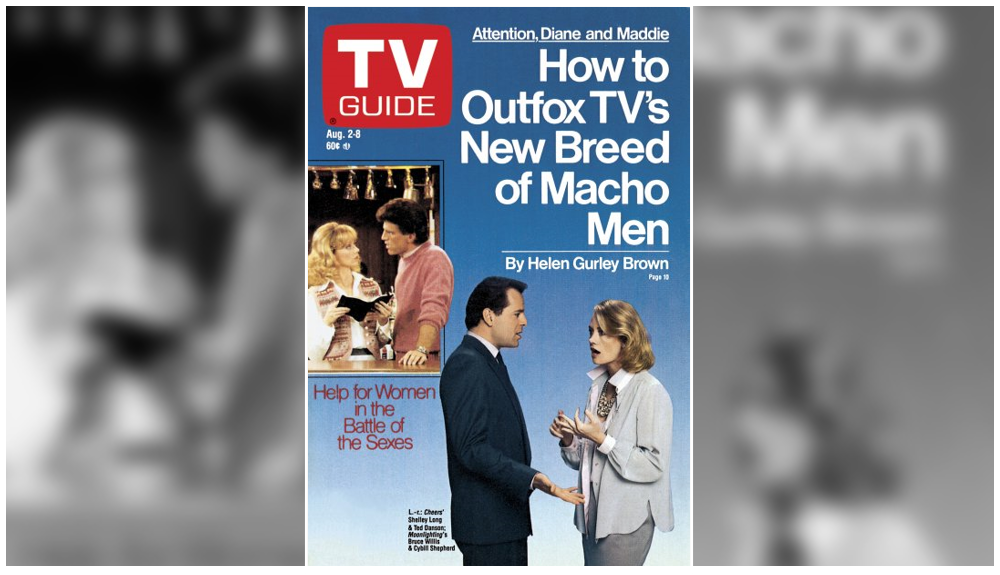
I wonder if Helen Gurley Brown would have been published in the TV Guide of the 1950s or '60s, or even the '70s? We're past that point now, though, and so she features in this week's article, "How to Outfox TV's New Breed of Macho Men." It even reeks of sensationalism, doesn't it? The "macho men" in question—perhaps they'd be called "toxic males" today—are Sam Malone, aka Ted Danson, of Cheers, and David Addison of Moonlighting, also known as Bruce Willis. Now, I'll admit right off the top that I never watched either of these series, nor do I read Cosmopolitan, so I'm basing all my opinions on their respective reputations, as well as my skill at reading about popular culture. 

As Brown enters the scene, her question is a simple one: why do these women spoon for men who are "probably the wrong men," men who'll make them losers even if they win? "Smart Women, Foolish Choices!" she says. Take Diane (Shelley Long), for instance—smart, sensitive, attractive; "why is she hiding her brains in Sam's bar, waiting on machos and men who are afraid to go home to their wives?" Even if she does succeed in landing Sam, she'll still be working at the bar, while he's out playing the field. (So much for the redemptive love of a good woman, I guess.) Here's Brown's prescription for Diane: "Let Sam propose to slick councilwoman Janet Eldridge," she says. "That way, Diane can have the more rewarding role of The Other Woman. Sam is bound to cheat on Janet once he has her." 

As for Maddie (Cybill Shepherd), she's stuck pining for "a Peter Pan unwilling to grow up." Her suspicion is that Maddie would find David a better lover than husband, so she suggests the writers consider having Maddie give in to him. Or they could "have Maddie make the first official move on David, with him being chased around the desk and told he could either give in our lose his job." Wouldn't that be a switch? After all, she's the boss of the firm, and if things go south, it's always the lesser person 

According to Brown, both Diane and Maddie are suffering from "a real-life condition: men who are unwilling to face the responsibility and lack of excitement of a long-term relationship." All Diane gets is "great verbal sparring at which she wins only some of the time." Maddie, meanwhile, is "so involved with David professionally she doesn't get much of a chance at an outside life in which she might meet a prince." Could Diane and Sam, and David and Maddie, live happily ever after? Brown doubts it, and besides, "Their series would be canceled."

The whole article, well-written and witty though it may be, sounds exactly like one would get from a magazine like Cosmopolitan. And while some of her advice is actually insightful—Diane, for example, "may seem a feminist but is actually caught up in the time-honored, one-sided love affair in which a masochist is more in love with a semi-sadist than he is with her."—the whole thing seems, I don't know, so—shallow. There's no depth to these relationships, which always revolve around sex and sexuality, rather than sense and sensibility. And overriding all of this is the idea that for men and women, true equality means letting women benefit from easy sex and shallow connections, just the way men do. I know that there's more to this article than that, but really: isn't the Cosmo lifestyle just the Playboy philosophy for women? I rather think that the answer lies not in bringing women down to the level of men, but raising men to the level of women. But then, I'm old.

l  l  l

It's what Judith Crist calls a "between-seasons" movie week; that doesn't mean, however, that it lacks for quality. The week's major premiere is that of David Lynch's magnificent The Elephant Man (Monday, 9:00 p.m. PT, NBC), featuring a "remarkable performance" by John Hurt as John Merrick, for which Hurt received a well-earned Best Actor nomination, coupled with Anthony Hopkins' compassionate performance as Frederick Treves, who struggles to help Merrick. The black-and-white cinematography paints a grim picture of Victorian London, and Lynch's direction gives a disorienting aspect to a movie that could easily have drifted into sentimentality in the hands of a lesser director. The result is a movie that makes "a deep mark in our sensibilities." 

Anthony Hopkins is back, and "memorable," in a rerun of the 1982 TV movie The Hunchback of Notre Dame (Saturday, 9:00 p.m., CBS), which Crist describes as "a brilliant, glowing version" of Victor Hugo's novel, with Lesley-Anne Down matching Hopkins's performance. Hopkins isn't in Absence of Malice (Sunday, 9:00 p.m., ABC), but it's not lacking for star power, with Paul Newman and Sally Field leading the way in "a slick and witty melodrama." And then there's the documentary The World of Tomorrow (Wednesday, 9:00 p.m., PBS), a wonderful and evocative (and occasionally bittersweet) look back at the 1939 New York World's Fair, narrated by Jason Robards. It's a "first-rate" look back at what Crist calls "a lost American yesterday."

l  l  l

It's football season again, at least the practice version, euphemistically referred to as "pre-season" games. On Saturday afternoon (11:30 a.m., ABC), Wide World of Sports presents the NFL Hall of Fame Game from Canton, Ohio, pitting the New England Patriots and St. Louis Cardinals. The Patriots are off of a 46-10 drubbing in the Super Bowl at the hands of the Chicago Bears, but the real attraction of this game is at halftime, with highlights of the Hall of Fame induction ceremonies, with honorees including Paul Hornung, Fran Tarkington, Ken Houston, Willie Lanier, and Doak Walker. What a group.

On Sunday, the league takes its road show overseas, as those very defending champion Bears take on America's team, the Dallas Cowboys, from Wembley Stadium in London, England. (10:00 a.m., NBC) It's the first game of what would come to be known as the "American Bowl" series of pre-season games played outside the United States; while most games in the early years were played in London, the sites expanded to include Japan, Germany, Mexico, Australia, Ireland, Spain and Canada, before being phased out in 2005. Nowadays, the overseas games get played during the regular season. 

There's one more Hall of Fame worth celebrating, though; on Sunday, ESPN has coverage of the National Baseball Hall of Fame ceremonies; the great Willie McCovey, who hit 521 home runs during his illustrious career, is the sole inductee from the Baseball Writers Association of America, guardians of the gates of the Hall. Bobby Doerr and Ernie Lombardi were elected by the Veterans Committee.

We all know the start of the NFL season means the practical end of any other sport, but they keep trying; on Thursday and Friday, ESPN presents first- and second-round coverage of the 68th PGA Championship from the Inverness Club in Toledo, Ohio (11:00 a.m.); Bob Tway wins his only major with a two-stroke victory over Greg Norman. 

l  l  l

There are a few other things of note in a month that's usually given over to summer reruns. On Saturday night, we've got a couple of failed pilots, and it doesn't take a genius to figure out why: In The Family Martinez (8:30 p.m., CBS), Robert Beltran plays a young lawyer who, on his first day in court, has to figure out how to sneak his fugitive client back into jail. Maybe not the worst plot in the world, but what do you do for an encore? Later (9:30 p.m., NBC) Sylvan in Paradise stars Jim Nabors as an inept but well-meaning bell captain at a Hawaii hotel, where his disasters have a way of working out for the best. That one's all too predictable, even with Brent Spiner playing a man with the unlikely name of Clinton Waddle. After that, a name like Data seems almost normal.

On Sunday, Motown Returns to the Apollo (8:00 p.m., NBC), a three-hour, star-studded tribute marking the 50th anniversary of the famed Harlem theater, dominates the evening. It's hosted by Bill Cosby, and stars Smokey Robinson, Stevie Wonder, Sarah Vaughan, Diana Ross, Sammy Davis Jr., the Commodores, Lou Rawls, Mary Wells, the Four Tops, Martha Reeves, Luther Vandross—well, just about anyone and everyone you can think of, plus Rod Stewart, Boy George, and Joe Cocker thrown in. Anyone left out is due strictly to tired typing fingers.

Throughout the week, PBS's American Masters has "The Long Night of Lady Day," a 90-minute documentary on the often-sad life and hard times of jazz great Billie Holiday. I'd try catching it on Tuesday, unless you're committed to watching 1986, (10:00 p.m.), which was NBC's 14th failed effort at putting together a weekly newsmagazine. It's hosted by Roger Mudd and Connie Chung, and as I recall, the most notable thing about it was that it used the Rush song "Mystic Rhythms" as the theme. It was probably also the best thing about it.

There are a host of other relics of the '80s, lesser series that failed to reach the heights of, for instance, St. Elsewhere, Hill Street Blues, Magnum P.I. or Cheers but still help to define a decade: Knight Rider, Remington Steele, Lifestyles of the Rich and Famous, Silver Spoons, Hunter, Hotel, Perfect Strangers, Webster, and others. It's far from my favorite decade of television, but, as we've seen today, there's still enough to keep viewers occupied.

l  l  l

The reason I chose this particular issue to look at this week was that I felt in it was a foreshadowing, as it were, a shape of things to come. I spent a lot of time looking at two articles that didn't really have all that much to do with what was on television, but they said a lot about what kind of people we were to become. 

I enjoyed the article about the Florida retirement community immensely. It reminds the reader that television is fun, that there's no such thing as hate-watching a program—if you don't like it, you don't watch it. Viewers discuss the shows not over social media, but around the tables after lunch or dinner, and trade stories about their favorites. And yet, you can see a shadow of the future, can't you? Some can't afford any kind of entertainment or exposure to the world other than television. Many of them no longer have family and friends around; they've all moved away or died. There's an isolation to their lives, even if it doesn't weigh them down. But that isolation will only increase over the years, and not just for the elderly, but for everyone. We all live in our own little worlds now, the metaverse, or whatever kind of alternate reality you want to call it, and if that wasn't bad enough, the absurd virus lockdown was about enough to finish us off.

And while Helen Gurley Brown's article had its moments, it points toward the pornographic society we live in today, one where everything goes, and magazines like Cosmopolitan are at the forefront of it. They've succeeded in making women as randy and debauched and depraved as men—that is, if they even recognize such a thing as women, among all the genders, and cis-this and trans-that and how to have sex with anything that moves. I suspect Brown's Cosmo was tame compared to today's, but you still know them by their fruits. 

A fascinating issue, and at the end of the day I'm pulled back to the movie about the New York World's Fair on PBS. The World of Tomorrow, that fair was called. Indeed, we now live in the world of tomorrow that this issue of TV Guide might have presaged, and as we look back to 1986, we see our own "lost American yesterday." TV 

May 27, 2022

Around the dial


Let's start this holiday weekend on a musical note, with David's piece at Comfort TV on who wrote the most memorable TV music: Henry Mancini or Mike Post? Granted, they're not the only two composers, but they're the most prolific, so: place your bets.

Now we return to the world of The Prisoner, and the world of Cult TV Blog, as John advances his theory that Patrick McGoohan's series takes place in a psychiatric hospital. This week, it's a look at the episode "The Chimes of Big Ben." Is he winning you over yet?

Television's New Frontier: The 1960s visits 1962 and Laramie, and poses questions that we've often wondered about: how do you balance your own view of a series against the view audiences had when it was aired? And do things such as repetitive plots harm your viewing of them today? 

Good news from Paul at Shadow & Substance: Night Gallery Season 2 is headed to Blu-ray, to join last year's Season 1 release. Since commentaries are provided by several of the bloggers you've seen mentioned here, it's a good bet we'll have this on our shelves at some point.

That's it for the week; a quiet one, but with a three-day weekend on the way, I think a lot of us have more important things going on. Anyway, see you back here tomorrow for the TV Guide review—same time, same channel. TV