Showing posts with label Noir. Show all posts

July 31, 2026

Around the dial


Wt Cult TV Blog John leads off the week with a very interesting comparison between the 1967 Avengers episode "Never, Never Say Die" and the 1967 movie Night of the Big Heat, which was later released here with the evocative title Island of the Burning Damned.) Is he right or wrong? Check it out.

At RealWeegieMidget, Gill is back with a look at three neo-noirs from the 1960s, all of which center around "a character duped by another character,' which is a specialty of the noir genre if ever there was one: Mississippi Mermaid, Seance on a Wet Afternoon, and Diabolically Yours. Highly recommended.

I don't know when we'll reach the end of The A-Team at The View from the Junkyard, but until that happens, we'll have Roger's review of the latest, which this week happens to have the unfortunate (for me, at least) title "The Road to Hope." And I have a feeling it's not Bob we're talking about. 

The feature film based on the 1960s version of Batman came out 60 years ago this week, which doesn't seem possible, but it is! And at A Shroud of Thoughts, Terence has a fond look back at a very fun movie. He also has a fond remembrance of the lovely Antoinette Bower, who lit up the screen in every movie and television show she ever appeared in, who died earlier this year at the age of 93.

Finally, Martin Grams has another of those great tie-in products that were so in vogue in the 1950s, this one a children's coloring book featuring the one and only Hopalong Cassidy. Check it out while you can! TV
If you enjoy the content here and want to support my broader creative work, please consider leaving a tip at my Ko-fi page. Any amount you contribute helps me continue writing, researching, and sharing these articles and projects. Thank you!

November 22, 2024

Around the dial


Now, this is how Thanksgiving dinner ought to be served! Not that we do it this way in our home, of course. We need all the table room we can get for the different dishes. However, it's nice to know that when dinner is over, the football will still be there for us.

On to business, starting at Comfort TV, where David has a review of Ed Robertson's new book, Men of Action, which goes behind the scenes of four classic shows that featured, well, men of action: The Untouchables, The Magician, Run for Your Life, and Harry O. I'll be having a look at this book myself in two weeks, so stay tuned.

At Cult TV Blog, John is back with the start of another series of posts focusing on the work of an individual action. This time, it's character actress Ann Way, and the episode is "Don't Forget the Driver," from the late 1970s British sitcom Mind Your Language. 

When I'm in the mood to watch something that's not too heavy, film noir is generally my first choice, so I'm grateful to Jo at The Last Drive In for giving me some great suggestions in The Unseen Side of Film Noir–Part 1. I wonder what Part 2's going to be like?

Let's keep with the noir theme, as Maddy at Classic Film and TV Corner reviews one of the seminal noir classics, Murder, My Sweet, the 1944 adapatation of Raymond Chandler's Farewell, My Lovely, with Dick Powell recreating his career in what I consider the definitive portrayal of Philip Marlowe.

At A Shroud of Thoughts, Terence flashes back to the 1966 police series Hawk, which starred Burt Reynolds as a full-blooded Iroquis working as a special investigator for the District Attorney. It was shot on location in New York, and probably deserves more attention than it gets.

Although "The Brain Center at Whipple's" may not be among the best Twilight Zone episodes, there are, as Mike and Roger (and the comments section) at The View from the Junkyard point out, some serious issues raised about automation, modernization, and the future, and they aren't pretty.

And at Travalanche, Trav looks at yet another of the major figures of broadcasting's past who's unjustly forgotten today: Jack Lescoulie, who served as an announcer, second banana, pitchman, and co-host of The Today Show from 1952 to 1967. TV  

March 3, 2023

Around the dial


Fridays have been my favorite night of the week since I was in grade school, so it makes sense that I'd identify with David's latest entry at Comfort TV, where his journey through 1970s TV lands on Friday nights, 1971. We often talk about murderers-row lineups, and look at ABC's on Friday nights: The Brady Bunch, The Partridge Family, Room 222, The Odd Couple, and Love American Style.

At Realweegiemidget, Gill looks back at the Hallmark Hall of Fame's 1976 presentation of Peter Pan, with Mia Farrow in the role made famous by Mary Martin, Danny Kaye in the dual roles of Captain Hook and Mr. Darling that Cyril Ritchard played in the original TV version, and John Gielgud as the narrator. How does it compare to the original? See what you think.

There's a long tradition of children's stories in which a group of kids are entrusted by the plot to take down a gang of criminals, and so it makes sense to have an entire television series built around the concept of kids in the world of gangsters. At Cult TV Blog, John looks at this 1986 series, Running Scared, including a theme by Kate Bush.

I've always enjoyed film noir, as I think I've mentioned before, so how can I possibly resist this month's Movie Quote Game at Classic Film & TV CafĂ©, where Rick looks at famous film noir quotes. I mean, how can you not fall for a genre that includes lines like, ""I get the general idea. She was a tramp from a long line of tramps."

It's farewell to one of the legends this week, Ricou Browning, who died aged 93. He's best known as the Creature in the movies Creature from the Black Lagoon, Revenge of the Creature, and The Creature Walks Among Us, as well as co-creating Flipper. Martin Grams remembers the man, who was one of the celebrities at the Mid-Atlantic Nostalgia Convention. TV  

August 26, 2022

Around the dial


A bit of business to take care of first: only four copies of The Electronic Mirror remain, so if you're interested in getting one for free (plus postage and handling) send me an email! And now we return to our regular programming.

A new writer steps into the spotlight of Jack's Hitchcock Project at bare•bones e-zine: it's Kathleen Hite, and her third-season story "Disappearing Trick," with Robert Horton, Betsy von Furstenberg, and Mr. Drysdale—I mean, Raymond Bailey.

At last, one of John's shows that I've seen! I haven't actually seen the episode of Sapphire and Steel he's writing about this week at Cult TV Blog; it's part of the third assignment, and I haven't gotten that far yet, but I'll want to have this up when I do reach it.

Not many actors get a third act when it comes to TV series, but Dick Van Dyke did, with his eponymous sitcom, followed by his new eponymous sitcom, followed by Diagnosis: Murder, and at RealWeegieMidget, Gill looks at a DM telemovie, "The House on Sycamore Street." 

Once we cut the cord, we didn't get TCM anymore (but we do subscribe to The Criterion Channel, so I think it's a fair trade), but one of the things I do miss is Noir Alley, and for those of you with access to TCM, Terence at A Shroud of Thoughts has the highlights.

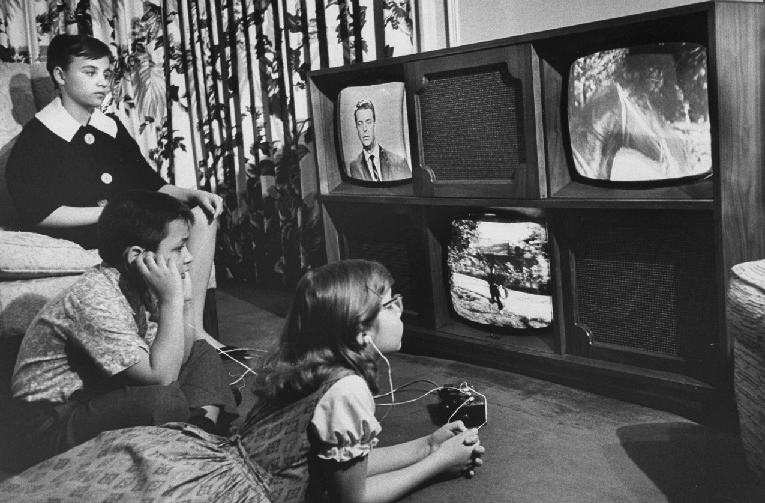
I've mentioned more than once that hanging around this site can make you old, and JB contributes to the feeling with his The Hits Just Keep on Comin' piece about two recent articles: the demise of the manual transmission, and Lynn Spigel's book TV Snapshots: An Archive of Everyday Life, which shows midcentury pictures featuring the television set as a focal point of the home. Not unlike the pictures you see at the top of each week's "Around the Dial." 

JB ends with a quote I'll borrow for the end as well, from novelist L. P. Hartley: "The past is a foreign country: they do things differently there." TV  

May 20, 2022

Around the dial


At bare-bones e-zine, Jack's Hitchcock Project takes us to "The Young One," a nasty but excellent third-season story written by Sarett Rudley, with Carol Lynley, Vince Edwards, and Jeanette Nolan, and directed by Robert Altman. I think this is a good one to check out.

Jodie has a great story at Garroway at Large regarding her RCA BK-4 "Starmaker" microphone, the kind that you see Dave Garroway wearing in early pictures from Today. Seems it needed some paint restoration work; I would have felt just as bad about it as she did, and just as glad when everything turned out all right!

At the Broadcasting Archives, it's the front page of WMAR's "Television Topics" newsletter, from September, 1969. Check out the station's NFL football schedule at the bottom of the page, including coverage of the final NFL-AFL Super Bowl.

Last week, John wrote a very interesting post at Cult TV Blog about watching The Prisoner using the premise that Number 6 is actually a patient in an asylum. It's an intriguing scenario; as I told John, I think I'll see what it's like the next time we watch the series. (Which can't be too long from now.)

I didn't participate in Rick's "Four Favorite Noirs" blogathon at Classic TV & Film CafĂ© to celebrate National Classic Movie Day on May 16th, but if you're a fan of film noir (as I am), you'll enjoy the posts from the blogs that participated. I should have offered some of my favorite Japanese noir!

Funny that Terence should bring up the Kim Sisters at A Shroud of Thoughts; he's sharing a video of them performing on The Ed Sullivan Show in 1965, and I just saw a different video of them performing on Sullivan from a later date. I guess great minds think alike; anyway, take a good look at the kind of non-superstar entertainment Ed used to bring us, and why we should be familiar with them.

If you don't recognize the name Tim O'Connor, you'll certainly recognize his face; he appeared on just about every television show in the '60s and '70s, and played Dr. Elias Huer on Buck Rogers in the 25th Century. But MeTV tells how he found true love three doors down the road.

At The Hits Just Keep on Comin', JB has a reflection on what we were at one time, and how we've changed since then. Good thoughts ("If we’re lucky, we might still retain the best of what we were."), and some very interesting links. A good note to end on for the week. TV  

December 3, 2021

Around the dial


We've got a full slate of stories to look at this week, and we'll begin at bare-bones e-zine, where Jack's Hitchcock Project focuses on the seventh-season episode "What Frightened You, Fred?", an excellent and taut story starring R.G Armstrong, Ed Asner, and Adam Williams, and directed by Paul Henreid.

I think I've mentioned this before, but a great episode title can do wonders, and if you're an occasional viewer of Love That Bob, an episode called "Grandpa Meets Zsa Zsa" is going to be hard to turn down. Find out if Hal agrees with our instincts at this week's The Horn Section.

At Silver Scenes, the Metzinger Sisters take a gander at The Entertainers, the 1964-65 variety series that boasted a trio of rotating hosts: Bob Newhart, Carol Burnett, and Caterina Valente. The Entertainers may be an example of one of those shows that sounded better in practice; I wrote about its troubled season a couple of years ago.

Inner Toob has a fun look at John Astin's portrayal of Gomez on The Addams Family, and the crossover potential with other Astin characters, including his version of The Riddler in Batman. 

Nothing sells like courtroom drama; remember that what's interesting in legal dramas is not the lives of the lawyers, but the cases they try in court. In a continuing seres, David looks at three memorable such episodes from the world of Comfort TV.

Stepping away from the exclusive world of classic TV for a moment, it's time to wish a happy blog anniversary to Gil at one of my favorite blogs, Realweegiemidget. And you can't beat the blogathons she hosts, a couple of which I've been privileged to be in.

At Cult TV Blog (or, as John now calls it, "That Blog Where the Bloke Who Never Wears a Shirt Blogs about TV and Tries to Stay on the Subject"), it's a look at a Freudian episode of The Tomorrow People, and I'll take John's word on the analysis of the episode.

One of the more controversial periods of The Twilight Zone is the brief era of videotaped episodes, made necessary in order to cut costs and meet the budget. At Shadow & Substance, Paul invites your vote on which taped episode was the best; taken as a whole, they're really pretty good.

At A Shroud of Thoughts, Terence provides us with a handy guide to the Christmas movies appearing this year on Turner Classic Movies. I think I've seen 14 or 15 of them, most of which I enjoyed quite a lot. Of all the cable stations we're without since cutting the cord, I'd say that I miss TCM the most, although having The Criterion Channel more than makes up for it. Japanese noir, anyone?

Speaking of noir, The Last Drive-In begins a series of 31 flavors of noir on the fringe. As it happens, I've seen a few of these as well, and I urge you to check them out—they're the perfect antidote to those Christmas movies over at Hallmark. TV  

November 26, 2021

Around the dial


Happy day-after-Thanksgiving to you all, and hopefully you've recovered from yesterday's tryptophan coma (which, as we all know, is just an urban legend). Classic television, of course, does not take time off for holidays, so we're back with a reduced, but still potent, trip around the dial.

We begin with Drunk TV (which is how some of you might feel today) and a look at the infamous 1978 Star Wars Holiday Special, which Paul assures us is "what today's world needs." Find out what's behind his thinking at this very special post.

At Cult TV Blog, John brings us to the insane humor of The Goodies, the 1970s Pythonesque comedy which John calls "stonking good television." We really are going to have to have a conversation someday about what I should be watching with my region-free DVD player.

RealWeegieMidget takes a look at "Cop Out," a first-season episode from Hart to Hart, with the late Markie Post in a guest-starring role. At MANC a few years ago I got to see Robert Wagner and Stefanie Powers, who were as charming and witty as they are on TV. Just think: wealthy, good-looking, and smart: Nick and Nora Charles live!

Once Upon a Screen celebrates its tenth anniversary this week, and Aurora takes a look back at some of the blog's hits from the last decade. Take some time to read the highlights, and follow the links to read a lot of terrific writing.

As I'm writing this, I'm also watching Miracle on 34th Street, the greatest Christmas movie ever, which starts with the memorable image of a drunk Santa, portrayed by Percy Helton. At A Shroud of Thought, Terence takes a closer look at Helton's filmography, one loaded with noir and other dark roles.

And speaking of noir, don't miss The Last Drive In and 31 flavors of noir that are sure to draw you in. It may be the most wonderful time of the year, after all, but that doesn't mean everything needs to be merry and bright. TV  

July 30, 2021

Around the dial


I think we can all agree that the real Avengers are not the superheroes from the comics, but the superheroes of British intelligence: John Steed, Mrs. Gale, Mrs. Peel, Tara King, et al. And speaking of movies, at Cult TV Blog John has some movies you'll like if you like The Avengers. 

One of the the arguments you'll hear in favor of classic television as opposed to the television of today is that classic television shows had the ability to inspire viewers, to encourage them to follow in the footsteps of their heroes. Case in point is at Comfort TV, where David asks how classic TV has inspired you over the years. By contrast, what inspirational value do today's shows have? To make you want to be a meth dealer?

On Wednesday I mentioned Dick Powell's portrayal of private detective Richard Diamond on the radio; at Once Upon a Screen, Aurora goes a step further and looks at Powell's long history of playing radio P.I.s, including a gig I hadn't been aware of: a turn as America's fabulous freelance insurance investigator: Yours Truly, Johnny Dollar. 

That Wednesday article referenced Richard Diamond and Johnny Staccato, two private detectives with more than a touch of noir and pulp about them. Appropriate, then, that at A Shroud of Thoughts, Terence writes about two new books, Dark City: The Lost World of Film Noir, by Eddie Muller. It's coupled with Master of Mystery: The Rise of The Shadow by Will Murray. Might want to include them on your wish list.

At The Random Access Television podcast, Zach and Nas take a look at the story of Monday Night Baseball. Although ABC liked to fashion it as the summer continuation of Monday Night Football, it actually came from NBC, which, beginning in the 1960s, broadcast three Monday night games a year, before going to a full season's worth in 1973. In the days before cable TV, these night games were a really summer treat.

"Day of Reckoning," the fourth Hitchcock Project script by William Link and Richard Levinson, is Jack's latest entry at bare•bones e-zine. It's a nasty little story of infidelity, murder, and a confession that isn't believed, and stars Barry Sullivan, Dee Hartford, Claude Akins, Hugh Marlowe and Louis Sullivan. Once again, I particularly enjoy how Jack contrasts the original novel by John Garden and the Link-Levinson adaptation.

At Great but Forgotten, an interesting piece on The Funny Company, a 1963 syndicated cartoon that appeared as filler on local kid shows. I have to admit it doesn't ring any bells with me, but I'm certainly familiar with this kind of five-minute type of cartoon, something like The Mighty Hercules or Roger Ramjet. I miss those days, as much as I miss local kids' shows. But there again, I'm just showing my age. TV  

November 6, 2020

Around the dial


The blogosphere has been a bit quiet this week—unless you're writing about politics, I guess. Fortunately, we don't do that gig here, unless you want to see about ten hours of NBC's coverage of Election Night 1960; it might be a tad presumptious of me, but I'm going to assume you're not in the mood for that.  Therefore, let's see if we can find something a little more fun.

OK, well, one exception. Run over to Michael's TV Tray and click on the Mary Tyler Moore first season episode in which Lou puts Mary in charge of the station's election night coverage. I'll let you be the judge as to whether or not this is an improvement over what passes for news today.

In the absense of political noir, The Last Drive In kicks off Noirvenber with a look at some noir classics that are well worth your time. If you can't find something to watch from that list, you aren't really a noir aficionado. 

My first introduction to Sean Connery was through the Bond movies that ran on ABC for so many years, and I've been a fan of both since. The definitive Mr. Bond died last week at 90, and Terence has an appreciation at A Shroud of Thoughts.

At bare•bones e-zine, Jack's Hitchcock Project continues with "Bonfire," the second Hitchcock script from Alfred Hayes. Again, I'm not this far along in watching the Hitchcock series, so all I can tell you is that it stars Peter Falk and Dina Merrill, and Jack's writeups are always worth your time.

From last week, it's F-Troop Friday at The Horn Section, and "Here Comes the Tribe" features everything you'd want, including the "kidnapping" of an Indian maiden, and how Captain Parmenter may have to suffer the consequences.

And at Shadow & Substance, Paul takes another look (pun intended) at one of the most beloved TZ episodes, "Time Enough at Last," with Burgess Meredith as Henry Bemis. Find out what the secret is.  TV  

January 21, 2015

The noir side of television

TV Noir: The Twentieth Century
by Ray Starman
(180 pages, $7.95 on Kindle)

When we talk about noir, we think of some of the great mystery movies of the mid-20th Century - Out of the Past, The Postman Always Rings Twice, Double Indemnity, Touch of Evil, The Big Sleep.  We think of hapless heroes and hardened dames, dirty double-dealers and bitchy betrayers and bad, bad endings; cigarette smoke and ceiling fans and the shadows of blinds slanting diagonally across the room, all in glorious black-and-white.

In other words, we don't often think of television, other than as a place where we've seen so many of these movies.

Which is why Ray Starman’s book TV Noir: The Twentieth Century is both an unlikely and a welcome addition to the television bookshelf.  Starman takes an encyclopedic look at TV shows from the 1940s to the present, examining them not only in visual terms, but in how the underlying themes of noir – corruption, pessimism, persecution of the innocent, and a feeling of helplessness – have penetrated programs all the way from Dragnet and The Untouchables to less likely prospects such as Miami Vice, Millennium and The X-Files.  All of which is to say that this is a book that causes me to look at some of these shows in a different, more appreciative light – both shows I’ve watched and enjoyed in the past, and new series to which I’ve never given much thought.

The noir roots of some series are obvious – Peter Gunn, for example, in which most all of the action takes place at night, on rain-slickened streets or smoky lounges full of jazz musicians and torch singers.  But then there’s Manhunter, the 1974-75 CBS series starring Ken Howard as a 1930s amateur crime fighter hunting down criminals following the death of his best friend during a bank robbery.  It only ran for 22 episodes, so many of us might not be familiar with it, and noir might not be the first thing that comes to mind.  But, as Starman writes, the show’s noir elements, “such as the loner fighting crime in his own personal, unofficial way, the lonely existence and mission that ruled his life and kept him from living more pleasant experiences [and t]he accent on violence and happenstance and accident] are obvious noir parallels.

I mentioned Miami Vice earlier, and Starman concedes that on the surface, with the bright colors and Phil Collins tunes, it’s so “not noir.”  But Starman disassembles Vice, looking at everything from photography and color difference to camera angles, to conclude that there is indeed a particular cinema associated with television noir (shooting nighttime scenes at night rather than through a filter, for example) that simply does not appear in non-noir TV.  And then there’s the cynicism, so typical of film noir, the hopeless feeling that Crockett and Tubbs will never succeed in the fight against crime, that for every hood or dealer they arrest or kill, another one will simply take his place.  As screenwriter and director Paul Schrader notes, noir is not a genre in and of itself, but “a style that reveals itself in any genre or drama.”  Given that, the analysis that follows is not only provocative but brings a new appreciation to the program.  Is it any wonder, then, that Vice’s mastermind, Michael Mann, has gone on to make noir-affiliated movies such as Public Enemies?

Rather than using a narrative, Starman looks at each show individually, categorized in such genres as “Police,” “Private Detective,” “Reporters,” “Spies,” and even “Westerns,” “War,” and “Science Fiction.”*  While this makes analysis of each show easy, it does limit the ability to look at trends as they form throughout time, although Starman offers a prologue for each “age” of the book that helps track such evolutions.  In addition, there are some typos and line breaks that indicate the manuscript could do with the oversight of a good editor. (I’d be happy to volunteer!)

*As I’ve noted in the past, the Private Detective genre, once such a dominant part of television, is virtually non-existent by the 2000s.

These flaws do nothing to get in the way of the enjoyment of the book, however, nor do they detract from the valuable information that Starman provides.  TV Noir is a necessary book that puts the spotlight on a less-obvious aspect of television, particularly in the color era, and it taught me things I didn’t know and hadn’t considered.  It is, therefore, a perfect addition to the Hadley Television Library.

May 2, 2013

Around the Dial

Apologies for another abbreviated issue - and so with that, let's go to the good stuff.

Kliph Nesteroff at Classic Television Showbiz has this great clip of William F. Buckley Jr. interviewing JFK assassination conspiracy guru Mark Lane on Buckley's TV show, Firing Line.  Buckley's introduction alone is worth the price of admission.

At The Classic TV History Blog, Stephen Bowie's provided a master index to some of his great pieces.  Be sure and check them out - when you've got an hour or two, because it'll be just like Lay's potato chips.

Meanwhile, dig the great noir photos in the latest Postcards from Shadowland from Monstergirl at The Last Drive-In.

Rick's got a terrific interview with Julie Adams at Classic Film and TV Cafe.  Any fan of classic TV will recognize her, especially if you're a fan of Murder, She Wrote.

That's all for today - sorry again for the brevity, which I'll explain later.  In the meantime, have a great end to the week, and I'll see you back on Saturday!  TV