Showing posts with label The Brady Bunch. Show all posts

January 9, 2026

Around the dial


At The Twilight Zone Vortex, it's a look at Volume 4, Number 2 of The Twilight Zone Magazine, with Gahan Wilson's review of John Carpenter's Christine, an interview with director John Sayles, dystopian movies of the 1970s and 1980s, and more!

A terrific story from David at Comfort TV on his visit to the Brady home, the home shown in The Brady Bunch that was renovated into a replica of what you saw on the series. What a fantastic experience; read about it for yourself.

At Cult TV Blog, John reviews "Killer with Two Faces," an episode of the 1973-76 British series Thriller (not to be confused with the American version hosted by Boris Karloff), and the insights gained from repeated viewings of the episode.

How on earth can you have a "non-violent" episode of The A-Team? Well, as Roger finds out at The View from the Junkyard, it can be done, as we see in the episode "Semi-Friendly Persuasion." Well, at least for a time, anyway.

Rounding out this short but sweet week is A Shroud of Thoughts, where Terence reflects on the legacy of Inner Sanctum Mysteries on the occasion of the radio show's 85th anniversary. The show made the transition to both the big screen and television, but it's the radio program that continues to be the most remembered. TV


If you enjoy the content here and want to support my broader creative work, please consider making a donation at my Ko-fi page. Any amount you contribute helps me continue writing, researching, and sharing these articles and projects. Thank you!

December 26, 2025

Around the dial


The above is not me, alas, although it does feature three of my favorite things: Christmas, television, and cats. And while there are no cat posts below, we do have plenty of the first two that we can look at on this Boxing Day, which I've always thought ought to be a national holiday. Of course, when you're retired, every day is a holiday it its own way. Anyhow. . .

At Cult TV Blog, John brings to a conclusion his series on The Prisoner and how it may (or may not) mirror Soviet Russia. We come to the final two episodes, "Once Upon a Time" and "Fall Out," plus his overall conclusions from this fascinating exploration.

I love Paul's review of A Very Brady Christmas at Drunk TV. Granted, it might not be the most charitable review of the Bradys, but it's all done with affection toward the original series, and makes the excellent point that "we don’t want these classic properties helpfully 'updated' for the times." Amen, brother.

Comet over Hollywood interviews Jeremy Arnold, film historian and author of Christmas in the Movies: 35 Classics to Celebrate the Season on—what else?—the history of Christmas movies, with some very insightful historical, cultural, and sociological notes on the evolution of the genre. 

Speaking of which, at A Shroud of Thoughts, Terence has a look at five Christmas TV movies from when Hallmark was good. I don't know if there's much for me to add to what I've already written about Hallmark movies in the past, but if you haven't read it yet, my annual Christmas humor essay does the heavy lifting.

Martin Grams dips into the Christmas season with this review of "Cold Death," a 1937 episode of The Shadow, starring 22-year-old Orson Welles in the title role, and telling a story that bears more than a passing resemblance to one of our favorite Christmas stories, proving just how adaptable it is.

At The Lucky Strike Papers, Andrew shares two different versions of "The Christmas Song," sung by Rosemary Clooney and Nat King Cole, on their respective television series. What a fun look back at one of the great songs of all time. In fact, I'm listening to Nat as I write this, with total enjoyment.

Garry Berman is back with a story on the resurgence of the network sitcom, one of the oldest and most loved of television genres, and his report is that the sitcom is alive and well. Hard to imagine television without it; whether it's your favorite genre or not, it shows people can always use a good smile. 

I hope you all had a very Merry Christmas, that you're enjoying this Boxing Day, and that the rest of your Christmas season is a peaceful one. See you back here tomorrow! TV


If you enjoy the content here and want to support my broader creative work, please consider making a donation at my Ko-fi page. Any amount you contribute helps me continue writing, researching, and sharing these articles and projects. Thank you!

March 14, 2025

Around the dial


Let's start this week at Comfort TV, where, in the wake of Gene Hackman's death, David wonders what would have happened had Sherwood Schwartz gotten his way and cast Hackman as Mike Brady in The Brady Bunch.

At Cult TV Blog, John returns to the idea of devoting a series of posts to a single actor in different roles. In this case, it's the actress Sylvia Coleridge, with many Brit TV credits to her name. For this first piece, we look at her in Who Dares Win from 1983.

In other Brit TV, it's back to The View from the Junkyard and Roger's latest New Avengers review. This week, it's the episode "Dirtier by the Dozen," and if you're tempted to think of the movie with a similar name, it's no accident: it's a grim look at war, violence, and the "just following orders" mentality.

At Travalanche, it's a look back at the life and times of the legendary Willard Scott, best known as the weatherman on The Today Show, but with many more credits to his name, from Bozo the Clown to the original Ronald McDonald. You'll find he's quite a character.

If you're in the market for Adam West's Batman Utility Belt, you're in luck! It's just one of the many TV props up for bids at the Los Angeles Spring 2025 Entertainment Memorabilia Live Auction, and you can read all about them over at Television Obscurities.

At A Shroud of Thoughts, Terence plays tribute to a pair of actresses with considerable credits in classic television: Jan Shepard, who died in January aged 96; and Olive Sturgess, who died last month aged 91. Read more about them, and learn about their legacy.

Martin Grams has a quartet of reviews of the latest entertainment books from Bear Manor Media, including biographies of Cary Grant, Boris Karloff, Joe E. Brown, and James Cagney. Their inventory is always worth looking at; I have a book from them myself that I'll be reviewing shortly.
 
At Drunk TV, Paul is back with a look at season one of the 1950s series Sergeant Preston of the Yukon, starring Richard Simmons (no, not that one( as the stouthearted Mountie sergeant. It's good fun, and also an example of an early all-color series. 

Finally, at Classic Film and TV Corner, Maddie takes a fond trip down memory lane to the third Doctor Who, Jon Pertwee. Pertwee played the Doctor with style and elan, and led the show into the modern, color era. It's a perfect example of the show the way it was meant to be. TV  

February 10, 2024

This week in TV Guide: February 7, 1970


No, I didn't inhale. Never even had the desire. But then, I always was a square, even though the edges have been worn off over the years.  

Now that we have that joke out of the way, we can get on to Dick Hobson's report on Marijuana use in Hollywood. I suppose there's a tendency to think of this as being part of the "good old days," as opposed to today's talk about fentanyl or other opioids. But "The use of marijuana is one of the most vigorously debated subjects in America today," and Hollywood is a community, just like any other, with adults trying to figure out how to cope with this latest aspect of the Generation Gap. Some try to supervise the drug's use by their children; some, like Meredith MacRae, take a benign attitude towards it. "I have friends who smoke it and some who don't," she says. "So long as they're not hurting anyone else, why not?" Others, like Buddy Ebsen, will have no part of it. He says that "Parents who do that are soft-headed pseudo-intellectuals!"

Everyone has an opinion on this, and most of them are pretty predictable: Peter Fonda is for it, Dick Clark says its use is "rampant" in Hollywood and elsewhere, Eddie Albert sees it as the "in-thing" for swingers, and an act of rebellion by kids. Steve McQueen thinks it should be allowed, but the "bad drugs" should be banned. Jack Webb doesn't buy the distinction; "I am a very narrow-minded person on this subject." MacRae acknowledges that if she were to be caught with it, it would ruin her career; her contract with Petticoat Junction includes the standard morals clause, which would "probably not be invoked until bad publicity began to hurt the show."

For our purposes, what I find interesting is how television is handling this ticklish subject. Art Linkletter, whose daughter died after taking LSD, complains that many top 40 songs contain "secret messages" on drugs, and Hobson notes that "most" variety shows, including The Ed Sullivan Show, feature "head music." Ernest Chambers, producer of The Smothers Brothers Comedy Hour and The Leslie Uggams Show, says that "CBS censors are going crazy," citing an example from the Smothers Brothers show in which Leigh French was prevented from calling herself "Mary Wanna" but okayed the name "Goldie O'Keefe," only to wonder later if "'Goldie' referred to Acapulco Gold, high-grade Mexican marijuana, and 'Keefe' to kef, a high-grade variety from Morocco." "They were always coming to us with 'Does this mean something? Does that mean anything?' Chambers says. "They think the young are putting something over on them."

What all this tells me is that the line is always being drawn somewhere, and the same issues keep coming back time and again, under different guises. Take sex, for example; it has, at various times, been about married couples in separate beds, use of the word "pregnant," Elvis Presley's swiveling hips, pre-marital sex, nudity, homosexuality, and transsexuality. It all boils down to the same thing, one way or another; it's just the scale that keeps sliding. Violence, language, "Me Too," drug use—it's all the same. Half of the concern is about what's being shown on-screen, the other half is about what's being done off-screen by those responsible for what's being seen on-screen. TV Guide was always at the forefront of asking these questions, back in the day. The magazine, such as it is, doesn't cover these issues anymore, at least not in any serious way, and that's too bad, because it would be interesting to see what it would say about the times we live in today.

l  l  l
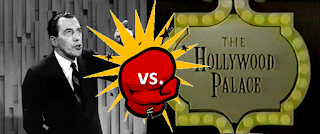
During the 60s, the Ed Sullivan Show and The Hollywood Palace were the premiere variety shows on television. Whenever they appear in TV Guide together, we'll match them up and see who has the best lineup.

Sullivan: Ed's scheduled guests include country music’s Chet Atkins, Floyd Cramer and Boots Randolph; comic-impressionist David Frye; Connie Stevens; comic Richard Pryor; and Sam and Sammy, balancing act. 

Palace: Bing Crosby, who hosted opening night at the Palace on Jan. 4, 1964, rings down the curtain with a large sampling of highlights from the past six years.

If we were traversing these TV Guides in chronological order, we would be coming to the end of this feature today, as The Hollywood Palace bows out after a six-year run. Fortunately (or not, depending on how you look at things), that's not how it goes around here, so you still have many more episodes of Sullivan vs The Palace to look forward to. We're not playing by the regular rules this week, though: who can argue with a highlights package that ranges from Nat King Cole and Fred Astaire to James Brown and Sammy Davis Jr., and stops along the way to pick up Ed Wynn, Bert Lahr, Buster Keaton,  Milton Berle, Buddy Rich, Tiny Tim, Kate Smith, Don Rickles, Petula Clark, Burns and Schreiber, Perry Como, David Janssen, and so many others we've read about through the years. And who better to guide us through this history than Bing Crosby, who hosted Palace more than anyone else. I'm not even going to bother looking at Ed's lineup (or whether or not it has any head songs), because this week The Hollywood Palace takes the prize for old times' sake

l  l  l

Throughout the 60s and early 70s, TV Guide's weekly reviews were written by the witty and acerbic Cleveland Amory. Whenever we get the chance, we'll look at Cleve's latest take on the shows of the era. 

If there's one thing—OK, make that two things—we've seen in abundance over the last couple of seasons, it's been sitcoms featuring widows and sitcoms featuring widowers. To break the mold, says Cleveland Amory, The Brady Bunch gives us something new and different: a sitcom about a widow who marries a widower. Not only that, but there are children, too—the widow has three, who all happen to be girls, and the widower has three, who—"you'll never guess this"—all happen to be boys. And there's a dog, too! As for the "all-knowing housekeeper," don't worry. "The all-wise people who run this show have her, all right." This show seems to have everything—except a point.

"There's nothing really wrong with The Brady Bunch," Amory acknowledges. "But nothing is really right, either. Everything is so contrived that you don't believe what goes on any more than you believe sketches in a variety show." In one episode, for instance, Alice the housekeeper begins to feel unneeded, and tells the family she has to leave to tend to a sick relative in Seattle. "Don't you," asks Cindy, "like us better than Attle?" ("Honestly, that's what she said—we wrote it down.") "Seattle's a place," one of the boys replies, "like Mississippi." "Mrs. who?" asks the girl. "We tell you," Cleve says, "kids not only say the darnedest things, they also have the damnedest writers." Another episode features Bobby, the youngest boy, wanting to run away from home because, after seeing Cinderella on television, he thinks his stepmom, Carol, doesn't love him. Amory's theory is that "he didn't really want to run away from home—just the show." 

I paid scant attention to The Brady Bunch when I was growing up, and I've never had the urge to revisit it in later years. Lately, we've been watching The Defenders, that great legal drama from the early 1960s, and every week I wonder how Robert Reed, the junior half of that father-and-son law partnership, ever wound up on a show like The Brady Bunch. There is a temptation to suggest that Reed's agent may have urged him to take the role as a career move, stressing how it would be good for the public image of a man who was, in fact, a closeted homosexual. I'm not sure, but I think Amory may have furnished another possibility. "There are millions of stepchildren nowadays," he notes, "and surely their problems, and those of their parents, deserve, even in a comedy series, something more than this mish-mush." Perhaps that possibility was something that appealed to Reed's serious side as an actor, when he signed up to play Mike Brady. Unfortunately, for both him and us, Sherwood Schwartz had other ideas.

l  l  l

A couple of weeks ago, we were looking at an issue from this same year, 1970. In that issue, we read about "Married Alive," a comedy starring Diana Rigg and Robert Culp that seemed to promise some light entertainment. I wasn't familiar with it, nor was one of our commentators, who was sure he must have seen it but didn't have any recollection of it. Now, thanks to a fairly pointless feature called "Second Look" by Scott MacDonough, we can get some idea of what it was all about.

I call this feature pointless not necessarily because of MacDonough's writing, nor his judgment, but because the purpose of "Second Look" is, for the most part, to look back at what's just been on TV*. That makes sense today, but back in 1970, with no VCRs, no video-on-demand, no way to see a show again unless it's shown during the summer rerun season, what service does it perform to let us know about a show that's already aired, especially a one-off special? I can understand how a single episode from a given series might tell us something about the quality of episodes to come—that's Cleveland Amory's gig. And Judith Crist's movie reviews can help us decide whether or not to invest a couple of hours of our time on the CBS Thursday Night Movie. But unless there's some in-depth analysis to be found in the review, I don't see where it does us any good. If the show's going to be repeated later in the year, that's the time I can use a reminder of how good (or how bad) it was, not in the immediate aftermath, when I'm likely to have forgotten about it by the time it's shown again. And as I've said, it's not as if I've recorded it for playback later; that technology doesn't exist yet for you and me.

*As if to prove me a liar, MacDonough also has a (very good) preview of an upcoming program, but in this recurring feature that's generally the exception, rather than the rule

As for "Married Alive," MacDonough wasn't impressed. While he liked Rigg and Culp (farceurs supreme, he calls them), the story itself was a piece of "flapdoodle." "When a playwright has nothing to say and nowhere to go," he writes, "a fashionable way of padding is to bring on the food and drink. During "Married Alive," Mr. Culp (by our tally) consumed four lightly boiled eggs, two pots of tea, two slices of whole-wheat toast, four Scotch and sodas, and a half-bottle of ketchup. Draw your own conclusions." MacDonough says he mentions this "primarily for the benefit of trend-spotters," so I suppose we should automatically be suspicious of any future shows that feature people eating and drinking, which doesn't bode well for the next airing of the movie Tom Jones, I guess. But will I remember it by the time "Married Alive" rolls around again? Your guess is as good as mine. 

l  l  l

Some highlights from a quiet week:

Saturday's Wide World of Sports (5:00 p.m., ABC) comes from Tulsa, Oklahoma, where we get tape-delay coverage of the U.S. Figure Skating Championships, with Jim McKay and Dick Button on hand to describe the finals in men's, women's, and pairs competition. I suppose it ages me that, as is with the case in most other sports, I recognize all these names—Tim Wood, John Misha Petkevich, Janet Lynn, and Julie Lynn Holmes—while I couldn't name the current champions if you offered me a million dollars. I also recognize the names on a colorful Andy Williams Show (7:30 p.m., NBC), as Andy welcomes Sid Caesar, Dusty Springfield, and Jo Anne Worley in a something-for-everyone show. 

Sunday
morning offers a possible example as to why religious belief has steadily been falling in the united states over the last few decades. It comes in a CBS religious special, "Concern, Confrontation and Crisis" (8:00 a.m.), hosted by Hughes Rudd, and discusses the two challenges facing the National Council of Churches: "how to embrace more Christians (including Catholics) and recruit additional black leaders." Notice there's nothing there about things like, you know, spreading Christianity and preaching the Gospel. I suppose they know best. In more pleasant news, we greet some old friends once again, as Kukla, Fran and Ollie return for a five-episode run on NET (5:00 p.m.). On tonight's episode, Ollie attempts to engage the Supremes and the Beatles for a variety show—gratis. Good luck, Ollie! 

The Shape of Things to Come, part two: Last week, it was NBC's special "The Voice of the Dragon"; this week, it's "In the Company of Men," a report on NET Journal (Monday, 9:00 p.m., NET). From the description: "A sensitivity-training session becomes a battleground for thrashing out the hostilities between whites and blacks. At a Southern auto factory, films show psychiatrists’ work with white foremen and blacks who have been termed ‘hard-core unemployed.” On camera: preparatory sessions with the foremen; roleplaying sessions where blacks and whites exchange jobs; and a candid discussion about the ambitions of both foremen and workers." Reminds me more than a little bit of Jane Elliott's "blue-eyes-brown-eyes" experiment from the same era, don't you agree?

That favorable preview by Scott MacDonough that I mentioned above was for "The Day Before Sunday" (Tuesday, 9:30 p.m., CBS), an original drama written for CBS Playhouse, starring Uta Hagen and Martin Balsam as two middle-aged people who meet on a flight Hagen is taking to her niece's prep school graduation, and the obstacles that stand in the way of a possible relationship. It's an examination of the rapidly changing mores of a culture that, with its turbulent shifts, seems to be tearing itself apart, The "free-swinging hedonism and forthright honesty of the 'younger generation'" is presented as both appealing and appalling, resulting in a ending that is "inconclusive, or, if you prefer, [a] cop-out." Best to tune out ten minutes before the end, to appreciate Hagen's powerful performance, as well as strong supporting portrayals by Michael Anderson Jr. and Dianne Hull. I should note here that not all contemporary critics were as kind to the play as MacDonough, so perhaps there's hope for "Married Alive" after all.

On Wednesday, Lorne Greene and Bobbie Gentry host highlights from the 30th edition of the Ice Capades (9:00 p.m., NBC), an annual television special. It's part of an evening's entertainment that's heavy on music on all three networks; CBS offers Hee Haw, with the gang welcoming Lynn Anderson and George Jones (7:30 p.m.), while ABC counters with The Johnny Cash Show, featuring Ray Charles, Neil Diamond, and Tammy Wynette (9:00 p.m.), followed at 10:00 p.m. by The Engelbert Humperdinck Show, with Lena Horne, Joel Grey, Trisha Noble, and Vanity Fare.

Thursday is Lincoln's Birthday, which in 1970 was a holiday in 24 states and the District of Columbia, and to commemorate the 161st anniversary of his birth, Daniel Boone tells the story of the stormy courtship of Lincoln's parents, Tom Lincoln and Nancy Hanks (7;30 p.m., NBC). The Boones' efforts to bring the couple together are hampered by Tom's practicality, which clashes with Nancy's conviction that she will have a "boy baby who will sit in high places." William Wright's script is based on characterizations from Carl Sandberg's The Prairie Years

The Name of the Game is another one of those wheel series that revolves around a central concept, in this case, a publishing company. There were three rotating leads; Gene Barry was the publisher, while Tony Franciosa and Robert Stack played, respectively, a reporter and an editor of other publications. Susan Saint James, in her pre-McMillan and Wife days, was the only constant appearing with all three leads. The episodes starring Barry could, at times, be quite offbeat or surreal, as we see on Friday in "Tarot" (8:30 p.m., NBC), which stars Jose Ferrer in a rare television appearance involving the occult and an alleged suicide. William Shatner, David Carradine, and Bethel Leslie costar.

l  l  l

Robert Musel takes a look at what British television has had to offer this season, and among the notes we read about "Monty Python’s Flying Circus—the name means nothing—a late-night comedy show which is the end product of giving five young. actor-writers complete artistic freedom and an adequate budget. It is a strident, biting, sometimes cruel mélange of sketches and animation that some of its small, fanatically loyal audience might describe as satire, although the cast dreads the word." No word on whether or not this show will ever be seen in the United States.

Staying with the subject of possible British imports, The Doan Report speculates that "A TV-user tax similar to Great Britain’s is being quietly discussed in Washington now as the prime means for generating millions of dollars yearly for U.S. public television." According to the proposal (which, thankfully, never comes to pass, the plan would mean something like "a levy of $2 or $3 on each TV set in the home, paid annually with income taxes." It might work, says one cynical insider, "because the taxpayer has no lobby to fight it."

And Carolyn See profiles Dick Sargent, the new Darrin on Bewitched, who comes across as a wry, modest fellow who's extremely proud of the work he's done renovating his house, particularly the garden. ("Oh, actors have a lot of time on their hands, you know, ha ha.") Among other things, we learn that he was actually suggested to play Darrin when the series first started, but at the time he was committed to Broadside, a spinoff of McHale's Navy that ran for the 1964-65 season. Did he regret how things turned out? "No, I couldn’t tell then which series was going to make it. I don’t think anybody really knows what's going to happen, although they generally make enough remarks one way or the other to cover themselves either way." In the entertainment business, as in politics, that's the name of the game, isn't it?

l  l  l

MST3K alert: 
Gorgo 
(English; 1961) It might not have been a good idea to bring that live prehistoric monster to London— it has a parent that’s coming after it. Bill Travers, William Sylvester, Vincent Winter, Bruce Seton, Martin Benson. (Friday, 6:30 p.m., KTXL in Sacramento) Leonard Maltin's memorable cameo as himself, trying to come up with the world's worst movie in order to torture Mike and the Bots, is one of the great bits in the show's history. Asked if this movie was going to "hurt" them, he replies, "Well, that's a matter of opinion, Mike. Now I actually like Gorgo, but when we reviewed it for my number one best-selling Movie and Video Guide, it put two of my assistant editors into intensive care. So who knows?" Need we say more? TV  

August 13, 2021

Around the dial


For my money, Friday has always been the best day of the week. I'll grant you that the best 24 consecutive hours are those from midnight Friday to midnight Saturday, but there's a satisfaction in reaching the end of the work week, and surrendering myself to a fine night of TV viewing. But there's another reason for enjoying Fridays, and that's our trip around the classic TV dial, and some most excellent blogs.

Let's start at bare•bones e-zine, where Jack wraps up his review of the William Link and Richard Levinson Hitchcock scripts with the ninth-season "Nothing Ever Happens in Linvale," with Fess Parker, Gary Merrill and Phyllis Thaxter. I think it would have been kind of fun if it had starred Joanna Linville, but I wasn't there for the casting.

I'm no longer at a point where I need to feel any older than I am, but David's latest at Comfort TV has succeeded in reminding me anyway: Marcia Brady is 65. Or at least Maureen McCormick is, and so a happy birthday to someone who, from all accounts, is as nice a person as she appeared to be on TV.

At Cult TV, John worries that he's straying too far from the subject, which happens to be the Doctor Who episode "Fury From the Deep," starring Patrick Troughton, but in actuality it's a very interesting discussion on the topic of reconstructed Doctor Who videos. You might think this is a little too "inside baseball" unless you've collected telesnaps and grey market videos, but I loved it.

You've all heard the jokes about reading Playboy for the stories, but back in the day the magazine, like so many of the era, had an excellent reputation for publishing short fiction from some of the best (or soon-to-be best) writers around. At The Twilight Zone Vortex, Jordan looks at the magazine's contributions by TZ writers, including Ray Bradbury and Charles Beaumont. 

Staying in the genre, Shadow & Substance has a writeup of Rod Serling's Night Gallery story "The House," a nasty little story starring Joanna Pettet and directed by John Astin. Night Gallery was, I thought, always a bit uneven in quality (even without the Sixth Sense episodes thrown in), but this is certainly in the upper percentile.

At Inner Toob, it's a look at the various crossover stars and historical figures from the WB western series Bronco that link the show to other WB series. (You can choose to believe me or not when I say that we were just talking about Bronco at dinner last night, for no particular reason. The clincher that caused me to add this piece is the 1960 Maverick episode "Hadley's Hunters," and trust me: you don't want to run into them.

It seems that every time I head over to A Shroud of Thoughts, Terence is penning another obituaries of a star who has passed, and this week there are three: Pat Hitchcock, Markie Post, and Jane Withers. Godspeed to them all.

Television's New Frontier: The 1960s returns with a trip to 1962 and The Donna Reed Show. The year saw the end of the show's fourth season and the start of the fifth, and as Reed began to tire from the 39-episode grind, the focal point, more and more, became Paul Petersen. That's not all there is to the show, of course, with storylines and guest stars aplenty.

Now, if all this has added to your enjoyment of the best day of the week, I'm pleased to have helped out. But stay tuned for tomorrow; there's even more to come. TV  

July 16, 2021

Around the dial

The guests gathered after dinner to watch C-SPAN

.
T
he Hitchcock Project at bare•bones e-zine is always a good way to start the week, and today Jack looks at the first hour-long contribution by Levinson and Link, "Captive Audience," with a superlative cast starring James Mason, Angie Dickinson and Ed Nelson. 

There was more to Eve Plumb's career than playing Jan Brady, as David reminds us at Comfort TV, and this week he looks at her work outside of The Brady Bunch, a wide variety ranging from The Smothers Brothers and Family Affair to The Facts of Life.  

Realweegiemidget reviews the 1983 Brit TV movie Those Glory, Glory Days, and I normally wouldn't pay much attention except it's about a woman's teenage obsession with the Tottenham Hotspur soccer team, and as a (former?) Arsenal follower I can't possibly let this go unnoticed. The Spurs star she encounters, by the way, is real-life star Danny Blanchflower, who went on to serve as a color commentator for CBS's soccer coverage in 1967.

I may well have mentioned this last year, and I suspect I'll write about it again next year, but this week marks two notable birthdays in the classic television oeuvre: first, at Garroway at Large, Jodie honors Dave Garroway's birthday, as well as the fourth anniversary of her blog. (Has it really only been four years? It seems as if we've known you much longer!)

Meanwhile, at Bob Crane: Life & Legacy, it's the 93rd birthday of Bob Crane, which Carol celebrates with a birthday celebration podcast. I just can't imagine him at that age, even though Robert Clary, the last survivor of Hogan's Heroes, is in his 90s as well. It doesn't—TILT—compute.

Do I have to surrender my credentials as a Whovian by admitting I've yet to make it all the way through the Matt Smith episodes of Doctor Who? I've nothing against him; I have all the discs; what I don't have is the time. Fortunately, John is here at Cult TV Blog to save me, at least with the writeup to "The God Complex," which I have been accused of having a time or two. 

At Classic Film & TV Café, Rick interviews Michael Asimow, co-author (with Paul Bergman) of the book Real to Reel: Truth and Trickery in Courtroom Movies, which sounds like a book I really should own. I wonder if they had anything to say about the sanity trial of Kris Kringle in Miracle on 34th Street?

At A Shroud of Thoughts, Terence has a three-part look back at Saturday Morning Musical Kids' Shows of the 1960s and 1970s, which brings back a lot of memories for me. You can (and should) read parts two and three as indicated. How different Saturday morning TV was back then! TV  

June 19, 2020

Around the dial

I'm not a drinking man, but it seems as if it helps to be one any time you turn on your TV nowadays. Somehow, though, they don't seem to have the same motive as you and I have today.

At bare•bones e-zine, Jack introduces us to Harold Swanton, the latest in the Hitchcock Project, and his first effort for Alfred Hitchcock Presents: "Premonition," the second episode of the series, starring John Forsythe, who just happened to be starring in Hitchcock's new film, The Trouble with Harry, which had opened nine days before.

David points out something important in this week's Comfort TV: you can learn a lot from classic TV shows of the past. In this case, a look at a lesson in life courtesy of The Brady Bunch. Great stuff.

Interesting piece up at Cult TV Blog, where John looks at a unique film from 1976, made by The Children's Film Foundation, entitled "One Hour to Zero." It's a rich-in-period-details look at what happens when a nuclear power plant moves into your neighborhood.

The wonderful Jodie, who will appear at this site with a guest column next Wednesday, checks in at Garroway at Large with a link to the legendary radio program of the past, NBC's Monitor, which prominently featured the Master Communicator. And by the way, you'll love next Wednesday's piece.

Lawman was one of the last of the Warner Bros. westerns, and its final season is the subject at Television's New Frontier: the 1960s. You'll enjoy not only a comprehensive rundown of this underrated western, there are also some nice shots of the series' merchandise tie-ins.

Finally, I'm assuming that you're all retro fans, and you obviously enjoy reading or you wouldn't be here, so you might want to go to Martin Grams' website for this story and subscription offer for the magazine Retro FanTV  

December 13, 2019

Around the dial

No more secret missions for work this year, so let's get back to basics and see what's new in the classic TV blogosphere.

First up is David at Comfort TV, who gives us a tantalizing idea of what his Brady Bunch book might have been, offering us a sample chapter. That's a book I would have had on my bookshelf.

A joke in the Hadley household is that if a television episode has a lot of speechifying and pontificating, it must have been written by Sterling Silliphant. Seriously, though, Sillliphant was a very talented writer, as Jack reminds us at bare•bones e-zine with his Hitchcock Project look at the outstanding first-season episode "Never Again." 

Let's go across the pond to Cult TV Blog, where John reviews an episode of the surreal British sketch comedy show of the 1970s, The Goonies. I think the "Playgirl Club" sketch will give you a pretty good idea of what the show's all about.

My primary exposure to the British actor John Thaw was through the superb 1990s detective series Inspector Morse, but Rick at Classic Film & TV Café points out that he should also be remembered for his work in a much different series, Kavanagh, Q.C.

The Secret Sanctum of Captain Video has a fitting tribute to the late Rene Auberjonois, who was best known from Benson and Deep Space Nine, but I recall him as well from some fine documentary voiceovers through the years.

Meanwhile, A Shroud of Thoughts looks at the life and career of actor Ron Leibman, whom I still remember from Kaz, but he, too, did much, much more.

At Garroway at Large, Jodie takes a look at a small book called You Don’t Say! …Or Do You? Read about the role this book had in the career of a young man named Dave Garroway.

It's time for another The Twilight Zone Magazine flashback at The Twilight Zone Vortex, and Jordon's looking at the August, 1982 issue, one that includes Ben Herndon's interview with former TZ producer Douglas Heyes.

I'm always kind of amused to see Death Valley Days described in TV Guide listings as "drama," when, as Television's New Frontier: the 1960s points out, it could be considered perhaps "the first realistic western TV program." Read here about the 1961 season.

I always enjoyed TV Guide's year-end look back, and when it was the review of a decade, that made it even better. The Television Obscurities review of 1989 continues with the December 9, 1989 issue that looks at a very active decade.

Tomorrow's active as well, so be sure to stop back and see what's what. TV  

October 11, 2019

Around the dial

The picture up top comes from a Radio Times article from a couple of years back. The Radio Times is the British publication that is, I suppose, most comparable to what the old TV Guide was like, although perhaps one of our British readers can enlighten me further; I've only read it for Doctor Who. The article is by Alison Graham, who appears to be a woman after my own heart; it's titled "What Do People Talk About If They Don't Watch Telly?", and I swear that this quote could have come, unedited, from my own lips:

There are some phrases that place a cold, dead hand of fear around my heart. Top of the list is “Have you read my blog?”, closely followed by “And now it’s time for Thought of the day”, with “Will you sign my petition” coming a very close third.

Actually, may I just revise that. Really, really at the super-top of the list is “I don’t have a television.” By choice! Can you imagine? There are people who don’t have tellies? What’s wrong with them? How can anyone not watch telly? It’s like saying “I choose not to breathe because I take all of my essential nutrients via osmosis from fairy dust.” Or, “I’ve decided not to eat because it messes up my mouth.”

It gets better from there; just read it.

At Garroway at Large, Jodie completes the story of The CBS Newcomers, part one of which began last week. It's the tale of Dave Garroway's attempted comeback as host of a televised talent show. Of Garroway, one critic says, “This man has too much talent to languish on the sidelines.” Would that we were able to see more of that talent today.

You've probably seen, read, or at least heard about, the hit that HGTV had with A Very Brady Renovation, and at Comfort TV, David points out how the show's success demonstrates the great affection that people have for the Bradys, and wonders what show could get the treatment next?

Seeing as how I'm a sucker for Perry Mason, it should be no surprise to any of you that I've chosen Thursday, October 8, 1964 as the daily entry to visit in this week's trip to the TV Guide 365 project at Television Obscurities.

The second Bill Ballinger script for Alfred Hitchcock Presents is the fifth-season episode "Road Hog," with Raymond Massey and Robert Emhardt, and you can read all about this terrific episode in Jack's Hitchcock Project at barebones e-zine.

Fire-Breathing Dimetrodon Time takes a look at what is perhaps the most unique Doctor Who story ever. It's the one-episode "Mission to the Unknown" from 1965, and what's unique about it is that neither the Doctor nor any of his companions appear in it. It's the prologue to the epic Daleks' Master Plan that would air later in the year. It is, alas, one of those missing episodes, but thanks to the University of Central Lancashire, you can now see the animated reconstruction (featuring the original soundtrack). Always good to end on a high note!


   TV  

September 27, 2019

Around the dial

No prattling on from me this week; we'll just get right to it.

At bare-bones e-zine, the Hitchcock Project moves on, with Jack introducing us to the works of Bill S. Ballinger—specifically, the 1959 episode "Dry Run," with Robert Vaughn, Walter Matthau, and David White. Quite a cast, wouldn't you say?

Speaking as we were of Hitchcock, at Classic Film and TV Café Rick has a list of his choices for Hitch's best movies. Try not to get dizzy looking at these titles, a reminder of how great, and how successful, Hitchcock was as a director.

If you've ever thought that The Brady Bunch was a live-action comic strip, here's your confirmation: The Secret Sanctum of Captain Video takes a look at the Brady Bunch comic book story "T.V. or Not T.V.," a cautionary tale of "television and its' effect on the newly-blended family!" Ooh. . .

At Comfort TV, David has a look back at highlights from the career of Sherry Jackson and her journey from a child star on The Danny Thomas Show to her very grown-up guest roles in the 1960s and beyond: everything from Star Trek to Lost in Space to Charlie's Angels.

Now, this is the kind of thing I'm a sucker for: nearly three hours of retro television introductions, courtesy of The Last Drive In. It was videos like this that got me into watching the FredFlix channel at YouTube, many, many pleasant hours ago.

It's time once again for Hondo at The Horn Section, and this time Hal's watching "Hondo and the Apache Trail," the follow-up to "Hondo and the Apache Kid," with guest appearances by Nick Adams and Annette Funicello.

This would have been about the time that I wrote about our experiences at this year's Mid Atlantic Nostalgia Convention, but as you know, real life intervened this year. Never fear, however, for Carol has her own write-up at Bob Crane: Life & Legacy.

Now, which Doctor Who story was "The Macra Terror"? Ah yes, now I remember. At Cult TV Blog, John takes a closer look at the reconstructed story, with animation filling in the gaps where the original footage was unavailable. (Thanks, BBC.) Time for me to start watching again, perhaps.

Do you remember The Baileys of Balboa? Television Obscurities does, so take a trip back (including the links provided in the story) to learn more about this single-season sitcom, starring Paul Ford and John Dehner, which premiered 55 years ago. Has it really been that long? TV 

March 23, 2018

Around the dial

Kind of slim pickings this week - oh, you should still read the blogs on the sidebar because they're really good, but there seem to be more movie stories this week than usual, which leaves us with a small but strong group of classic television entries. Have at it!

Remember Alan Burke? I can't recall seeing him when I was of the proper age, but since then I've seen plenty of ads for his show in various issues of TV Guide. Now you can check him out for yourself, thanks to this link from the Broadcasting Archives at the University of Maryland.

A couple of years ago I wrote about the existential implications of the Twilight Zone episode "The Changing of the Guard," but if you're interested in a wonderful deep dive regarding the episode, I can't think of a better recommendation than to read Brian's recap at The Twilight Zone Vortex.

At Comfort TV, David reviews the best non-Brady roles by members of The Brady Bunch. As he notes, none of them did anything approaching the impact that The Brady Bunch made, but when you're in an iconic series like that, it's to be expected.

Television's New Frontier: The 1960s looks at the 1960 series The Westerner, a product of Sam Peckinpah, and starring Brian Keith. I know this has gotten much critical acclaim over the years, but I never seem to keep it straight with all the other Westerns from that era. Perhaps if I actually saw an episode...

At Garroway at Large, Jodie's backstage story about the dangers of ad-libbing a lead-in to a film report (Dave Garroway: guilty) includes a hilarious reminder that you always need to watch out what you say when the kids are around.

Kate Knibbs of The Ringer talks about the death of Frank Avruch, a famous Bozo the Clown, and recalls the history of how just about every market in the country had their own Bozo.

Back tomorrow with a dip into another TV Guide, which I think you'll enjoy! TV  

September 18, 2015

Around the dial

Random thought: why didn't I call this feature "This Week's Best Bets" when I started it?  Named after the old TV Guide page, you know.  I must have been too enamored with the idea of posting pictures of different television dials.  Oh well.  Another idea for another time.

It is true, however, that these are the best bets of the week.  First off, though, here's an update on the progress of the crossword puzzle we started on Wednesday.  Keep going, everyone - you're doing great so far!


I usually get my fix of British TV from Cult TV Blog, and we'll get to that shortly, but first this digression to a nice piece at Classic Film and TV Cafe on two British shows I've never seen, one of which I've never heard of.  I've read about The Baron; just never motivated enough to check out a clip on YouTube, let alone buy the set.  But Adam Adamant Lives! has escaped my attention completely.  If you're reading this Cult TV, do you have any thoughts?

In Monday's TV listings feature, I mentioned Bowling for Dollars, which should not be confused with Celebrity Bowling.  It's the later that takes center stage here, as David of Comfort TV writes about that show's appearances by members of The Brady Bunch.  Not everyone would admit to owning this DVD, and for that alone I want to shake David's hand; if you ever make it to Dallas, David, I'm buying you dinner!

If you like those old TV listings, then check out The TV Guide Historian - there are a slew of them up this week (try this one on for size), and each one of them - as, indeed, is the case anytime one looks at old listings - tells a very specific story of time and place, and generates strong emotions, even if they're only of curiosity.  Which is why we keep coming back to them week after week.

Now, back to Cult TV.  To top off a week of good posts, there's an excellent essay on another show with which I'm not familiar: The Strange World of Gurney Slade, starring Anthony Newley! (Who knew?). To say I'm intrigued, after both the positive and negative comments in the essay, is an understatement.  Here's the opening scene from the first episode to give you an idea of how quirky this show was.  Now, to figure out how to see more of it...


Michael's TV Tray has a commercial for a do-it-at-home milkshake.  Did I ever have this, or something like it?  There seems to be something familiar about it, some sense of disappointment that it didn't measure up to the ones that I would get at Bridgeman's.

By the way, when you're browsing through the links on the sidebar, you might notice that some of the sites appear to be abandoned; that is, there hasn't been any new content for quite some time.  And this is true.  However, I keep the links up there because there's almost always something interesting buried in there somewhere (otherwise, I wouldn't have linked to it in the first place), and I'll bet none of us have read them all.

Rest assured that if I ever abandon this blog - and if I call it a day, you'll know about it; this won't be one of those where all of a sudden there are no new posts and no explanation - I'll still leave it up, so you can see what you've missed.  But one thing you shouldn't miss is tomorrow's TV Guide review, so be here! TV