Xn television's earliest days, dramatic anthologies were, if not the rule, at least quite common. They were populated by young, hungry actors and actresses, and since New York was still the center of television activity, there was no shortage of stage talent looking to make a break into television or the movies. And while we're familiar with the biggest of them—Studio One, Playhouse 90, The Twilight Zone,Hallmark Hall of Fame, Kraft Television Theatre—there were dozens of lesser-known shows that, nonetheless, introduced viewers to up-and-coming performers, directors, and writers. They may have been modest in their ambitions, but for that they were no less entertaining.
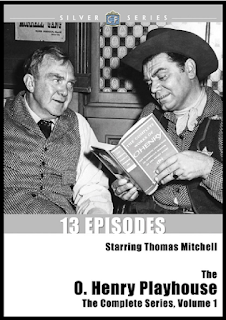
Thanks to the miracle of video (and, considering how negligent networks and studios were with their inventory, it is something of a miracle), we've had the opportunity to catch glimpses from many of these shows. Some survive almost intact, while others have but an episode or two as their legacy. And while some can best be described as, well, time fillers—you know, shows that are maybe a step or two above amateur productions—others have proved to be well worth watching. And, thanks to our friends at ClassicFlix, we have another of these programs that we can consider: The O. Henry Playhouse.*
*Full disclosure: I received this disc gratis for the purposes of 1) reviewing, and 2) enjoying. Thanks to Classic Flix for supplying both.
You're probably familiar with O. Henry (real name: William Sydney Porter,), or at least with his most famous stories, such as "The Gift of the Magi" and "The Ransom of Red Chief." His stories were best-known for their surprise endings, and while critics often panned them, they were immensely popular with readers of the magazines in which they appeared.
In 1957, The O. Henry Playhouse came to television as a syndicated series which ran for 39 episodes. Starring as O. Henry (and that's always the way people referred to him; I guess neither "Mr. Henry" nor "O"—or would that be pronounced "Oh"?—would have felt right) was veteran character actor Thomas Mitchell, who appears in each episode through the framing device of telling his publisher, or some other acquaintance, his latest story. Sometimes, as in the early episode, "Man About Town," O. Henry is himself an active participant in the story; but most of the time he's simply content to let the story unfold, luring his listener in until he springs the surprise ending on them. Mitchell's very good in the role, exuding a warmth that immediately draws you in, while exhibiting a little of the larceny of the real O. Henry (who was, among other things, a convicted bank embezzler), as when he repeatedly asks his publisher for an advance on his next story.
The stories themselves are, for the most part, fun and entertaining. No, it's not Shakespeare, but, as I've mentioned many times in the past, it doesn't have to be. It does, however, need to be enjoyable, and it succeeds. And, in keeping with one of the great charms of early television, it's a kick seeing some of the stars in their early years, such as Charles Bronson, DeForest Kelley, Johnny Crawford, Chuck Connors, Claude Akins, Jean Cooper, and Roger Smith—as well as more established not just stars like Ernest Borgnine (in the very first episode!), John Carradine, Morey Amsterdam, Tom Conway, Beverly Garland, Louis Hayward, and Gerald Mohr. Even if the names don't always ring a bell, you're likely to recognize their faces or voices.
As for the product itself, the first (of three) volume of The O. Henry Playhouse (the volume I'm reviewing) comes with 13 half-hour episodes on one disk. There are no extras, but the prints are clear and crisp ("lovingly restored") and are far better than what you might find on YouTube. Volume 1 retails for $11.99 at Amazon; you'll have to decide whether or not that fits your price point. Volumes 2 and 3 are scheduled to be released later this year.
I can't say that The O. Henry Playhouse is going to make or break your classic television collection, but who doesn't have room for an enjoyable 30-minute story that isn't going to get you upset, will probably give you a chuckle or two, and might just introduce you to some classic faces you haven't seen for awhile? If you watch television for pleasure, then this comes strongly recommended. TV
I never noticed at the time how many British comedies were being aired in the Twin Cities in 1981. Sure, there was Monty Python, but look at the rest: The Fall and Rise of Reginald Perrin on KTCA; Dave Allen and Morecambe and Wise on WCCO. (I was probably too preoccupied with my college studies.) Soon, you won't be able to spit without seeing Britcoms everywhere. (Of course, you might have had them even earlier in your market.) And that doesn't even include the ones that have been Americanized, from All in the Family to Sanford and Son to Three's Company. And yes, if you're sharp-eyed, you'll notice that those are TV Guide critic Robert MacKenzie's fingers drumming away on the typewriter on the left. Enjoy these listings from the Twin Cities edition.
Xere's Jane Seymour, looking not at all like the future Dr. Quinn, but with a bit of a slutty, come-hither appearance to her, quite consistent with the role she's playing in ABC's three-part miniseries, East of Eden (starting Sunday, 7:00 p.m.). And for those who think we don't need another version of John Steinbeck's classic, especially when we have one with James Dean in it, TV Guide assures us that we do—this one is "more faithful to Steinbeck," and Seymour, as the "Satanic siren" Cathy Ames, is a major attraction.
In Bill Davidson's profile, Seymour (real name: Joyce Penelope Wilhelmina Frankenberg) confesses she likes "evil parts," as did Barbara Stanwyck, Bette Davis and Joan Crawford. She's just now coming into her own as an actress; despite her appearance as a Bond Girl in Roger Moore's 007 debut Live and Let Die, her most recent fame comes from her Emmy-nominated turn in Captains and the Kings, followed by another miniseries, Seventh Avenue. With East of Eden, she's ready to cement her status as "Queen of the Miniseries." And this is before appearing in War and Remembrance.
Perhaps her fame today rests on her ability to sell jewelry, but Jane Seymour has come a long way from being mistaken for one of Henry VIII's wives.
lll
There's another movie on this week, CBS's A Gun in the House (Wednesday, 8:00 p.m.), starring Sally Struthers, and that's the subject of this week's editorial. As one might imagine from the title, there's a gun involved in the story, and it's the violence surrounding the gun that's attracted TV Guide's "anger and disgust." "Television drama," Merrill Panitt writes, "had gone too far again, in pursuit of a Serious Issue." Surprisingly, given the movie's title and TV Guide's political leanings, the Issue is not gun control, at least as far as this editorial goes.
In the movie Struthers plays a woman terrorized by two robber-rapists who resorts to a gun "only when she has good reason to believe it is her only chance to avoid being raped and possibly murdered." So far, so good. "But the script establishes this by offering scenes of prime-time soft-core sadism that go considerably beyond the artistic requirements of showing a woman who fears for her life." To cite one extreme example, "Was it really necessary for the would-be rapist to pour pear brandy over the head of his intended victim? Two glasses of pear brandy? (What is this, 9½ Weeks?) And then force her to wipe the floor with her body?" Ooh, kinky. Too bad Jane Seymour wasn't available for the role.
But I get what Panitt is saying here. It sounds campy today (and even he described it as blackly humorous), but over thirty years ago, something like this quite possibly would have earned a theatrical release an R rating. And, in fact, what does it have to do with the main story? Are the writers trying to establish the rapist as a sadistic, possibly psychotic, criminal? It is, as Panitt says, "an excuse for scenes of gratuitous nastiness."
The point, the editorial concludes, is that scenes like this aren't necessary. "For lessons on how to create terror without sleaze, they should see any movie of Hitchcock's."* But in this case, it was business as usual for the writers, who simply followed the maxim of "hasty TV writing" that "tastelessness is a shortcut to powerful effects."
*Notwithstanding that Hitch received much of the same criticism for a movie called Psycho.
It isn't just Panitt feeling that way, though. Judith Crist's review calls it a "simple-minded" movie that winds up "exploiting sex and violence," is more interested in "sadistic perversions," and "loses all its credibility with the introduction of a near-manic district attorney and Struthers' being left to solve her own case." Says Crist, "It's true that social-issue movies need juicing-up to hold the viewer, but lascivious drool isn't the lubricant."
lll
And now a local note: I've had occasion in these reviews to allude to the Great Affiliate Switch of 1979, in which three of the Twin Cities' four commercial stations changed their affiliation, with KSTP switching from NBC to ABC; WTCN teaming with NBC instead of being an independent; and KMSP, the former ABC affiliate, winding up with the short end of the stick, becoming the new independent.
Or maybe things didn't turn out so bad after all.
lll
As I said a couple of weeks ago, I'm not going to take up space with another of my gratuitous shots at what's become of the Hallmark Hall of Fame—I mean, it's like catching fish in a barrel, isn't it? Instead, I'm just going to concentrate on this week's presentation, the one-man show Mister Lincoln (Monday, 9:00 p.m., PBS), starring Roy Dotrice and taped at Ford's Theatre in Washington, D.C.
The broadcast is one of three that appear this season on PBS*, the other two being Casey Stengel, another one-man show with Charles Durning, and Dear Liar, a two-person play with Jane Alexander and Edward Herrmann. It's one of the Hall of Fame's most interesting recent seasons, the only one since 1979 in which the presentations were staged as plays rather than movies. As for Mister Lincoln, I recall having seen this when it was first broadcast. Dotrice, an English actor known as a man of many faces, is a most convincing Abraham Lincoln, and TV Guide's description of his "stirring reading of the Gettysburg Address" is no exaggeration. This is one of the few instances in which Hall of Fame was done before a live audience, and at the end of that reading the audience burst into spontaneous applause. But here—see for yourself. The Address comes about an hour and 10 minutes in.
*Somewhat disingenuously, back when PBS still pretended to be commercial-free, these presentations were simply called the Hall of Fame, with Hallmark providing the grant. Today, using the full title would hardly be an issue.
There's also a nice article by Herbert Mitgang, author of the play, putting Lincoln's life in context and debunking many of the myths that have grown up around him, such as his being a hick lawyer, and that he opposed racial equality. TV Guide would do this from time to time under the label "Background," with an article, often by an outside expert, providing added information regarding one of the more significant programs being shown during the week.
lll
A warning, though—if you want to see Mister Lincoln, you're going to have to pass up part two of East of Eden (8:00 p.m., ABC), and the remake of the Doris Day movie Midnight Lace (8:00 p.m., NBC), starring Mary Francis Crosby in Dodo's role. Capitalizing on the whole Dallas angle, the teaser proclaims, "She Shot J.R. Now Who's Trying To Kill Her?"
That's the way of it during Sweeps Weeks of course, and February has long been known for the networks packing as much star power into their programming as possible. East of Eden has it particularly hard; not only does it go up against Midnight Lace on Monday and A Gun in the House on Wednesday, its Sunday night premiere has to face NBC's three-hour docudrama Kent State (7:00 p.m.), which Crist calls a "stunning film [that] allows us our individual judgment but, more important, does not allow us to forget."
And that's not all. Both Kent State and East of Eden have some real competition with the week's other blockbuster movie, Burt Reynolds' Hooper (7:00 p.m., CBS), co-starring Sally Field and Jan-Michael Vincent. It was one of the big box-office hits of 1978, and Crist's favorable review describes it as "wonderfully rowdy, funny and on occasion touching."
On the other hand, all this week Family Feud features competition between Miss USA and Miss Universe. I don't suppose that has anything to do with Sweeps, do you?
lll
What else is on this week?
With Howard Hesseman's death last week, there's only one choice for Saturday: a special one-hour edition of WKRP in Cincinnati (7:00 p.m., CBS) in which Johnny Fever moonlights as a TV disco host.
On Sunday night, it's part 6 of one of the most popular Masterpiece Theatre stories of the '80s, Danger UXB (8:00 p.m., PBS), the story of a bomb disposal unit during World War II. I must admit I never saw an episode of it, but I hear it was a blast.
With all the sensationalism on Monday's shows, it's nice to know you can depend on a wholesome family drama like The White Shadow (7:00 p.m., CBS). Tonight: "Falahey's girl friend is young, pretty, and pregnant!" Never mind.
TV Update reports that Fred Silverman's job as programming boss at NBC is in jeopardy, and we might have a glimpse into why by looking at the network's Tuesday night lineup. Whereas top-rated ABC has Happy Days, Laverne & Shirley, Three's Company, Too Close for Comfort, and Hart to Hart, NBC counters with Lobo, BJ and the Bear, and Flamingo Road. Maybe that's it, or maybe it's something else?
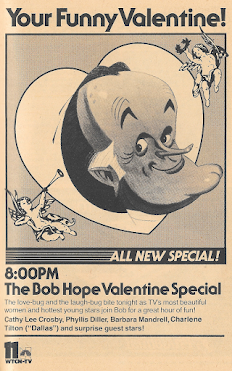
Wednesday, NBC presents The Bob Hope Valentine Special (8:00 p.m.), with the usual lineup of beauties: Cathy Lee Crosby, Barbara Mandrell, Charlene Tilton, and, of course, Phyllis Diller—plus "surprise guest stars!" The listing mentions Dr. Joyce Brothers, but I can't believe that's all, can you?
Thursday NBC rolls out a brand-new series, The Gangster Chronicles, starring Joe Penny, Michael Nouri, and Brian Benben, with a three-hour premiere. This was later repackaged into movie form as Gangster Wars. The series itself runs for 13 episodes, after which it's edited down into a 121-minute VHS presentation also called Gangster Wars. Confused? So am I.
I'm also a bit confused by Friday's movie Inmates: A Love Story (8:00 p.m., ABC), starring Perry King (Joe Penny's old running mate from the series Riptide) and Kate Jackson as residents of an experimental co-ed prison (!) who fall in love. Gee, who could have seen that coming? Fortunately, Judith Crist reports that it wasn't made available for preview.
lll
As I was running through those blockbuster Sweeps matchups, I wondered how much any of this would mean to younger viewers, those who've grown up with DVRs and streaming video. I mean, when you can record a half-dozen or shows at once, or go to your computer and watch a show any time you want, what difference does it make if there are two or three good ones simultaneously?
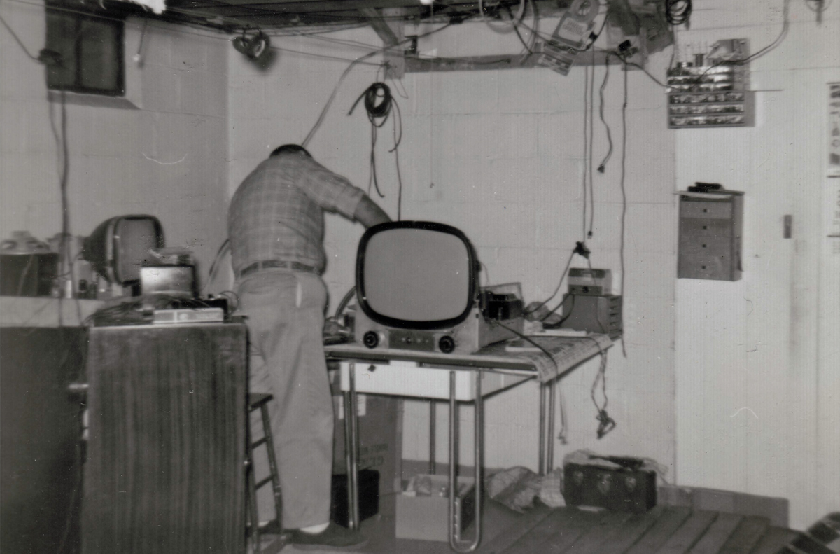
Remember, though, that this particular electronic age is in its infancy right now. I was reminded by an ad that appeared just before the programming section. It was for Audio King, an electronics chain that was big in the Twin Cities at the time. It asks you to imagine the absolute wonder of being able to play a television program over again and again.
But be forewarned: this technical marvel will cost you. The top-of-the-line MGA HS300U features infrared remote control, speed search, slow motion and a 7-day timer, all for $1,450. If that's a little too rich for you, there's the Hitachi—it's compact and easily programmable, and only sets you back $1,250. And for those of you on a budget, JVC has a two-speed model that still offers remote control, still-frame and slow motion for $950.
These are all in the VHS format, but don't forget there's another player in the field. An ad for Video Images offers you your favorite movies and television shows on either VHS or Beta! And when you buy three, you'll get a fourth title free! What a deal! And free with your order, you'll get their giant video catalog with "over 400 all-time favorite TV shows, feature films, cartoons, etc!" (That should just about cover it all.) The cost? Well, each Beta is $39.95, while VHS runs you $42.95. And to think - today you can get a movie on DVD, a far-superior format, out of the bin at Walmart for a buck.*
*And you can download to your laptop or the cloud and not even have to have it physically in your possession. How far we've come.
With prices like that, it's no wonder people are still complaining that they always put all the good shows on at the same time.
TV
I think we'll start this week with something we see far too little of these days, longform journalism, and a kind of remarkable piece by Andy Greene at Rolling Stone. He'd come to know the late Michael Nesmith fairly well over the last few years, and in A Final Visit With Michael Nesmith, he sheds some light on the former Monkee, his relationship with his costars, and some surprising insights as to how he really felt about his most famous role.
At Comfort TV, David reviews one of the classic sitcom tropes: two dates on the same night. In a comedy, it can be a cause of charming discomfort; in a drama, it usually results in a double homicide.
Cult TV Blog returns with another entry in the "orphaned episodes" series, in which John looks at shows from the past with only a handful of surviving episodes. As he points out, the pleasure of finding these assorted fragments is somewhat offset by "a genuine sense of sadness at how much no longer exists."
At Drunk TV, Paul reviews the first season of I Dream of Jeannie, a series that never failed to please its fans. He also has a well-placed word or two about those who might love to "cancel" a show that's so obviously oppressive to women. Well played, Paul!
At A Shroud of Thoughts, Terence leads the way with remembering the career of Howard Hesseman, who died last week, the latest in an apparent non-stop passing of classic TV icons. And from someone in the business, JB offers his own tribute to Johnny Fever at The Hits Just Keep on Comin'.
Finally, Television's New Frontier: the 1960s goes in-depth on calendar year 1962 for Bonanza, television's top-rated program, with reviews, guest stars, and a recounting of how physically demanding the show was for its stars. Glad I chose a more sedate occupation. TV
Throughout this series I've looked at different ways in which classic television has depicted a society descending into Hell, as a kind of warning against what could happen to us. But what if it turns out we're already there?
lll
According to the Encyclopaedia Britannica, Moloch was "a Canaanite deity associated in biblical sources with the practice of child sacrifice." Traditionally, Moloch has been depicted as a grotesque figure, a bronze statue having "the body of a man and the head of a bull," inside which children would be consumed by fire. The Old Testament viewed Moloch as "a foreign deity who was at times illegitimately given a place in Israel’s worship as a result of the syncretistic policies of certain apostate kings," and Moses delivered harsh warnings to the Jews against the cult of Moloch; "You shall not give any of your children to devote them by fire to Moloch, and so profane the name of your God." (Leviticus 18:21) Despite such stern admonitions, several kings, including Amon, worshipped the pagan god, gathering at Topheth, a hilled site just outside the walls of Jerusalem, until Josiah the reformer destroyed the site.
lll
In 1956, the beat poet Allen Ginsberg published Howl, a monumental work that caused a sensation (and, for a time, was banned as obscene). It's not for the faint of heart; the poem begins, "I saw the best minds of my generation destroyed by madness, starving hysterical naked. . ." and proceeds from there. It is, in the words of one critic, "a revolutionary manifesto," both autobiographical and a chronicle of the times.
In part II of Howl, Ginsberg uses Moloch as a symbol of an all-enveloping materialism and greed that was consuming America just as the pagan god had consumed the lives of young children. What would we not sacrifice to this great "idol of consumerism"? Ginsberg's Moloch is a "sphinx of cement and aluminum [that] bashed open their skulls and ate up their brains and imagination," resulting in "Solitude! Filth! Ugliness! Ashcans and unobtainable dollars! Children screaming under the stairways! Boys sobbing in armies! Old men weeping in the parks!" Not a pretty sight.
And when you think of consumerism, power, wealth, big business, avarice, lust, teeming throngs living in quiet desperation—everything, in other words, that goes into Ginsberg's conception of Moloch—there's no place that typifies it quite like the Big Apple itself, New York City.
lll
In 1999, Ric Burns (brother of Ken), debuted a remarkable documentary series; a biography, if you will, of America's most storied city. New York: A Documentary Film took viewers from the city's Dutch roots to the fall of the World Trade Center.* And if The Children's Story was the most subversive program ever shown on television, there's a moment in New York that may well be the most prophetic.
*The series was originally scheduled to comprise five two-hour episodes; however, when it premiered in 1999, the ten hours only took the story up to 1931, with the remaining two episodes scheduled to run at a later date. They did: at the end of September 2001. Burns and his crew then reassembled to produce an eighth episode, airing in 2003, that told the story of the birth and death of the WTC.
The story of New York is one of constant development, constant change, and as the city grows it begins to overshadow the people who live in it, until they assume the size of ants in a colony, moving rapidly this way and that but never getting anywhere. And soon the point that Burns is making becomes apparent, as the character and the flavor and the people itself become a mere impediment to be knocked down by the wrecking ball in favor of progress, industry, and above all, money: it is that New York is Moloch itself, steamrolling, destroying, consuming all under its wheels like wheat under the crusher. And as architecture critic Ada Louise Huxtable describes the price that the people pay, the cameras pan over the canyons of the concrete behemoth, while the planners and the financiers and the industrialists try to wring every bit of humanity out of it in the name of profit:
Moloch whose mind is pure machinery! Moloch whose blood is running money! Moloch whose fingers are ten armies! Moloch whose breast is a cannibal dynamo! Moloch whose ear is a smoking tomb!
Moloch whose eyes are a thousand blind windows! Moloch whose skyscrapers stand in the long streets like endless Jehovahs! Moloch whose factories dream and croak in the fog! Moloch whose smoke-stacks and antennae crown the cities!
They broke their backs lifting Moloch to Heaven! Pavements, trees, radios, tons! lifting the city to Heaven which exists and is everywhere about us!
It was, for me, the most powerful, the most evocative moment in a powerful and evocative series. Perhaps it was Brian Keane's soundtrack; perhaps it was Josh Hamilton's narration; perhaps it was Allen Ginsberg's words. Or perhaps it was all of that, along with a realization of what it all meant.
lll
As I've said, Moloch can be used as a metaphor for many things, none of them good. There is one description I'm particularly fond of, a critic who describes Moloch as the greed and jealousy devouring our society; "everything the people want, their greed, is being held above God. Instead of worshipping God, the people are worshipping their possessions and in doing so, they sacrifice their faith and trust in God."
And so I wonder, if we are in Hell, how many different ways we see our own version of Moloch? And how many things we'll do for him, not in his name, but in our own?
Moloch, for whom we murder the unborn, to maintain our lifestyle.
Moloch, for whom we inject ourselves and our children with strange drugs in search of eternal life.
Moloch, for whom we mask our faces, wondering if we are not ashamed to see our own reflections in the mirror.
Moloch, for whom we send our children to fight wars on foreign lands, in order to make the oil flow and the cheap labor and the profits and the power and the glory.
Moloch, the social media apps that erase our individuality. Moloch, the alternate realities that hide our shame. Moloch, the technocrats that seek to control us and trace our every movement. Moloch, the scientists who seek to controls us. Moloch, the wealthy who seek to exploit us. Moloch, the governments who seek to dominate us.
Moloch, in whom we trust, above all.
What's the old saying? If the shoe fits, wear it? TV