s you probably know, I've done a lot of interviews since this website started. For the most part, I enjoy talking with people who expand my knowledge of the classic TV world: fellow authors, classic TV buffs, people who can tell me (and, by extension, you loyal readers out there) about shows that we should know more about. This week, The It's About TV! Interview presents Brandon Hollingsworth, as we discuss the 1962-63 World War II drama
I think you'll enjoy our conversation.
It’s About TV: Even classic TV fans might not be as familiar with The Gallent Men as they are with other period war dramas, and I’m thinking of shows like Combat! or Twelve-O’Clock High. Let’s start by talking a little about the premise of the series and its origins.
Brandon Hollingsworth: The Gallant Men is the story of a core group of eight men within the U.S. Army’s Fifth Division from the amphibious landings at Salerno in September 1943 to a point north of Naples in late spring 1944. The cast is a simplified cross-section of Army personnel in the fictional Able Company, led by Capt. Jim Benedict (played by the recently-deceased William Reynolds). Almost every episode is framed at the beginning and end by the narration of newspaper correspondent Conley Wright (Robert McQueeney), who was embedded with the company.
 |
| William Reynolds as Capt. Jim Benedict |
Series creator William T. Orr had come up with the concept, under the working title
Battle Zone, as early as 1957, but the Big Three networks weren’t interested. It took him until 1961 to sell the show to ABC. That network was looking for a varied programming slate in the fall of 1962 that it hoped would siphon viewers away from NBC and CBS. ABC was also the Warner Bros. TV division’s best customer, so there was a relationship that I think aided
The Gallant Men in landing there.
There had been a couple of World War II dramatic series in the '50s. But the big thing was Westerns (a ship that was also launched by Orr, because he created Cheyenne in 1955; its success touched off the thirst for television Westerns). I know we’re talking about The Gallant Men, but focus group data collected in early 1962 for the Combat! pilot showed that kids and adults were favorably inclined toward a World War II drama. So I think by that time, a substantial number of people could handle a war show as an exercise in entertainment.
How did you first find out about The Gallant Men? It’s not as if the show is easy to find on TV.
My spouse got me interested in World War II, and with my interest in TV history, I naturally started wondering if there were small-screen depictions of the war before Band of Brothers. That's how I found Combat! In reading about Combat!, I kept seeing references to this "other" series that debuted the same season. I naturally got curious. But when I started searching for The Gallant Men online, I could find so little about it. The series doesn't live on YouTube, like Combat! and 12 O'Clock High, and it's not in current reruns on MeTV or Antenna or Decades. It didn't have detailed, dedicated fan sites. There was just hardly anything about it, and what was available was very incomplete. And if you're anything like me, when you're interested in something and find that it's hard to get to, it only increases your interest. So I got the DVD set in December 2019 and started from there.
Besides William Reynolds, who are some of the co-stars or guest stars who we'd recognize?
Roger Davis, who played radioman Roger Gibson, will immediately be recognized by Dark Shadows fans for his role as cursed portraitist Charles Delaware Tate. In 1972, he succeeded Pete Duel as Ben Murphy’s co-star in Alias Smith and Jones.
Robert Ridgely (Lt. Frank Kimbro) hit it off with Mel Brooks and ended up in amazingly silly bit roles in a few of Brooks’ films (a flasher in High Anxiety and an executioner in Robin Hood: Men in Tights, to name a couple). Ridgely also landed a number of bit parts in television series and had a long career in cartoon voice work. Once you know his face or his voice, you see (or hear) him all over the place.
Others from the regular cast turned up in one-off roles on other series, such as Perry Mason, the ubiquitous Westerns of the era, other Warner shows of the early ‘60s and the crime dramas of the ‘70s. Davis and Ridgely were definitely the biggest "successes," at least in terms of regular gigs, to come out of the principal cast.
Recognizable guest stars include William Windom, who later played Dr. Hazlett, the town doctor on Murder She Wrote; Julie Adams, who was in Creature From the Black Lagoon; Hans Gudegast, who would go on to play Dietrich, the antagonist in Rat Patrol; George O’Hanlon, who was the voice of George Jetson; Peter Breck; Robert Conrad; and three people who would become extremely well known in another context—DeForest Kelley, George Takei and James Doohan.
What role did the other men in the unit play with regard to the overall storytelling?
It really depended on the episode. While Gallant Men had better continuity than Combat!, it still aired well before the era of the show bible and airtight continuity, in which viewers really expect an ironclad universe and ample backstory. But there are some trends that generally hold true throughout the series.
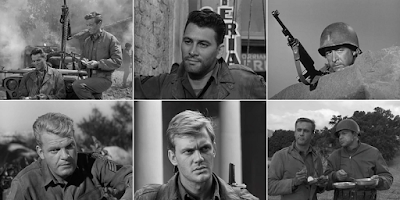 |
Upper row, left to right: Reynolds and McQueeney, Fontaine,
Ridgely. Lower row: Slattery, Davis, Gothie and La Starza. |
Gibson is the youngest of the group and probably the least worldly. The other men of the unit typically tease him as they would a younger brother. He gets storylines about having to mature fast and to think differently in a combat zone to ensure his own survival. McKenna (Richard X. Slattery) is the by-the-book sergeant who has to learn to accept the validity of methods different than his own—which is hard for him. Hanson and Lucavich (Robert Gothie and Roland La Starza) are mostly there for comic relief. Kimbro is the character most likely to question the wisdom of the orders Able Company is given, or try to improvise if he feels like the orders he's given don't match reality and good sense.
D’Angelo (Eddie Fontaine) probably goes through the most of any regular character in the series. He’s shot, he’s captured, he accidentally shoots an old friend while on sentry duty, and he almost gets conned into losing his G.I. benefits to a prostitute. Generally, if something unfortunate is going to happen, it happens to D’Angelo.
A pattern that holds true through the series is that Capt. Benedict and Conley Wright form a strong but largely unspoken bond. Benedict, who normally keeps people at arm's length, confides in Wright more than anyone else. And though Wright is a reporter, not a GI, he's seen enough combat during the war that he can commiserate with the responsibilities, stress and grief that are inherent in Benedict's decisions and orders from farther up the chain. And of the principal characters, only Wright can usually get away with challenging or questioning Benedict, another indication of the trust and latitude present in that relationship.
How did the show compare to Combat!, which premiered the same season?
Combat! was grimmer and more naturalistic. At times, it felt more like a docudrama than a primetime network series. Orr acknowledged The Gallant Men had a fundamentally different aim, and many of its plots revolved around romance, psychology, and ethics away from the battlefield (one critic drily noted that Able Company must have arrived in Italy during a lull in the war, so few were the battle scenes).
Combat! very early on adopted its house look and tone: serious, long stretches without dialogue, lots of outdoor shooting. You can look at a Gallant Men episode and see most of it is filmed on indoor soundstages, and a few outdoor locations that appear again and again. It felt more like a standard weekly drama of the period (which reflects WB's assembly-line style of production). It's harder to suspend disbelief that these guys are in 1943 Italy when you notice they're on the same set you saw three episodes ago. Of course, it should be noted that Combat! frequently re-used outdoor shooting locations, something that became more and more obvious in later seasons.
One thing I find interesting is that, in the decades since these two shows were in first-run broadcast, an impression developed that somehow Combat! was the superior show and Gallant Men was an errant stepchild that deservedly got cancelled. Even Rick Jason (Combat's Lt. Hanley) hinted at that in his memoir, reinforcing the view. But I think a lot of that is assumption that ossified into accepted wisdom. The ratings and Q scores paint a different picture, one of more equal footing for these two freshman dramas that were each good, but in different ways.
It's worth noting that, for all the discussion about the pros and cons of these two dramas, both placed way behind McHale's Navy in the Nielsen ratings. Make of that what you will.
The Gallant Men was on the air while the Vietnam War was in its early days. Was there any attempt, a la M*A*S*H, to try and draw a parallel between what was going on in WWII and contemporary issues? I know that's probably not the case; the war had yet to become unpopular, and I don't think the show was the "social issues" type of program that you see with writers like Sterling Silliphant, but I'd be interested in your take.
You’re exactly right. The Gallant Men wasn’t so much a careful, incisive exploration of war so much as it was William T. Orr’s attempt to expand the Warner TV brand into war shows. There are glimpses of topics like PTSD and the stress of ceaseless combat duty. We get some taste of the difficulty of re-establishing government and order in towns turned to rubble. A couple of installments show us what war does to the frightened and weary civilians of the villages Able Company visits. But generally, there wasn’t the kind of clear social or moral message you would see on The Twilight Zone or Route 66.
About the closest I think the series comes to serious commentary is the episode “One Puka Puka,” in which a squad of our regulars encounters a group of Nisei from the 100th Infantry Battalion (a real unit from the Italian campaign, highly decorated and very well respected for their valor and actions). McKenna reveals he served at Pearl Harbor before the 1941 attack, and developed a strong distaste for Asians and Asian-Americans. The combined group has to defend itself against a German unit that sweeps in, and McKenna learns to trust and even embrace the unorthodox methods of the 100th Infantry guys. That episode aired in March 1963, when racism in the United States was really being challenged in education, law and politics. I feel like viewers would would see the parallel there.
What was the competition that the show faced from NBC and CBS? As far as you know, was ABC doing any kind of intentional programming to put it on when they did?
The competition was strong. ABC initially put The Gallant Men up against Rawhide on CBS (a top 25 show that season). In December 1962, ABC cancelled another of its freshman shows, a Roy Rogers-Dale Evans vehicle, and threw Gallant Men into its place on Saturday nights. And in that timeslot, the competition was even stiffer: Jackie Gleason on CBS (a top-20 show). NBC’s competing shows in the respective timeslots were the variety show International Showtime and legal drama Sam Benedict, neither of which was a real smash.
Those choices raise a question my research hasn’t totally answered yet: Did ABC put Gallant Men in those challenging timeslots because they believed in it, or because they didn’t? ABC's pre-premiere advertising expressed a hope for a broad audience. The leadoff spot on Friday night was considered a critical one to build an audience. The network further hoped Gallant Men would at least steal some viewers away from Rawhide. But the mid-season switch to Saturday nights frankly baffles me. It’s like the network started the season with a goal, then threw in the towel early and resorted to guessing. And, based on the trade publication reports, that inference may be a safe bet.
 The Gallent Men runs for only one season, 26 episodes. Why do you think that was?
You know, Bill Reynolds asked me the same question. Even he didn’t know why the show was cancelled! The show was no worse than any other drama running on TV at the time. Its Q scores, as I mentioned earlier, were pretty close to those of Combat! While ABC may have decided it was an underperformer, its ratings weren't awful. And Warners had commissioned at least a dozen scripts for additional episodes, indicating that they thought a second season was in the cards.
What I’ve gathered from contemporary accounts indicates the show was dropped because of politics between ABC and Warners. ABC had been WB television’s biggest customer, but the network seemed to lose its ardor for the studio during that ‘62 season, when the programming spaghetti it threw at the wall refused to stick. The TV division of Warners, meanwhile, entered a period of turmoil as it failed to sell new shows to the networks for the upcoming 1963-64 season.
Is there something that could have made the show more likely to be picked up for another season—say a better timeslot than Saturday against Jackie Gleason?
I think better relations between Warners and ABC and a stronger promotional push from the network would have helped. It's likely the show would have turned out a second season comparable in quality to the first, and then ABC could have made a better decision about its future based on the show’s own merits, not the network’s bad blood with the production company.
What did critics and viewers think of the show?
There were a couple of ways to measure viewer response. One was the Nielsen ratings. In November and December 1962, Gallant Men averaged 17.9—which means one in six TV-equipped homes in the U.S. were tuned to the show. That's an amazing success in our highly-fractured entertainment environment today, but back the Big Three days, 17.9 put The Gallant Men in the lower third of the primetime pack. But get this—it did succeed in drawing viewers away from Rawhide. Not enough to beat the Western, but an outcome that was in line with ABC's original goal.
The other way was Q scores, which purported to measure how much viewers personally liked a show. And by that measure, The Gallant Men did pretty well. In late 1962 and early '63, its Q scores were a couple points behind those of Combat! It consistently was among top ten primetime shows that season. But The Gallant Men's highest Q scores were among people 17 and younger, a demographic that may not have impressed ABC or potential advertisers.
Critical response to the show was mixed. The TV critic from the Atlanta Constitution praised it; Variety yawned, and said the show "might hang on." TV ratings prognosticator James Cornell predicted The Gallant Men would win its timeslot, based on the strength of the pilot episode. Toward the end of the season, he revised his view, opining that the succeeding episodes were weaker.
Over the years I've become a fan of the Warner Bros. series from the 1950s and 60s, particularly the P.I. and Westerns. Did The Gallant Men display any typical characteristics of WB shows, or was it more traditional? And in keeping with that, was William Reynolds the star of every episode, or did it focus on guest stars and/or other members of the cast?
To answer the last question first, each of the eight principal characters had at least one “focus” episode in which they played the central role. In a few of those, Capt. Benedict had only a peripheral role. Out of the 26 episodes produced, I’d say there was a good balance in giving the main cast something substantial to play. The guest stars usually had something interesting to do—and of course, were written out or “killed” by episode’s end to tie everything up.
I’m less familiar with the world of Warner Bros. television from this era than you, but in researching for the wiki, I noticed a lot of cross-pollination among the actors and crew. Names like actors Richard X. Slattery and William Reynolds, directors Charles R. Rondeau and Richard C. Sarafian, and writers Richard Landau and Don Tait appear in the credits lists for multiple Warners shows. If you were watching back then, you'd have noticed Reynolds, for instance, and thought to yourself, "Isn't that the guy from Pete Kelly's Blues and The Islanders?" both of which were also Warners shows. The writers had mostly turned in scripts for the private eye dramas and Westerns you referenced in your question. Lots of credits for Hawaiian Eye, Surfside 6, Cheyenne, and Maverick.
Is there a particular episode of the program that stands out for you?
"Retreat to Concord," the show's second episode, features Peter Breck as a master sniper who became embittered and misanthropic, essentially to protect his own mind, after watching nearly all his friends die in one horror after another. It's not a terribly original plot, but Breck does such a good job playing this damaged man that the hour becomes something of a standalone "play of the week" that you get wrapped up in. I won't spoil the rest of the plot, but if all 26 episodes had been as good as that one, the show might have had a better reputation.
Is there a "message" that you think resonates from the show, or does it stand on entertainment and the performance of the actors?
I believe the show stands on its own entertainment value and the actors. Some of the folks who made Combat! said it was always an anti-war show (the same thing said about M*A*S*H a decade later), but I don’t sense that vibe from The Gallant Men. Nor was it a pro-war show. I think it’s a standard, but entertaining, melodrama set against the backdrop of the Italian campaign. Reading between the lines, it's fair to argue that plots of Gallant Men episodes point out there are some things that remain with us, even during the upheaval of war—there is romance, there is strife, there are interpersonal conflicts, and there are moments of levity.
This is also perhaps a good place to note that it wasn't just the writers, producers and directors determining what each episode would look and feel like. The show's technical advisor was Lt. Col. David Sisco, who had himself served in the Italian campaign. But Sisco wasn't just there to teach the actors how to shoot believably (though he did that as well); he had a veto power over storylines. So when he decided a particular plot didn't reflect well on the Army, he'd have it nixed, or some watered-down compromise would be written and shot. So while I mentioned a moment ago that the show wasn't explicitly pro-war, Sisco wanted to make sure it was in some way pro-Army.
Do you have any plans for writing a book? Because if you do, I’m buying it!
Kinda-sorta. What I've found is that if you're going to have a good reference book for any classic TV show, it's almost always up to the fans to research and write it. Someone like Douglas Brinkley isn't going to swoop in and do it. So my plan at the moment is to take what I've collected so far from period publications, notes drawn from the episodes themselves, databases such as IMDB, and material from the Warners archives at the University of Southern California, and write a concise history of the show and its context in the 1962-63 TV season. Something that I can make available in some way, so if a TV scholar or enthusiast of the future wants to learn about the show, they'll have somewhere to begin.
Incidentally, the Warners archives have been closed to researchers and the public for nearly three years. A finding aid indicates there's a lot to be mined there, so I can't really finish this putative mini-book until I can go through the USC holdings. And I'm very enthused about doing that.
You mentioned earlier that The Gallant Men doesn't live on retro channels—is it available anywhere right now?
My short answer is, it ought to be! But sadly, no. The only place one can find complete episodes is on the Warner Bros. whole-season DVD set. Copies can be found on eBay and Amazon.
One final question—the world has changed a lot since The Gallant Men; do you think there's a place for a war drama on television today? I suspect that WW2 and Korea would be too old to appeal to an audience, and we're probably now at that point for Vietnam as well. Is the Gulf War too divisive, or is there something that a series could teach us?
I might quibble just a bit with the idea that a WWII or Korean drama wouldn't find an audience. Saving Private Ryan, Band of Brothers, and The Pacific helped ignite an interest in the Second World War among people who were born long after the real thing ended. At the same time, those works really raised the bar for production values and scripting. I'm not sure a Combat! or a Gallant Men would necessarily succeed today, but if you wanted to produce a version of those shows with Band of Brothers production values, I think it could succeed on cable or on a streaming service. Like with every other television genre today, you have to reset your expectation of success; a much smaller audience is a hit these days, and I think a well-done war series could meet that mark.
The question of lessons is probably better directed to a philosopher or historian, but my personal view on the matter is that, from Combat! to Tour of Duty to Generation Kill, the message is pretty clear: war is bad, and even when fought for the "right reasons," it damages people and places in many ways. Yet we still make war. So the message isn't landing with the right people, I guess.
I don't think I'm wandering out on a limb to say it's harder for people to agree on what the lessons are, the closer in time we are to the event being depicted. There's so much information, and so many perspectives, that emerge only years after the last shot rings out. I think there's a reason The Gallant Men, M*A*S*H and Tour of Duty came out 20 years after the wars they depicted. It's also worth noting there's a nostalgia factor, particularly with WWII productions, and we're a long way from feeling romantic about Iraq and Afghanistan. I am curious whether that changes two decades from now, or ever.
And also a big thanks to one of my partners in crime, my ol' buddy Jodie Peeler, who put Brandon and me in touch—thanks for always looking out for us! TV


