Showing posts sorted by relevance for query rudolph. Sort by date Show all posts

December 16, 2014

What are we to make of Rudolph? (and other foibles of adults watching cartoons)

CELESTE HOLM AND GREGORY PECK IN A SCENE FROM GENTLEMAN'S AGREEMENT
We've been having a lot of fun at the expense of Rudolph the Red-Nosed Reindeer lately.  Now, we all love Rudolph, but let's face it - the script isn't going to win any kind of award.  In fact, for adults, the whole thing can be kind of, well, stupid.  Last week at the Facebook site I linked to a couple of articles pointing out the inconsistencies, if you will, of the story, not unlike the piece I wrote here last year.

And yet we watch it each year, and we're not about to give it up.  So what about people like the Hadleys - with no children to appreciate the simple treasures, as well as the fears that all kids have about being part of the "right" group, watching Rudolph is pretty much an act of nostalgia.  We marvel at the animation, hum along with the now-familiar tunes, but suffer in trying to make sense of it all.  Because it doesn't make any sense!

Some years ago I posted this piece, based on my friend Peter's ruminations about Frosty the Snowman, another cartoon that, shall we say, would fit in well at MST3K.  And yet Peter wasn't satirizing Frosty, but looking at it from another, more serious angle.  And it's true that stories can often have meanings beyond those intended by the storyteller.  So while watching Rudolph last Sunday afternoon (at 4:30pm CT, its original air time), I let my mind speculate on how one might choose to look at the story in a way that not only adds meaning to it, but puts it squarely in the context of its time.  After all, this is why It's About TV! exists in the first place.

Gentleman's Agreement, the 1947 Oscar winner for Best Picture, told the story of a journalist (Gregory Peck) who went undercover, posing as a Jew, to expose anti-Semitism in New York.  At the time, and for years afterward, discrimination against Jews was fairly widespread in certain quarters; the stories about Jews being unable to join country clubs are all the more powerful because they were true.  It didn't matter that many of these Jews were successful businessmen, pillars of the community, good and decent people - there were still landlords that wouldn't rent to a Jew, hotels that wouldn't book rooms for Jews, doctors that wouldn't treat Jews.  Oftentimes, the best evidence that someone was a Jew was simply the sound of their name.

That discrimination still existed thirteen years later, in 1964 - the year that Rudolph was first broadcast. At the same time, and even less subtly, was the discrimination suffered by many American blacks.  Based solely on an external - the color of their skin - they were forced to drink at separate water fountains, eat at separate restaurants, stay at separate hotels.  They too faced neighborhoods in which they couldn't buy homes, employers that wouldn't hire them, colleges in which they couldn't enroll, laws that were applied differently to them.  Although there's nothing to suggest that Romeo Muller, the writer of the animated Rudolph, had any of this in mind, it's inconceivable that he would have been unaware of it.  Did any of it influence what he wrote, even indirectly?

To go back to Rudolph, we know that there's no reason Rudolph should be prevented from being on Santa's sleigh team just because he has a red nose, and Santa was a jerk for going along with it.  He was like many people throughout history, basically good and decent men who were afraid to buck the majority (no pun intended).  Rudolph's father Donner was more interested in prestige and influence than he was in justice.  The other reindeer picked on him because he looked different from them, and it's always easy to hate those who are different.  Only Clarice and Rudolph's mother were able to look behind the externals and see Rudolph for who he really was.  The color of his nose was no different from the color of a man's skin, or the kind of religion he practiced.  That didn't stop people from discriminating against him, though.

To really make sense of Rudolph, therefore, it seems that one has to really understand the era from which it comes, and the cultural pressures that existed.  And indeed, it's not too hard to imagine that at least one child somewhere might have looked at Rudolph being ostracized by the reindeer community and wondered to himself why, if that was wrong, it was okay that the family of one of his classmates had such a hard time finding a place to live because of their religion or the color of their skin.

Not to put too fine a point on this, but this societal context can be seen in more than just Rudolph, of course.  Take Santa Claus Is Coming to Town, another Rankin-Bass animated special from 1970.  The story features an orphan baby named Claus being taken in by a family of elves, headed by the matriarch Tanta Kringle, who were formerly official toy makers to the king of the country in which they live, which is now under the rule of the Burgermeister Meisterburger, who lives in the capital city of Sombertown.  Now, I've often thought that this actually represented an allegory on Communism or some other totalitarian form of government, and over the weekend I deepened this thought.

Life was apparently once good in this country, until the Burgermeister came to power, so it's unlikely that the capital was always called "Sombertown."  More likely that it was renamed, in the same way that St. Petersburg was renamed Leningrad.  Also, note the atmosphere of Sombertown, all drab and gray, much as our perception of the Eastern bloc - East Germany, for example, or Czechsolvakia.  Remember, this was just two years after the Soviet army crushed the uprising in Prague.  As for the toys being thrown in a bonfire and burned, I don't know how anyone could not think of the Nazi book-burnings, or similar Soviet-era purges.  The Kringles themselves, in exile following the overthrow of the Czar - er, King - would have been outcasts in Siberia, much like other enemies of the state.

The Burgermeister and his predecessor, Stalin
You might think that I'm reading too much into these animated specials, which are merely meant to entertain kids (and sell toys), and I'm not suggesting that the makers had these allegorical messages in mind at all.  What I am saying is that you can never pull any piece of art out of its era without also looking at the context in which it was created, and the forces at work in the culture of the times.  Just as Rudolph was made in a time were people would have been well-aware of discrimination against blacks and Jews, viewers of Santa Claus Is Coming to Town were living during the Cold War, and many of the traits of the Burgermeisters would have been instantly recognizable to them as sharing aspects of Communist- or Nazi-era totalitarianism.

In other words, these shows, and many like them, are products of their times.  Look at when they were made, and you see a window into another time, another culture.  And we can often speak a truth unknowingly.  Caiaphas the High Priest, for instance, tried to justify Jesus' death by telling the Jews it was "better for you that one man should die for the people, not that the whole nation should perish." Christians clearly see the fulfillment of this prophesy in the Resurrection of Christ as the Savior, yet this is certainly not what Caiaphas meant - he denied that Jesus was the Christ.  His words, therefore, carried a truth that even he was not aware of.

So it is then, and also today.  If we're inclined to watch Rudolph and Santa Claus and Frosty and the rest, by all means.  And next time you do so, think about watching them while keeping in mind what I've written about here.  The main lesson to take from this is that we're all part of history and it will always inform whatever we read or watch, whether we know it or not.

December 5, 2013

Why is it we love Rudolph again?

Well, it may only be December 5 (or later, depending on when you read this), but Rudolph the Red-Nosed Reindeer has already aired.  What with Thanksgiving being as late as it can be this year, CBS was apparently unable to restrain itself for even a couple more days, and the first Christmas cartoon of the year aired before the turkey had even been cooked.  Which is OK with me; I've got it on DVD anyway*, so I can watch it whenever I want.

*Two versions, actually: the standard DVD release, which has been remastered in brilliant color and contains much that had been edited out over the years; and the original televised version, which I bought a few years ago from the Rankin-Bass historian, which includes the original ending (Santa's trip to pick up the Misfits isn't shown) and closing credits.  

I don't know if I've written much about Rudolph in the past - wait, let me look it up.  Yes, I did, right here.* The point is, the magic of Rudolph is, I think, specific to having seen it as a kid.  Any adult who would watch it today does so either because he has kids of his own, or he's like me and the annual viewing brings back childhood memories.  Because, to be perfectly honest, for adults Rudolph the Red-Nosed Reindeer is prime fodder for a MST3K treatment.

*And here and here as well, going back to the old Our Word days.

In my opinion, nobody points this out better than James Lileks, and so I'm simply going to defer to his analysis of Rudolph, from a few years ago.  (Don't worry; nothing has changed since then.)   He's going through the annual viewing with his daughter Natalie, aka Gnat:

She was curled on the floor by the tree, watching the living room TV, her stomach aching. She enjoyed the Seasonal Viewing, but we picked it apart together. Santa, as many have noted, is a jerk. The elves show up to sing a song that essentially celebrates their unquestioned servitude, and he’s checking his watch the whole time. The Reindeer Dad is overbearing; Clarisse is quite forward, and good for her, but one does question the ease with which she forges an alliance with Mother to find the errant Rudolph. Let me find him so I can take him away from you, withered sexless deer-crone! They’re gone for months, yet Rudolph shows up at the EXACT MOMENT they’re about to be eaten? Uh huh. Yukon falls over a cliff, and even though the bottom can be clearly ascertained by the naked eye, everyone assumes he’s dead? I mean, if Bumbles bounce, surely some Bumble-bouncing would have happened right away and reassured everyone. Oh! Evolution has produced a spongy subcutaneous layer that prevented damage to the Bumble’s internal organs. Let’s throw him a rope and rescue him. But no: He’s GONE! HE’S GONE! And that’s the end of it.
No one seems to mourn the dogs who went over the edge with Yukon, do they.
Of all the characters, Gnat liked Yukon the best. She thought Moonracer the Winged Lion was cool, but seriously, what the hell: is this a hereditary monarchy? How did a lion with wings end up ruling a small island of damaged playthings, instead of swooping around Manhattan shouting HEED ME MORTALS. Charley-in-the-box tells us “he’s holding court right now,” but “holding court” consists of Moonracer perched on a throne, or maybe a commode, in an empty hall. Did he spend all day sitting there, thinking, well, here I am, holding court, yes indeed. Or – more likely – was this an elaborate scheme to gather unusual toys and hold them under their collector-value soared? We’re supposed to believe that Santa didn’t know about the Island of Misfit Toys. Right. Like a guy who runs a toy-construction industry based on aerial distribution would be COMPLETELY UNAWARE of a lion who flew around picking up toys. It all stinks, I tell you. The fix was in.

Is this not true?  I told you; couldn't have put it better myself. My wife, after rereading this, points out that it's becoming harder and harder each year to watch Rudolph with a straight face; if you can get by all of the above, there's still the question of jerk Santa having the gall to ask Rudolph, after everything he's done, to bail him out just because there's a little fog on Christmas Eve.  Personally, I would have said something along the lines of, "Oh, so now you need my help, huh?  Well, fat man, you can take that and stick it in your pipe!" I asked my wife if I'd just become a cynical adult, to which she replied, "No, I think even kids would probably say that nowadays."

Oh well.  We kid because we care, right?

December 4, 2012

Run, Run Rudolph!

Well, now that Thanksgiving is over we can all get on to the big holiday, right?  I hope you know that's sarcasm; I love Thanksgiving precisely because it isn't overrun by commercialism.  But it is true that once the turkey's been put away, it's free reign on Christmas shows - lots of products to be sold, after all - and when Thanksgiving is as early as it is this year, it means the onslaught is here before you know it.

Rudolph the Red-Nosed Reindeer airs next Tuesday on CBS; I'm actually kind of surprised it's that late in the year, as it's been run as early as the day after Thanksgiving in the past.  First seen in 1964, Rudolph's showings were as part of General Electric's occasional Fantasy Hour specials on NBC.*  Nowadays programs don't generally have single sponsors, but when G-E sponsored Rudolph they went all out - the elves even appear in the commercials!  It's a shame that we can't see this on the broadcasts today, because these charming bits are every much a part of the show as Rudolph, Hermey and Yukon Cornelius.

*Explains why Rudolph's nose lights up like a G-E bulb, doesn't it?


Those first couple of years, the elves - and the rest of the cast - even appeared in GE's print ads:


Great stuff, isn't it?  There's something slightly primitive about it that is thoroughly charming.  I know it's all commercialism, whether you're talking about the 60s or today, but wouldn't it be nice if there was at least a little thought put into it today as there was back then?

You can see more great Rudolph info, along with more neat things, over at the blog of Rick Goldschmidt, the Rankin-Bass historian.

December 17, 2021

Around the dial

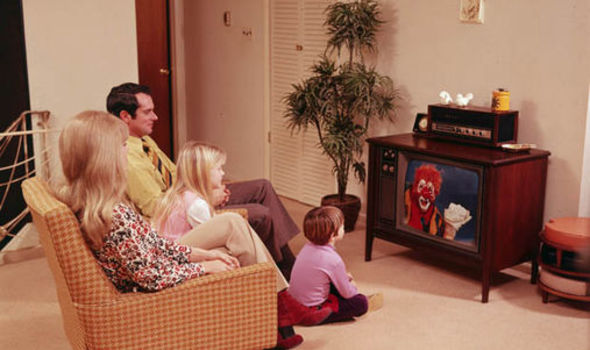
Another family gathered around the TV watching C-SPAN


Whenever I see an article about how classic shows of the past weren't really that good, my Spidey sense starts to in, and I immediately prepare for some kind of knee-jerk reaction—you know, something along the lines of how this author doesn't really know what he (or she) is talking about, blah, blah, blah. And when I saw this Atlantic article by Tom Nichols on how most Christmas specials are terrible, I was prepared to do the same. After all, his focus is entirely on animated specials, leaving out some of the most significant Christmas shows in television history. But in this case, I'm not going to jerk my knee, because as it happens, this is something I like a lot; I feel as if I could have written it myself.

The idea that Rudolph the Red-Nosed Reindeer is, well, kind of stupid, is not one foreign to this site. Its charm, and its classic status, comes almost entirely from the stop-action animation, the songs, and its connection to our childhood. But let's admit it: Rudolph's Santa is a jerk; if I'd been Rudy, with Santa asking for my help after everything I'd gone through, my answer would have been short and sweet: "Bite me, Santa!" (But then, I suppose Rudolph is a more forgiving soul than I am.) And then there's the idea that King Moonracer, who's apparently able to fly around the world gathering up misfit toys, can't fly to the North Pole himself and ask Santa's help. For that matter, why doesn't the king just fly over to Amazon and let them deliver the toys? Anyway, the point is that, unlike A Charlie Brown Christmas and How the Grinch Stole Christmas, the two specials Nichols singles out for praise, Rudolph's story really isn't very good.

There is one thing regarding the Rankin-Bass specials, though, that I ought to point out—and I really am fond of them; I own most of them, including some that aren't commercially available—and that is that they work splendidly, if perhaps unintendedly, as allegories for our modern times. As I've pointed out before, Frosty the Snowman can be seen as a retelling of Christ's Resurrection, while Santa Claus is Comin' to Town works best as an allegory of the fall of Communism, with Sombertown serving as a stand-in for East Berlin. In fact, it seems to me that these readings are the only way either special makes sense. But then, that's just me.

Meanwhile, let's see what else is on tap this week:

At The Guardian, Anne Billson has binged on Christmas romcoms and she's here to see what they're all about. The Hallmark (and now Netflix) Christmas movies have been in my bullseye for a long time, but after reading this article I felt like I needed to go to the bathroom. Fantasy is one thing, but these movies not only dishonor Christmas (although they especially do that), they dishonor moviemaking itself. Remember when the Hallmark Hall of Fame produced class entertainment? One of the things that makes A Christmas Carol timeless is Scrooge's realization that life is not all about "having it all," but about sharing it all, especially yourself, and that you can never undo the past—you can only redeem the present and the future. On the other hand, if this kind of escapism is what people really want, no wonder we have so much trouble confronting the issues we face today.

At bare-bones e-zine, Jack wraps up the Hitchcock Project look at Joel Murcott's contributions to the show with the ninth-season episode "The Dividing Wall," an uneven but nasty little piece of work featuring a nuclear cannister. It isn't quite Kiss Me Deadly, and not nearly vintage Hitchcock.

I've decided this week to use the full name of John's blog, That Blog Where The Bloke With No Shirt Blogs About TV and Tries to Stay on the Subject, as he covers a disastrous rendition of A Christmas Carol as seen on The Play That Goes Wrong, a bizarre series that you really need to see to believe.

And though Christmas is just around the corner, it's not too early to look forward to New Year's, and at Shadow & Substance, Paul lets us in on the episodes that SyFy's chosen for this year's Twilight Zone New Year's Marathon

Another icon of 60s television passed this week with the death of Mike Nesmith, and at A Shroud of Thoughts, Terence shares an affectionate remembrance of Wool Hat. And don't miss several other articles that Terence has on his favorite Monkees songs.

At Drunk TV, Paul is back with another look at Hanna-Barbera animated specials; this time, it's the 1972 A Christmas Story. No, not the movie, but a sparkling special with an all-star lineup of cartoon voices. 

Finally, since I started this off by talking a lot about myself, I'll end the same way, with a link to episode 118 of Eventually Supertrain, in which Dan and I revisit Search, Dan and Tim talk about Kolchak, and Dan and Chris take on Battlestar Galactica. Don't miss it! TV  

December 2, 2023

This week in TV Guide: December 4, 1982


I thought we'd try a little experiment this week. Last week, I pointed out in passing that TV's Christmas season seemed to start earlier and earlier every year; today, it pushes right up against Thanksgiving. (Excluding Christmas movies; I'm pretty sure some FAST network is already showing next year's movies, while this year's movies started somewhere around Halloween—or was it Labor Day?) 

Now, where was I? Oh yes; in order to prove this hypothesis, we'll take a look at two other issues of TV Guide in addition to this week's issue from 1982. They're from similar points in the month: one from December 4, 1953, the other from December 3, 1966. Is there a difference in how television programmed Christmas back then, or is it all just my imagination? Let's see just what each issue tells us.

We'll start with 1953, and the tale of the tape is pretty easy: there is no Christmas programming this week. Now, that doesn't mean there isn't anything Christmassy on, but most of what you see concerns cooking or decorating ideas for the holidays—how to make a Christmas mobile, for instance, or a table centerpiece with a Christmas motif. The singers on Bob Crosby's daytime variety show (2:30 p.m. CT, CBS) offer a Christmas tune or two, and Omnibus (Sunday, 4:00 p.m., CBS) gives viewers a look at the Christmas windows in NYC's Lord and Taylor department store. Otherwise, that's it. 

There's a logical explanation for some of this; as of 1953, there are no animated Christmas specials, and most of the weekly variety shows will air their special episodes closer to Christmas itself. We know that the shopping season is in full swing; there's an article about how toys based on television characters are a hot thing this year, and there's a note in the Teletype that RCA-Victor is putting out a record of Dragnet's complete Christmas episode ("The Big Little Jesus"), which I'm sure would make a fine gift for those who want to relive the moving story over and over. So my bet is that there are plenty of Christmas commercials on the the air, but nothing yet as far as specials.

Fast-forward thirteen years to 1966, and we can see right away that times have changed. On Sunday (5:30 p.m. PT, NBC), it's the second showing of Rudolph, the Red-Nosed Reindeer, with all kinds of commercials featuring General Electric's suggestions as to what would make good gifts. ABC's special The Saga of Western Man (Wednesday, 8:00 p.m.) has a show with an explicitly Christmas theme: "Christ Is Born," a recreation of The Nativity and the history surrounding it. It's sponsored by B.F. Goodrich; I'll bet at least one commercial will be for Goodrich's "For a Musical Merry Christmas," the third volume in their annual Christmas series. On Friday, CBS reruns Tchaikovsky's "The Nutcracker" (7:30 p.m.), narrated by Eddie Albert, with Edward Villella, Patricia McBride, and Melissa Hayden. 

There are also specials that are non-Christmas but function as outstanding vehicles for Christmas advertising: Wednesday's Hallmark Hall of Fame presentation of "Blithe Spirit" will  have a slew of commercials for Christmas cards—Hallmark always coordinates its shows to align with major card-sending holidays, and after all, it wouldn't do any good to advertise them once it became too late to mail them, would it? There's also a Frank Sinatra special Wednesday on CBS, and that same network's "The Glass Menagerie," with Shirley Booth, Hal Holbrook, and Barbara Loden, on Thursday. But in total we have only three holiday specials and, once again, there are no variety specials. 

Now look at how things are in 1982. We start on Saturday, with the acerbically funny movie The Man Who Came to Dinner (7:00 p.m., WGBH in Boston), and A Disney Christmas Gift, scenes with holiday themes from Disney cartoons and animated features. (8:00 p.m., CBS) Monday evening, with a CBS doubleheader: A Charlie Brown Christmas at 8:00 p.m. ET, followed by Bugs Bunny's Looney Christmas Tales at 8:30; opposite them, it's Rudolph's Shiny New Year (8:00 p.m., ABC) On Tuesday, it's another CBS doubleheader, and now we're seeing the variety specials: Johnny Cash's Merry Memphis Christmas, with June Carter Cash, Rosanne Cash (no relation), Crystal Gayle, and Eddie Rabbitt (9:00 p.m.), followed by Andy Williams' Early New England Christmas, with Dorothy Hamill, Aileen Quinn, James Galway, and Dick Van Patten. (10:00 p.m.) 

On Thursday, we've got a pair of movies: White Christmas (8:00 p.m., WLVI in Boston), and It's a Wonderful Life. (9:05 p.m., WENH in Durham, NH, repeated Friday on WMEB in Orono, ME) But that's not all; HBO is running Laurel and Hardy's March of the Wooden Soldiers and Rich Little: A Christmas Carol throughout the month, including this week; the same goes for Hans Christen Andersen's The Snow Queen, seen several times this week on various PBS stations. Inexplicably, Cinemax also has an Easter movie, Quo Vadis, throughout the week. Quite a difference from years past, don't you think? And in case you're wondering, Rudolph was already on last week; December 1, solidifying its standing as the first Christmas special of the year. 

Obviously, one of the reasons for the plethora of programs we're seeing here is simply that there are more of them than in years past, and that's even taking into consideration that the first animated special, Mr. Magoo's Christmas Carol, went into syndication in 1970, while the first program of any kind to become an annual Christmas special, Gian Carlo Menotti's opera Amahl and the Night Visitors, hadn't appeared on TV since the late 1970s. In addition, any variety specials are going to come early in the season (for the convenience of advertisers) since there aren't any weekly variety shows anymore.

Now, before we go too far with this, let me stress that I'm not against Christmas programs; from December 1 on, that's pretty much all we watch in the evenings, unless there's something else going on. I say the more programs, the merrier. And I don't mind Christmas commercials, either—who doesn't get a warm feeling remembering the Norelco Santa, or Ed Herlihy talking about Kraft recipes. (And that's not to mention the General Electric elves in the original commercials that ran during Rudolph.) For those of an age, those memories are as much a part of the Christmas season as the programs themselves.

What I don't like is showing all your holiday inventory in the first two weeks of the season, as if the only reason for them to exist at all is as a vehicle for commerce. I particularly don't like the cartoons that don't tell any story at all, but are around as a tie-in to the product they're trying to sell. (The Santa Bear animated special, for instance.) Leave at least a little something for Christmas week itself, even if everyone's already done their shopping. (Remember, they have to spend those gift cards they receive!)

Fortunately, thanks to the plethora of viewing options out there, from FAST stations to on-demand services to the good old-fashioned cable stations, there are options right up to Christmas Day and beyond (I mean, look at them!), and while a lot of them aren't particularly to my taste, beggars can't be choosers. Anyway, we've got our DVDs to keep us warm. 

l  l  l

I don't want you to think that it's all about Christmas this week; far from it. One of the feature programs of the week is the Hallmark Hall of Fame's presentation of "Witness for the Prosecution" (Saturday, 9:00 p.m., CBS), a remake of the classic Agatha Christie courtroom drama, one of the greatest ever made, starring Sir Ralph Richardson as barrister Sir Wilfred Robarts (played in the movie by Charles Laughton), Beau Bridges as Leonard Vole, the defendant (formerly Tyrone Power), Diana Rigg as Vole's wife (Marlene Dietrich), and Deborah Kerr as Sir Wilfred's nurse (Elsa Lanchester). Judith Crist praises the remake and the performances (while finding Bridges a bit lacking), even though she questions the need for such a remake in the first place. It would be a pity if it was because audiences won't watch a black-and-white movie, whether in 1982 or today.

Sunday is a night of specials on CBS, starting at 8:00 p.m. with An All Star Party for Carol Burnett. CBS took more than a little criticism a while back when they didn't take a flyer on the 90th birthday celebration for Carol (it wound up on NBC instead); it's nice to see them honoring her here. Among the guests are Steve Lawrence, Jimmy Stewart, Vicki Lawrence, Tim Conway, Tom Sellick, and Beverly Sills; there are also tributes from Lucille Ball, Bette Davis, Sammy Davis Jr., Monty Hall, Glenda Jackson, Jim Nabors, Jack Paar, and Burt Reynolds. I mention them all here to show that in this instance, "All Star" wasn't just hyperbole. There are also a few stars on hand for the seventh annual Circus of the Stars (9:00 p.m., CBS), although there are a few more examples of "stars" in this case. Mickey Rooney is the ringmaster, assisted by Scott Baio, Morgan Fairchild, Vincent Price, Martha Raye, Debbie Reynolds, and Isabel Sanford; among the performers the bigger names include Robert Culp, Roddy McDowall, Bob Newhart, Jean Marsh, and Brooke Shields.

NBC's blockbuster movie for the week is the made-for-TV Remembrance of Love (Monday, 9:00 p.m.), a somber reflection on the Holocaust (as timely now as it was back then, alas), with Kirk Douglas as a survivor of Auschwitz, traveling to Tel Aviv for the World Gathering of Holocaust Survivors—and to search for the girl he loved and lost during the war. Pam Dawber co-stars as Douglas's daughter, and Robert Clary appears as himself. Judith Crist gives it a guarded recommendation, saying that the recreation of the Holocaust Survivors event "overpowers the contrived plotting." 

Now here's a series I have absolutely no memory of. It's called Gavilan (Tuesday, 9:00 p.m., NBC), and perhaps I don't remember it because it's just another one of the many series that Robert Urich starred in; only 10 of the 13 episodes that were made were ever aired before it left the air in March. If I had seen it, it likely would only have been because of the presence of Patrick Macnee as one of Gavilan's sidekicks. I never saw Bruce Boxleitner's Bring 'Em Back Alive (8:00 p.m., CBS) either, but at least I'd heard of it; it's based on the life of big-game hunter Frank Buck. Well, I guess I can't remember everything.

Speaking of shows that weren't, shall we say, memorable, there are a couple more on Wednesday; Tales of the Gold Monkey (8:00 p.m., ABC), starring Stephen Collins, is, like Bring 'Em Back Alive, an obvious attempt to cash in on the excitement generated by Raiders of the Lost Ark; like Bring 'Em Back, it doesn't last very long; 17 episodes for the former, and 22 for the latter. This reminds me of the fad that started in the wake of Animal House; there were three shows based on that, and none of them did very well either. The other little-known series on Wednesday is Seven Brides for Seven Brothers (8:00 p.m., CBS), based "loosely" on the movie of the same name, and starring Richard Dean Anderson. It, too, lasts for 22 episodes, but Richard Dean Anderson will make out just fine. I tell you, though, these series made no impression on me; frankly, I was surprised to find out they lasted as long as they did.

After all that, it was a relief to come to Thursday's listings and see some familiar names: Magnum, P.I., Simon & Simon, and Knots Landing on CBS; Fame, Cheers, Taxi, and Hill Street Blues on NBC; and Joanie Loves Chachi, Star of the Family, Too Close for Comfort, It Takes Two, and 20/20 on ABC. Okay, Star of the Family (10 episodes) and It Takes Two (22 episodes) weren't smash hits; still, you can see what a blockbuster night of television it was on all three networks. 

One of the things I miss about television today is that it's so hard to go over the top nowadays. Take Friday's episode of Dallas (9:00 p.m., CBS), in which "J.R. and Sue Ellen's wedding party is interrupted by a brawl between Cliff and the Ewing brothers." Now that was exciting television back then, but today it's just another episode of Real Housewives or one of those other reality shows. Back then you could watch Dallas and enjoy it guilt-free; today, you just shake your head at what the world has come to—a real-life comic book. 

l  l  l

It's been awhile since a regular-season college basketball game drew much attention. After all, even the best teams usually wind up losing several games a year, and they're all getting into the post-season tournament anyway, so the stakes aren't very impressive. It wasn't always that way, though, as we see in William Gildea's article about how Ted Turner's cable superstation, WTBS, outbid the networks for coverage of next Saturday night's highly-anticipated game between Ralph Sampson's Virginia Cavaliers and Patrick Ewing's Georgetown Hoyas. "The game," Gildea says, "has stirred the imagination of fans across the country like no other since 1968, when [Kareem] Abdul-Jabbar's UCLA Bruins took on the Elvin Hayes-led University of Houston in the Astrodome." That game, college basketball's Game of the Century, drew a then-crowd of more than 52,000, and was the first regular season college basketball game ever broadcast nationwide in prime time, on the syndicated TVS network. 

The game isn't quite a cable exclusive; with only 34 percent of homes nationwide having access to basic cable, and with the demand for the game far outstripping the supply so to speak, WTBS winds up brokering agreements with local stations in major markets to show the game on broadcast TV. Nevertheless, WTBS's victory represents not only a landmark for television—the first time a cable network has outbid the legacy networks for a major sporting event other than boxing—it's a harbinger of things to come. TBS and its sister station, TNT, will eventually add the NBA, the NHL, the NFL (for a time), and the Final Four to its stable of programming, while more and more major games—not just "niche" sports like tennis and golf—move to cable stations such as ESPN and USA. Today, finding a big game on regular television seems to be the exception rather than the rule; except for the NFL, which might explain why it continues to be the top sport on television, and in every other way of life.

As for the game in question (which you can see here), it's a good-but-not-great game, won by Virginia 68-63.

l  l  l

Speaking of which, Jefferson Graham says that "the hot new approach in pay-TV is charging a fee for special events," known as pay-per-view, and he asks if "Paying to see the Super Bowl" is what's next. Graham discusses the recent history of PPV events, such as a recent special airing of Star Wars that earned $2.43 million without even appearing in the theater, thanks to 324,000 people who paid an average of $7.50 to watch it on television. The Rolling Stones broadcast the final concert of last year's American tour to about 25 percent of the total PPV audience, earning $3.7 million, and The Who's "farewell" concert (yeah, right) from Toronto in a couple of weeks will be looking to do the same. And a special showing of the Broadway show The Pirates of Penzance, with Linda Ronstadt, Rex Smith, and Kevin Kline, will be debuting in theaters and PPV the same day.

Studios admit to being worried about the competition, and there are whispers that some might boycott some releases in protest of PPV. Meanwhile, the networks are taking the long view, but concede that competition from pay-cable, and particularly PPV, will hurt them. John Severino, president of ABC, worries that there will be less of an audience for theatrical films by the time they show up on free TV. On the flip side, the studios are enthusiastic, to say the least. "There is no question in my mind," says MGM/UA chairman Frank Rothman, "that the ultimate release pattern is PPV as the first source before theatrical." And so on and so on.

Well, just what did wind up happening here? It's kind of hard to say; PPV on TV has, for the most part, been confined to sports, particularly wrestling, boxing, and MMA; plays, musicals, and other special events have wound up in the theaters, thanks to Fathom Events and similar services. And as for the movie industry, during the virus scare there was a moment where it appeared on-demand streaming would take the place of the theater experience completely, with Warner Bros. and Universal releasing movies in theaters and streaming simultaneously, but by 2022 it was already proclaimed a "dead" practice. Still, the amount of time movies spend in the theater shrinks by the day, with some of them making only a cursory appearance in your neighborhood metroplex. As is so often the case, we know what doesn't work anymore, but we have yet to find out for sure what does. We just know that the Super Bowl isn't headed for PPV—at least, not yet.

l  l  l

You know that I consider myself second to none when it comes to admiring classic television. At that, I don't think it's ever occurred to me to compare television's sitcoms to the classic French farces of Victorien Sardou and other artists of the Gilded Age. And yet that's precisely the question being asked by Sam Toperoff, professor of art at Hofstra University. Sardou, a master of the comédie de boulevard, or boulevard comedy, in which "all the characters would have a chance to display just about every frailty and foible known to man." Dialogue is crisp and witty, with fast-paced action, misunderstandings, and Toperoff calls it "a beautifully crafted piece of machinery." 

Which brings us to 1980s sitcoms, as Toperoff wonders if we have anything like boulevard comedy today. He concedes that "[a]t first glance, the comparison may seem absurd," but then begins to build his case. Like boulevard comedy, today's sitcoms feature ordinary people—"waitresses, cops, entrepreneurs, taxi drivers, maids, schoolteachers, secretaries and soldiers." Like good theater, the best sitcoms are built around a standard set, be it the home living room or the workplace office. Dramatic tension exists, in the conflict between, for example, Judd Hirsh and Danny DeVito's characters in Taxi. Characterizations of human weaknesses abound, but not too much exaggeration, lest the character become a caricature, "not really worth caring about as a human being." Toperoff cites Archie Bunker as an example of this "delicate balance," through which "we learn something about inadequacy in the process—Archie's and our own." 

"Just read any of the plot lines to the dozens of situation comedies listed each week," Toperoff says, "and you'll discover the heart of the old boulevard play." "George Jefferson discovers that Louise has taken a job at his competitor's cleaning establishment." On 9 to 5, "Judy is fired and throws the office into a buzz by posing as a man to regain her job." Laverne & Shirley is a "beautiful" example of the boulevard play staple: "a pair of friends—one wise, the other dissolute—[who] set about trying for a day or two to be something they are not." On the other hand, there's Bosom Buddies. "It wasn't unusual, in a Sardou farce, for a young man to spend the latter part of the evening in drag—that was often the comic peak. In Bosom Buddies, it was the comic premise, and a remarkably narrow one. So the show became a predictable, one-note exercise."

I'm not sure how I feel about Toperoff's analysis, whether he's reading too much into all this, or if I've underestimated some of the shows he mentions. And he worries that some of the best examples, shows like Barney Miller and WKRP in Cincinnati, have gone off the air recently, while broader caricatures such Too Close for Comfort and Three's Company, continue on. But then he tunes into an old episode of The Honeymooners, a classic comedy theater done "not for 600 ladies and gentlemen on a glittering Parisian stage once a season, but for the masses every week." It is with that realization that, "maligned as the sitcom may have been over the years, if is, at its best, a superb piece of work. It not only tickles the funny bone; it can touch the heart." And maybe that's what we all need nowadays, n'est-ce pasTV  

December 9, 2014

Celebrating A Charlie Brown Christmas, 49 years ago tonight

It was 49 years ago tonight that A Charlie Brown Christmas debuted on CBS.  As I suggested in Saturday's TV Guide review, there was a sense that this was a big deal, although almost everyone involved with the special, including the network, was filled with apprehension.

Lee Habeeb has a nice appreciation of the cartoon here (the details of which you might already be familiar with), which not only summarizes the doubts held by the network suits, but nicely puts the program into its cultural context:

As far back as 1965 — just a few years before Time magazine asked “Is God Dead?” — CBS executives thought a Bible reading might turn off a nation populated with Christians. And during a Christmas special, no less! Ah, the perils of living on an island in the northeast called Manhattan.

Yes, it was that long ago, and yet not so long; halfway through the tumultuous '60s, it was the end of one era overlapping with the beginning of another.  A few years prior, Linus' reading from the Bible might have raised nary an eye; a handful of years later, Theodore Geisel would insist that there be no religious overtones associated with his cartoon, How the Grinch Stole Christmas.  I don't know that Schulz could have pulled it off today, nor am I sure he would have wanted to.  He did back then though, and for that I'm grateful, along with his insistence on using the voices of real children for the characters, and the wonderful jazz score by the great Vince Guaraldi.

This year marks the 50th anniversary of Rudolph the Red-Nosed Reindeer, which CBS airs tonight, but while there will always be nostalgia associated with Rudolph*, it is likely A Charlie Brown Christmas which was the more culturally profound, and contains the most meaning today.

*It certainly can't be the story, as I pointed out here.  And while we're at it, why in the name of all that is good and holy did CBS ever give up the rights to the Peanuts cartoons?  Was anyone at the network thinking?  Wait, don't answer that.

In her book Merry Christmas!, Karal Ann Marling points out that the popular celebration of Christmas has always had a secular overtone to it, one that preceded not only the "War on Christmas," but Charlie Brown as well, so I don't mean to put too fine a point on all this.  But there's no reason why we can't celebrate both the secular and sacred aspects of Christmas, after all.  That's what shows like A Charlie Brown Christmas are all about, and that's why we're all entitled to enjoy Christmas like kids at least once a year.  Watch it, watch Rudolph, watch them all!

December 10, 2016

This week in TV Guide: December 10, 1977

Steady now, everyone. Before you get too excited, this week's cover story does not go into explicit detail on lewd and salacious scenes being trimmed for home consumption. There's no discussion about how much bare skin is appropriate, or whether or not a thrust under the sheets is acceptable. In observing the actions of CBS's Office of Program Practices, Eric Levin finds that the actual job of network censor is far more dry, and far less fascinating, than we at home might think.

What do we know about network censors? Well, if the team at CBS is any indication, they wear beards, they don't wear ties, they're relaxed, and they laugh a lot. They also spend a lot of time reviewing banal lines such as the following:

In the first script, a convict being taken to jail in leg irons tells his captor to go get a good meal and afterward pick him up, waiting at the roadside. "You can't miss me," he says. "I'll be the one with the dangling cuff." "And that ain't all," the cop quips. This, the group agreed, was a lewd reference to the convict's sexual organ. Not much had to be said. Here is the sum of it:

"Page five. Is it just my dirty mind?"

"No, we couldn't figure anything else that would be dangling."

"OK, that's going, going, gone."

Next, they looked at a scene in which several characters are discussing the remote possibility of an earthquake when suddenly the ground begins to shake. When the tremor passes, one man says to another, who has frozen in his tracks, "I thought you had to go to the bathroom." He responds, "I just did."

There was one sentence spoken about this line. "That's a little more bathroom than we want to go."

Other lines involve jokes about rape and prostitution, which they deem "not a valid source of humor." Adds one team member, "You make the jokes, you diminish the seriousness of the issue."

One problem, department director Jim Revard points out, is that "A lot of the producers seem to think their show is the only one on the air." It's true; "the department is responsible for the integrity of everything that appears on CBS, except news. Everything else, down to and including commercials." While one show might be able to get away with one joke about a hooker, say, if you multiply that joke by the number of shows on the network, all of a sudden CBS would be literally swimming in hooker jokes. It's also true that not all shows are judged the same; take the aforementioned hooker joke. If multiple shows do come up with similar angles, "we will often decide to give it to the show where we think it is most appropriate or natural, or where we have the most faith that the writers and directors will handle it well."

Violence is the other prime area of concern for Program Practices, and here it's typical to see a lot of give-and-take. A producer submitting a script with four acts of violence might be asked to "lose" one of them; if the plot makes that impossible, then they might have the next episode go lighter on violence. Even this counting system is going the way of the passenger pigeon, being retained only for the network's established action/adventure series, according to VP Van Gordon Sauter (future head of CBS News*). "It's misleading. It equates a pie in the face with a slap in the face with a bullet in the face. It's too inflexible." What's important, he says, is not the count, but the "overall tone of the program."

*And, in the small world that it is, brother-in-law of California Governor Jerry Brown.

When asked what the ideal qualifications for a censor are, director Paul Bogrow says the most important is intelligence. Zealous, supercharged prudes are rejected immediately,. "We don't want anyone who is eager to go out swinging a club on behalf of some personal, absolute moral standard," he says.

I'm sure there must still be network censors around today, and while I suspect their jobs are just as dry as they were back in 1977, it's a good bet that there are some dramatic differences as well. The allowable degree of permissiveness is far greater now than it was then, and they're probably being asked to make judgments that would have been unthinkable 40 years ago. Still, although it may be a dirty job (no pun intended), someone still has to do it.

***

This week's editorial, "As We See It," consists of a guest column written by the late Bing Crosby for his friend, columnist James Bacon, shortly before his death. It seems to tie in nicely with the week's cover story, in that Crosby writes about the state of television today.

"I was laid up for five or six weeks lately - hospitalized - and, of course, I saw lots and lots of TV. It became apparent to me that very slowly and very subtly writers and producers are working in nudity, permissiveness, irresponsibility, profanity, scenes of semiexplicit sex, provocative dialogue, smutty innuendos and situations into their shows. Moral responsibility is almost indiscernible."

The First Amendment doesn't apply in cases like this, Crosby says. "A citizen can say or do anything he wants out on the street unless he breaks the law, but he shouldn't be allowed to come into a man's house and fill his TV set with prurient material." Crosby's fear is for the effect such programming will have on children, who are susceptible to "anything they see in a film done by attractive, famous people."

He then makes a point that I bring up here, a political point. Crosby, as you may know, was politically a liberal, a supporter of FDR, a fervent proponent of equality. As a Catholic, he was educated by the Jesuits, not the most conservative of Catholic orders.* And yet what follows would undeniably be classified as right-wing in today's culture wars, perhaps even categorized as hate speech. "I happen to believe that the family is the basis for a strong society," Crosby writes. "A good strong society makes for a good strong community, and you get enough good strong communities and you've got a strong nation."

*As we see with the current pope.

Many people, when they find out I write about television and its relationship to culture, ask me about what I see as the eternal chicken-egg question: does culture influence what we see on TV, or does TV shape what we see in culture? Crosby's conclusion is as good an answer to that as anything. When he raised all of these concerns with a TV executive, the man replied, "We're only depicting life as it is." Says Crosby, "I fear that they are depicting life as it is going to be if they are not diverted."

***

There are only 15 days until Christmas as the week begins, which means the holiday programming season is in full swing - in fact, it's probably starting to wind down by the end of the week. What good is a Christmas program, after all, if it's too late to purchase the products being advertised on it?

Ah, that was cynical, wasn't it?

On Saturday, CBS hauls out two of it's venerable traditions, the animated specials How the Grinch Stole Christmas and Frosty the Snowman, beginning at 8:00 p.m. ET. It simply would not be December without them, even though I'm not exactly sure who broadcasts them nowadays.

Saturday's highlight is ABC's broadcast of Rudolph's Shiny New Year, which strictly speaking isn't a Christmas program at all, even if Billie Richards is back to reprise her role as the voice of Rudolph. In fact, it's all about Rudolph's search for Happy, the Baby New Year - and if this sounds a little lame to you, keep in mind that it's the best ABC can do, seeing as how CBS has the rights to the original Rudolph, which was broadcast last week. That's followed by the made-for-TV premiere of It Happened One Christmas, a retelling of the It's a Wonderful Life story with the sexes flipped. Marlo Thomas stars in the Jimmy Stewart role, with Cloris Leachman as her guardian angel, and since the original movie isn't a favorite of mine to begin with, it sounds perfectly dreadful to me. The only exception is the casting of Orson Welles as Potter - inspired, to say the least, as long as Welles brings as much enthusiasm to the role as he does when he's hawking Paul Masson wine.

Perhaps the quintessential Christmas cartoon, A Charlie Brown Christmas, takes center stage on Monday. (8:00 p.m., CBS) My ardor for Charles Schulz and the Peanuts gang has faded somewhat over the years, but no matter how many times I see this cartoon, I never get tired of it. It's followed by 'Twas the Night Before Christmas, a cartoon narrated by Joel Grey, featuring the mice who weren't stirring in Clement Moore's poem. Meanwhile, the independent WDCA runs one of the more underrated Christmas movies, The Bishop's Wife, with Cary Grant oozing charm as an angel sent to help out the harrassed bishop David Nivel (who's almost as thick-headed as George Bailey, truth be told), and the bishop's wife, Loretta Young. Watch for a scene-stealing performance by Monty Woolley. NBC counters with Sunshine Christmas, a TV-move based on the 1975 series of the same name, starring Cliff DeYoung.

WDCA is back at 9:00 p.m. on Tuesday with my favorite Christmas movie, Miracle on 34th Street. You can read why I feel this way here; be sure to also read this, where I show what happens when the movies intersect with real life. And Wednesday's highlight is Perry Como's annual Christmas show (10:00 p.m., ABC); this year, the globe-trotting star does an "Olde English Christmas" with Petula Clark, Leo Sayer, Olympic figure skater John Curry, and the Boys Choir of St. Paul's Cathedral. However, in order to get to Perry, you'll first have to sit through the Bradford clan in the two-hour Eight is Enough Christmas special. You might be all right with that, though.

On Thursday, The Waltons, Welcome Back Kotter, and Jackie Gleason (on WBAL) all have Christmas-themed episodes, and Friday rounds out the week with Mikhail Baryshnokov's staging of The Nutcracker at 8:00 p.m. on PBS, going head-to-head with the Hallmark Hall of Fame's annual Christmas appearance - this time, "Have I Got a Christmas for You," the story of how members of a synagogue volunteer to fill in at jobs for Christians who would otherwise have to work on Christmas Eve. It stars Milton Berle, Harold Gould, Jim Backus, Adrienne Barbeau, Sheree North, and Steve Allen and Jayne Meadows, and compared to some of their more recent showings it sounds rather charming. CBS responds with a movie of its own, House Without a Christmas Tree, starring Jason Robards and Mildred Natwick, and sounds a bit too precious for my taste.

***

I mentioned a few movies above, but I really have to share with you Judith Crist's take on the week's major features, and she's in rare form this week. Take, for example, her review of W.C. Fields and Me (Saturday, NBC), the 1976 movie based on the book by Fields' mistress Carlotta Monti, and starring Rod Steiger as Fields, with Valerie Perrine as Carlotta. "The result," says Crist, "is a silly fiction," in which "Steiger emerges as 10th-rate Rich Little, with makeup - of the death-mask-and-Pan-Cake variety - that makes him look like an aged Van Johnson with a clown nose. Not only is the real Fields available to us on film, but also the facts of his life are better than any fiction the exploitation boys might concoct. The one they've come up with is a stupid and pointless slander."

Up next: "Stupidity is the hallmark of 1976's The Next Man (Wednesday, CBS), a Sean Connery thriller in which the erstwhile James Bond plays a Saudi Arabian (with a Scottish brogue!) who's signed a mutual assistance pact with Israel. The powers-that-be want him dead because of this, and dispatch an international hit woman, "a Bryn Mawr grad, a ruthless killer and a sexpot. Corneila Sharpe is the last, all right, though her nude scenes, alas, will be cut. Everything else in this mindless mess should have been." Ouch.

Then, there's The Golden Voyage of Sinbad from 1974 (Friday, ABC), a movie "that should be run on Saturday mornings for the little ones." Morning, because if you run it in the evening, not even Ray Harryhausen's special effects will keep them awake. "And the wisdom of the sages, including 'Trust in Allah but tie up your camel,' is highly missable."

The good news is that she had nothing bad to say about either It Happened One Christmas or Sunshine Christmas. Possible reason: they were unavailable for preview.

***

Edith Efron has a News Watch feature this week that was probably controversial then, and in light of this year's presidential campaign, would surely be so now. Her target: "the liberal feminist fiction of the Helpless Wife," and how nobody on television is challenging this absurd claptrap.

What Efron notes is the epidemic of abused women striking back at the men abusing them, in most cases their husbands. She draws a distinction between the Helpless Wife and the other favorite of news, talk shows and dramas: the rape victim. "Women assaulted by rapists are helpless and unwilling victims of male abuse," she says. "But wives of brutal husbands are not helpless and unwilling victims - they are voluntary victims."

All of them live in houses with front doors. They can walk out those doors at any moment. If they lack friends, family and funds, if they have children, and if, to boot, they are total incompetents, they can go to charities or welfare agencies, any one of which is preferable to being routinely beaten to a bloody pulp. But such women have not walked out their front doors. They've clung to the male brutes like limpets, often for years, consenting to bestial abuse, concealing it, lying about it. They've covered up appalling cruelty to children. They complicity of such women in their own victimization, their genuine guilt, is enormous. But on the "reality" shows I've seen, that point is not made.

That's a very stern indictment. Efron goes on to discuss the psychology of women in this situation, many of whom suffer from a fear of independence, of standing on their own two feet. Anything, including brutal assault, is preferable to that. The problem, she writes, is that only once has she seen this portrayed on television - in the drama Family. It never comes up in any of those "serious" programs, and there's a good reason why. "The liberal feminists want us to believe that the land is burstling with oppressed females who cannot help themselves and need huge new social programs and bureaucracies that the feminists, of course, will run. Whenever such a campaign is on, TV becomes the megaphone."

Efron recalls a recent Phil Donahue show in which a woman who had been abused by her husband for years - had even left him, only to return - had finally had enough, whereupon she burned her husband to death. At this revelation, "the audience of middle-class Philadelphia ladies gave her an explosive hand of applause." Even Donahue seemed taken aback by this, reminding that audience that they were applauding murder, at which a second ovation resulted. "Not only did they applaud murder, but they were hostile to the very notion that the woman had ever had any conscious choice or responsibility in the matter."

This idea, she stresses, is incredibly offensive and derogatory to women, suggesting that they are incapable of independent thought, unable to take any form of proactive action, save when they're pushed beyond the point of no return, and Efron wonders if they're being programmed, in a sense, to behave that way. "However wretched 'battered wives' may be, that has not been an act of compassion but an act of corruption. And signs of that corruption are now showing up in the culture."

It is time, Efron concludes, for TV to "make immaculately clear the difference between an authentic feminine victim of male oppression and a woman who has cooperated every step of the way in her own victimization." To deny that there is such a thing as female responsibility, she says, "is to dehumanize women."

I'm sure that today Edith Efron would be pilloried on college campuses as a self-loathing woman guilty of hate speech. That's only one reason I doubt we'd ever read anything like this in TV Guide today.

***

I realize, friends, that you might be tired of politics. It seems as if that's all we've lived with these last few months, and with Christmas almost upon us, you probably think it's time to give it a rest. As you know, I try not to dip into politics too much here, and when I do I usually give you forewarning.

I thought this issue was different, because in Crosby's editorial, Levin's article about censorship, and Efron's essay, we see a kind of issue-wide theme being developed, one that's more important than the weekly programming. In addition, all three of these articles touch on issues that remain part of the political dialogue today. In looking at them, we see how things change, and how they stay the same; I sometimes use this phrase in jest, but not here. This is a time capsule issue in a way, because it shows us with specificity what the issues of the time were, and how people thought about them back then. With our perspective, we can see how things have evolved - or devolved - since then. TV  

August 3, 2022

What I've been watching: July, 2022


Shows I’ve Watched:
Shows Next on the List:
The Bold Ones: The Lawyers (abandoned)
Maverick
Tightrope

Looking at the Masterpieces
Unknown hour-long drama


Xs you've by no doubt realized if you read this site on a regular basis, I've long had a thing for TV courtroom dramas. (See Perry Mason and Judd for the Defense as Exhibits 1 and 2, but not programs like L.A. Law and Boston Legal, because I'm not interested in soap operas—even though, as I'm sure someone out there will point out, the Perry Mason radio series eventually morphed to television as The Edge of Night.) 

If you're still with me after that tediously long digression, what I like the most about courtroom dramas, besides the whodunnit part of it, is the idea of the lawyer as Single Combat Warrior, prepared to go into battle on behalf of his client. If you think it would be hard to stake your life on the performance of one man, imagine what it's like for that man to know that your life is in his hands. So when we had an hour or so of prime time to kill the other night, a lawyer series sounded like a good idea.

Back in the late 1960's NBC introduced a series called The Bold Ones, comprised of three separate stories—The New Doctors, The Lawyers, and The Protectors. I watched the show when it was originally on, though the one I remember best is The New Doctors, with E.G. Marshall, David Hartman, and John Saxon. I also recall The Senator, the second-season replacement for The Protectors, with Hal Holbrook in the title role, and even then, I was irritated by its liberal politics. But since none of those shows feature courtroom theatrics on a regular basis, I must be here to talk about The Lawyers, and if it seems as if once again I'm having trouble getting to the point, there's probably a good reason for it.

The Lawyers
stars Burl Ives as Walter Nichols, a nationally renowned defense attorney from California, along with Joseph Campanella and James Farentino as Brian and Neil Darrell, a pair of lawyer-brothers whom Nichols has taken on as partners, and it has to be said that Ives doesn’t just lend his name to the show, as do so many big stars do when surrounded by younger, more virile co-stars. In the episode in question, "The Shattered Image," he fairly dominates the story, to the point that he doesn't even allow Neil to act as his co-council when Nichols is put on trial himself for jury tampering.

But we're getting ahead of the story at this point, which starts out as a fairly routine murder, with Nichols's client accused of having murdered a popular former jock who'd supposedly attempted to rape the client's wife at a party. There's some reason to think that not everything is the way it appears, and it probably would have been a better story had that been the subtext, but in fact Nichols gets his client off on temporary insanity by bringing to light the checkered past of the former jock, who apparently had a past history of sex crimes. 

This was a great blow to the jock's benefactor, Ralph Turner (Will Geer), a respected member of the community who had taken the young man under his wing at an early age and thought of him as a surrogate son. With his protegee’s image thus tarnished, he contrives with a woman member of the jury (Audrey Totter, in a great cameo) to make it look as if Ives bribed her to come in with a not-guilty verdict, setting up the trial in which Ives defends himself. (It’s only at the end, when he realizes that it was his vanity that caused him to rely on his own skills, that he realizes the truth that a lawyer who defends himself does indeed have a fool for a client.)

Now, every actor has his own method of trying a case. Whereas Perry Mason is stentorian and intimidating, and Clinton Judd forceful and righteous, Walter Nichols is folksy and reasonable, right up until you take the bait and he throws the trap on you. There is a thing, though, as we know there always is: when Ives is speaking in that calm, folksy voice, he sounds remarkably like Sam the Snowman, the character he voiced in Rudolph the Red-Nosed Reindeer. At times the similarities were so distinct that I expected Nichols to call Rudolph as a surprise witness for the defense, an action that would have triggered great excitement in the courtroom except that the gallery isn't comprised of seven- and eight-year-olds. 

That wasn’t my problem with the episode, though, the thing that caused me to abandon the effort to go further with future episodes. (In fact, if Rudolph had turned up as a defense witness, I might have been encouraged to watch it every hour, waiting to see who else might show up—Snow White and the Seven Dwarfs as the jury, for instance.) No, it was how the story was resolved—or, rather, how it wasn’t resolved. 

In the first place, Nichols doesn't do a very good job of it; he’s obviously too close to the situation to be objective, and he dismisses Neil's suggestions that he try the case instead (the aforementioned “fool for a client” syndrome), but in the end Nichols realizes that it was all an act of vanity on his part. That becomes his defense; he offers himself as his only witness, a tactic which allows him to make a statement to the jury in lieu of direct examination, and during this statement he gives an impassioned argument for his innocence, coupled with a mea culpa that he’d done a lousy job of defending himself. The reasoning behind this, I suppose, is that the jurors, impressed by the brutal honesty with which he excoriates himself, will also believe he’s being honest when he says he did not tamper with the juror. They accept this, and he’s found not guilty. 

Except.

In the meantime, Neil has found a witness who will testify that Turner did, in fact, conspire with the juror, to frame Nichols. Furthermore, Nichols knows that Neil has this witness. Why Nichols doesn’t call this witness to clear his name, rather than depend on the kindness of strangers (in this case, the jurors), is a mystery to me. Your guess is as good as mine.

There’s only one logical reason for it, and there’s one logical problem with that reason. Perhaps Nichols has a kind of compassion for Turner, an old man who sees himself tarnished as his protege was tarnished, and thus he decides to spare him the humiliation of being exposed in court as a perjurer. If that’s as far as it went, I might be able to buy it. It’s not a good reason, but it’s a reason. But here’s the problem: Turner is guilty of jury tampering himself, and in the zero-sum game that is often the law, both he and the juror are going to stand trial anyway. So Nichols isn’t sparing Turner anything. If that’s the case, why even introduce the witness who Nichols doesn’t use, unless it’s to reassure the viewers that Nichols really is innocent. And if your viewers need that kind of reassurance, then maybe you don’t have a very good hero.

I spent the better part of a half-hour following the episode trying to figure all this out, but in the end I had to give up, partly so I could watch another program, but also because I couldn’t come up with any explanation. Perhaps one of you can, in which case I’d be indebted. Maybe, like Nichols, I’m just too close to it to make sense of it. And maybe I’ll return to The Lawyers someday, but for now I think I’ll let Mason and Judd do my defending for me. 

l  l  l

Whatever your preference in attorneys-at-law, it's a fact that there would be no courtroom drama without criminals and policemen, both of which television has an endless supply. One of the more unique police dramas is Tightrope, which ran for one season on CBS in 1959-60 and stars a pre-Mannix Mike Connors as "Nick," an undercover agent who assumes a different name and identity each week as he infiltrates various criminal gangs, and unless I've missed something along the way, this may be the first case of a television show featuring a lead character who's never referred to at any point by name.  

Tightrope
is yet another of the half-hour dramas so prevalent at the time, and while this makes a nice fit with The Felony Squad on Thursdays, I'm not sure that it always works plot-wise. Nick provides a voiceover during each episode, which helps tie the ends together and keep the story moving; even so, though, things seem to happen a little too fast or a little too superficially. On the other hand, since Nick has no personal life of his own, you don't have that angle to encumber things, so maybe you do only need 30 minutes.

Connors is very good in a role that is not unlike playing in an anthology series each week. He has to present himself as a real tough (and occasionally a heel) in order to ingratiate himself with the bad guys; once he's in the inside, he has to figure out ways to avoid getting caught up in things like murder, which can be tough in the instances where he's playing the head crook's enforcer. And since even the local police don't know his identity, only that there's an undercover man working from the inside, he risks getting captured, or worse, by the cops. Walking the tightrope, indeed.

Connors, who always showed an unusual degree of warmth and understanding in Mannix, displays a similar humanity here. He feels empathy for the victims of crime, but isn't allowed to let them in on the secret. He's often ruthless with women, even when they show feelings for him. On occasion, such as when one of his fellow crooks saves his life, he forms a genuine bond with them, but there's no room for softness here.

Speaking of which, frequently he has to rely on a fellow undercover agent to deliver his information to the police, and often it's a race to the finish to see if they'll show up in time, before the bad guys spring their plan. (Spoiler alert: they do show up in time. Every week.) One of the treats in these episodes is to try and pick out the bit character, a barfly or hussy, who at the end is revealed to have been Nick's contact to the law. 

Each episode ends with Nick, wandering the streets of the city at night, destined to be alone for as long as he works both sides of the tightrope, and Connors does a good job of conveying the ambivalence of a man who has to disappear each week into another identity, working both sides of the law, doing a dirty job that he nonetheless realizes has to be done. There's really something noble about that kind of self-sacrifice—and, as Ken Wahl would show many years later in Wiseguy, it's not easy to stay on the tightrope without falling.

Was there more on the TV menu this month? Of course, but I don't always form a conclusion about a show as quickly as I did with The Lawyers. That was a bold move, indeed. TV