Showing posts with label Sophia Loren. Show all posts

November 9, 2024

This week in TV Guide: November 9, 1974


A good rule of thumb in life is this: given a choice of TV Guide issues, choose the one with Sophia Loren on the cover. She's the cover story this week, in Edith Efron's "An Appreciation" that ties in to Tuesday night's Hallmark Hall of Fame remake of "Brief Encounter" (8:30 p.m. ET, NBC), which Loren stars in with Richard Burton. 

Noel Coward's timeless "lyric-tragic" story of two married strangers who meet in a train station and begin a passionate but unconsummated affair, so intensely British in its themes of repression and class, sees the heroine's nationality changed from British to Italian to match the star's own nationality; such a change has raised the eyebrows of Coward purists, but, says Efron, Loren is "the very physical incarnation of the British heroine" of the story. And despite the change, Loren says, "the love story remains what it was, because Love with a capital L never dies and never gets old-fashioned."

Love is an important part of Sophia Loren's life—"I need to love and be loved," she says—and believes strongly in that aspect of Coward's stories. "Private Lives" remains a favorite of hers; "Noel Coward was a great friend of mine; he wanted to do 'Private Lives' with me and with Cary Grant." She is drawn to romantic art and literature, and the music of Chopin, Liszt, and Tchaikovsky, filled with combinations of beauty and torment, love and pain. It is, in many ways, an outgrowth of her childhood during the war, her subsequent move to Rome in her early teens, a time she calls "trying to find my way out, trying to do things, to find out how to live." She has always been looking how to make life "something beautiful, something important, something extraordinary." It hasn't stopped despite her stardom. "Shall I stop living now, because I have got what I wanted? No—there is still something exciting—I don't even know what it is—something wonderful that I look forward to."

"Power and confidence emanate from this cool, beautiful woman," Efron observes, and "Brief Encounter" producer Cecil Clarke says that in working with her, he was struck by "her immense intelligence. Every comment, every question she's raised, has been strikingly intelligent." An excecutive at Britain's ATV echos these impressions; "She's got tremendous power, tremendous presence. You see her mind working constantly." After spending a few hours with her, Efron notes how difficult it is to reconcile this with her "sex-goddess-next-door-who-cooks-pasta" reputation in the world press. "Ho, you know, not everyone says that about me," she shrugs. "It all depends on the writer. That kind of story always surprises me. I'm not like that." 
The reviews for "Brief Encounter" are not kind, particularly when it comes to the production end. Of Loren's performance, the New York Times critic John J. O'Connor says that, if anything, she was too beautiful for the part of an ordinary English housewife. (We should all have such problems.) But, having experienced her up close and personal, Efron knows that she has "a profound affinity with the romantic Noel Coward world." For that world, she is a "good choice for the heroine of that little British masterpiece." Perhaps, even, "an inspired one."

l  l  l

From 1963 to 1976, TV Guide's weekly reviews were written by the witty and acerbic Cleveland Amory. Whenever they appear, we'll look at Cleve's latest take on the shows of the era.  

Between The Bold Ones and Good Morning America, David Hartman starred in a series called Lucas Tanner. It was about a schoolteacher who was dedicated to his craft and his students; television hadn't yet caught up to the idea of doing a series about crummy schoolteachers. And, let me tell you, Oscar Wilde's The Importance of Being Earnest has nothing on the earnestness of this series. It is, as Cleveland Amory says, "Sensitive with a capital S," and I suppose there are worse things for a TV series.

There's always a backstory in shows like this, and Lucas Tanner's is that his wife and child were killed in an automobile accident, for which he blames himself. (I want to say that there were some marital troubles involved and that his wife was returning to him at the time of the accident, but I may be confusing this with some other Sensitive series out there.) Looking for a way to make a difference in life, he decides to leave his profession as a sportswriter and become a teacher. His methods are  unorthodox, of course; that's the way of it with all heroic teachers. But his students need him, and ultimately that's what matters.

In fact, as Cleve notices, everyone seems to need Lucas: sensitive female students and old female friends, who are "always throwing themselves at him"; the boy next door, who's on a first-name basis with him; the principal, who overlooks his unorthodox methods because they produce results; and the scriptwriters, becuase, "if there's one thing a Hollywood scriptwriter wants to be besides a psychiatrist, it's a teacher." It's all designed to give you a warm feeling when it's all over, and for the most part it does. And if nothing else, it puts on display all those qualities David Hartman has that made him so successful on morning television for so many years.

l  l  l

On weeks when we can, we'll match up two of the biggest rock shows of the era, NBC's The Midnight Special and the syndicated Don Kirshner's Rock Concert, and see who's better, who's best.

Kirshner #1: Two different syndicated Kirshner episodes this week; in the first one, Donovan, Felix Cavaliere, and Michael Murphy are the guests. Songs include "Sunshine Superman," "Catch the Wind." (Donovan)

Kirshner #2: The Ohio Players ("Jive Turkey," "Skin Tight"); John Sebastian ("Black Satin Kid," "Dixie Chicken"); and Dr. Hook and the Medicine Show ("Insane Asylum," "Happy Trails.")

Special: Barry White, Love Unlimited, Love Unlimited Orchestra, and the Eric Burdon Band. Songs include "Never, Never Gonna Give Ya Up," "Can't Get Enough of Your Love, Babe," "I've Found Someone," "Love Train," "You're the First, the Last, My Everything." 

I suppose I'm showing both my age and my viewing habits by admitting that I've always had a soft spot for Barry White; "Love's Theme" served as the opening for ABC's golf coverage for more than 20 years, and hearing it automatically takes me back to high drama on the back nine in the final round of the U.S. Open. And while that's not listed as one of the songs on this week's Special, old allegiances die hard. Add in the Eric Burdon Band, and you've got an unbeatable combination no matter which episode of Kirshner it faces, and gives The Midnight Special the prize this week.

l  l  l

Since I just raised the topic of sports, let's look at Melvin Durslag's talk with Don Meredith, now the former "resident humorist, country philosopher and sometime Cosell-baiter" of ABC's Monday Night Football. For the last four seasons, Meredith was part of the announcing team that made MNF one of the most culturally significant sports shows in television history. After the end of last season, though, Meredith made the decision to leave ABC for NBC, signing a three-year, $750,000 contract for appearances "in sports, drama and variety offerings."

Why did Meredith leave such an outrageously successful program, one that had brought him fame to surpass that which he achieved as quarterback for the Dallas Cowboys? "We got so illogically successful that it was ridiculous," he says. "How could three guys sitting in a booth at a football game stir such commotion, gain such fame and earn so much?" He cites one calculation that more people see a single MNF broadcast than saw Gone with the Wind, The Sound of Music, and Fron Here to Eternity combined, and more than had seen Hamlet. "Weighing this in my head, I knew that values were twisted somewhere. I am not completely pure of mind and spirit, but I knew this was crazy." He became jaded and lazy, and wound up wishing he'd left a season earlier.

Meredith denies that the move had anything to do with animosity between himself and his frienemy, Howard Cosell. It's true, he allows, that there were times when he and announcer Frank Gifford had their fill of their colleague. "But at no time did we reach the stage where we coldn't live with each other." There are similarities to his decision to give up playing for the Cowboys in 1968, after just nine seasons. "[I] came to the point where I didn't care for the blood attitude of the game. It was out of 'synch' with my way of thinking. I felt there had to be experiences in life more enjoyable."

Not that he regrets his experience on MNF. It saved him from a career in a brokerage house in Houston, an experience he loathed. He gives Cosell proper credit for making Monday Night Football must-see TV. But beyond the money, the personal appearances, the endorsements, he was becoming more and more disenchanted. "The money was great, but I didn't like what I had to do for it." Speaking of on-air friction with Cosell, he says, "I decided I was taking it out on Cosell because of the respect I had lost for myself." Letters praising him for giving it to that "abrasive, Brooklyn-reared Jew" made him sick. (Meredith's wife is Jewish.) Looking around the Orange Bowl last season and seeing all the fan-made signs glorifying the three of them was apparently the last straw. "I thought about the trouble required to make those signs. Why would people waste their time?" He and his colleagues had become bigger than the game—something anathema to an athlete who respected the sport. "Monday Night Football had been good to me. But now it was a trip I wanted no part of."

He's now part of a far-more sedate broadcast booth, working with Curt Gowdy on NBC's primary game of the week. He also hopes to become a full-time actor, and goes on to make recurring appearances on the network's drama Police Story. He makes a comeback to Monday Night Football in 1977, remaining until 1984, retiring after working ABC's first Super Bowl, but much of his original enthusiasm seemed to be missing. Sometimes you can't go home again. 

l  l  l

I hadn't particularly planned on writing about movies this week, but there's a surfeit of material here, and another reminder (as if we needed one) as to how much network television has changed without the presence of movies in the weekly schedule. With some help from TV Guide's resident movie critic Judith Crist, we'll look at what the week has to offer, beginning Saturday with the fourth airing of one of the classic made-for-TV movies, Brian's Song (8:30 p.m., ABC), with James Caan, Billy Dee Williams, and Jack Warden. It's not the only sports movie of the night, though, as NBC counters with Winning (9:00 p.m.), a "simple-minded, stale-plotted auto-racing movie" that nonetheless proved a box-office smash with Paul Newman, Joanne Woodward, Richard Wagner, and Richard Thomas, along with a host of real-life racing figures. As an extra reward, it also features an excellent score by Dave Grusin.

If you haven't had your fill of Paul Newman yet, you've got two more opportunities on Sunday afternoon's matinee movies, with a choice between his Oscar-nominated perforamnce in Hud (4:00 p.m., WTNH in New Haven) and his take as a cynical private detective in Harper (4:00 p.m., WLVI in Boston) The highlight, though, is the television premiere of Dr. No (9:00 p.m., ABC), the first movie in the James Bond franchise, with Sean Connery unforgettable as the British super-spy, Ursula Andress memorable as Honey Ryder, Jack Lord as the first incarnation of Bond's CIA contact Felix Leiter, and Joseph Wiseman as the refreshingly unexaggerated title character. It's the start of a long and successful relationship between the Bond movies and ABC.

It's another TV-premiere on Monday, with Walter Matthau and Carol Burnett starring in Pete 'n' Tillie (9:00 p.m., NBC). The story of a romance and marriage bedtween two "middle-aging realists" starts out strong, but cliches, and "too many jokes about age and homosexuality" deflate the movie. Tuesday, it's that Hall of Fame broadcast of "Brief Encounter," as well as an ABC Movie of the Week, All the Kind Strangers (8:30 p.m.), starring a pre-Mike Hammer Stacy Keach and Samantha Eggar as motorists being held hostage by a family of orphans looking for new parents. Strangers wasn't available for preview, so we don't know what Crist thinks of it, but we can only guess. 

We do know what she thinks of the Wednesday Movie of the Week, though. The Gun (8:30 p.m., ABC), written by the famed combo of Richard Levinson and William Link, and directed by John Badham, is the story of a gun, from the time of its manufacture to its useage. "Without a polemic or a push, with a completely credible series of human-interest episodes that demonstrate the effect of the gun on the lives of those who own it, the authors make their message crystal clear—and you will have a thrilling time absorbing it." Oh, and if you want to check out Lucas Tanner (9:00 p.m., NBC), you find Lucas helping out that neighbor boy next door (Robbie Rist), whose grandmother, with whom he lives, is battling a critical case of pneumonia. 

On Thursday, we get a breather from the movies, unless you want to count Conquest of the Planet of the Apes (9:00 p.m., CBS), the fourth in the series, with Roddy McDowall now elevated to star status. "This one's brightly scripted, tightly directed, imaginatively designed and good fun." The night's other offerings include the season premiere of The Undersea World of Jacques Cousteau (8:00 p.m., ABC), with Joseph Campanella narrating "Life at the End of the World," a journey that traces Darwin's travels in the 1830s. Later, on the excellent detective series Harry O (10:00 p.m., ABC), Harry provides protection for a murder witness (Barbara Anderson) who refuses to believe her own life might be in jeopardy. Ah, it's a private detective's headache assignment. 

We'll stick with ABC for Friday night, where two of the three primetime shows boast either new days or new times or both, starting with part one of a two-part Kung Fu (8:00 p.m.) that finds Caine back in China with the priests of his temple under attack. That's followed by The Six Million Dollar Man (9:00 p.m.), and Steve trying to clear Oscar Goldman of involvement in a plot to pilfer $25 million in government gold. Since Richard Anderson played a bad guy (or a suspicious one) in many a TV series over the years, it's a plausible plot. The night wraps up with The Night Stalker (10:00 p.m.), and Kolchak uncovering a mystery—and a vicious dog—as part of an ambitious politican's campaign. If you still want a movie, check out the classic version of King Kong (10:00 p.m., WLVI), with Fay Wray trapped on the top of the Empire State Building. I think you can give the Cathy Lee Crosby made-for-TV version of Wonder Woman a pass (11:30 p.m., ABC) a pass, though; it just isn't the same.

l  l  l

Finally, some industry news. Robert Blake is set to star in a new television series being produced by Universal. They may or may not have known it at the time, but that series will be Baretta. Talking of Baretta always leads to its predecessor, Toma, and its star, Tony Musante, has turned down a 12-episode deal to make more episodes for ABC. He's also wrapped up work on the ABC Theater presentation of "The Trial of Lt. William Calley," in which he plays the officer at the center of the My Lai Massacre; the network is holding on to it until the Calley case has been resolved. (It airs in January, 1975.) Adam West is back doing a guest shot on Emergency! after having spent some time working overseas. The Law, an NBC telemovie starring Judd Hirsh, has generated enough enthusiasm in the executive suite that three one-hour sequels have already been filmed; it's rumored as a replacement for the aforementioned Lucas Tanner, said to be on the chopping block. And the best news of all: William Conrad will be hosting the Thanksgiving Day parade coverage on CBS. It's just around the corner, you know. TV  

January 8, 2022

This week in TV Guide: January 9, 1971


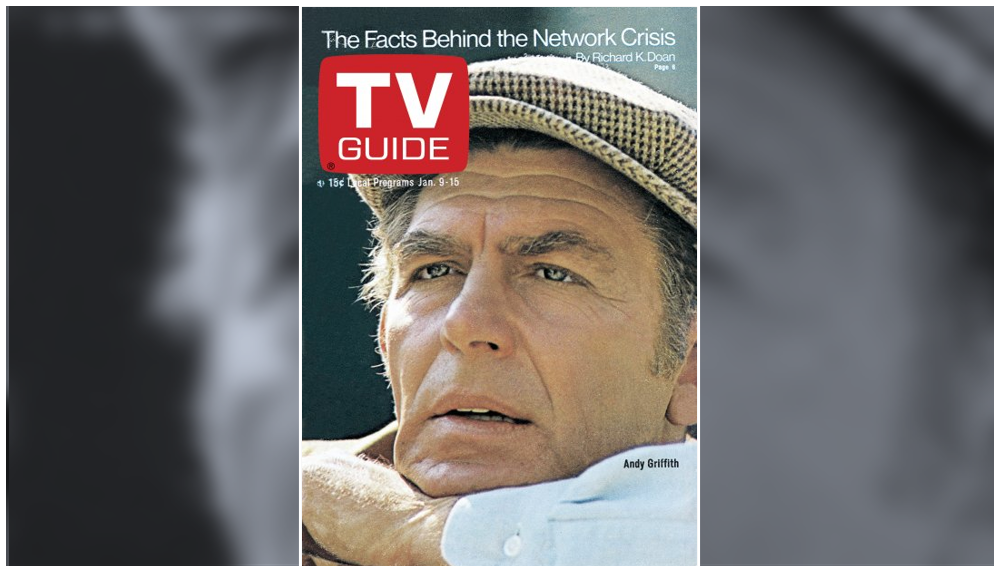
It's long been a contention of mine that the early years of the 1960s are really an extension of the '50s, and that the '60s as cultural phenomenon reach into the early '70s. However, as is the case with most theories, there are exceptions, and one of the clearest examples of how the decades differ is Andy Griffith. If this was a Matlock mystery, it might be called "The Case of the $3,500,000 Misunderstanding."

Bill Davidson's cover story does indeed tell a story, that of the beloved television star finding out you can't go home again, but if we're honest about it, that story really dates back to 1957, when Andy Griffith made a great movie called A Face in the Crowd, after which nothing would ever be the same. The movie made Griffith a star, but it left a deep scar in him as well; critics began to refer to him as "another Jimmy Stewart," and whether you agree with that assessment or not the fact remains that Jimmy Stewart never was sheriff of Mayberry (although he could be as homespun as anyone), and while The Andy Griffith Show made Griffith a millionaire and the undisputed star of CBS, it also left him craving another bite of that dramatic apple—a bite it seems he'll never get.

This would seem to explain his decision in 1968 to abandon Mayberry in favor of a five-year contract to star in at least ten movies for Universal, where they assured him he'd "be another Jimmy Stewart or Hank Fonda." The deal lasted but one year, and produced one movie (Angel in My Pocket), and when the studio asked him to do a comedy with Don Knotts, "That cut it," Griffith says. "I love Don, but teaming up with him again would be like going backwards."

And so his next step was, if not backwards, at least lateral—back to television, thanks to his longtime agent Dick Linke, in a dramedy called Headmaster. CBS was so excited at the prospect of getting their star back that they signed on to a series without a script, or even a scenario, for $3.5 million. Headmaster called for him to play "a stern but just high school principal," with the comedy left to others, but the Andy that audiences knew and loved clashed with the new Andy, the one "pompously moralizing with minsermons on such maxitopics as drug addiction and freedom of academic expression." The show was a bomb, and though Griffith's stature alone could probably have gotten the series a second season, both he and the network agreed to scrap it in favor of The New Andy Griffith Show, in which he returned to his rural roots as mayor of a small Southern town. There are hopes for the series as this issue goes to press, but alas, the new new Griffith show does even worse than the old new Griffith show, and before the year is out CBS is back to running reruns of Headmaster in the timeslot.

It's just one of several setbacks which will come Griffith's way: Adams of Eagle Lake, Salvage 1, and The Yeagers are all short-run series, and he'll make at least as many failed pilots. He remains popular and in the public eye due to his numerous TV-movie appearances, including some of those darker roles he craved. Finally, in 1986, he hits the jackpot again with Matlock, where he plays the down-home Southern lawyer, but with a sharp edge that had been missing with Sheriff Andy Taylor. The series runs for nine seasons, even longer than the original Andy Griffith Show.

But while it's always nice to go out on top, one can't help but think of his words when describing A Face in the Crowd. "I wish I could get a role like that again," he says in this article. "It'll come along." Success may return to Andy Griffith, but that one role he craves, that second bite of the apple, never does.

l  l  l

Throughout the 60s and early 70s, TV Guide's weekly reviews were written by the witty and acerbic Cleveland Amory. Whenever we get the chance, we'll look at Cleve's latest take on the shows of the era. 

It may only be January, but Cleveland Amory's already looking toward August—Dan August, that is, Burt Reynolds' new police drama that premiered on ABC just last September. And although the show seems to be of two minds about just about everything, Amory is single-minded in his verdict: no matter what the producers try, this series falls short. It is, in many ways, a prime example of television cynicism at its worst.

The problem plaguing August, according to Amory, is that "they want it both ways. A tough, hard-hitting, violent, beat-'em-up—but, of course, mustn't have too much violence, so, in at least two episodes so far, they give you, in the station house, a kind of second-degree third degree." Anti-establishment enough to attract "the kids," but not so anti that it turns the elders off. Stories that invariably feature two sides. And so on. Even the setting—large enough for big-city crime, small-enough that cases still involve August's friends.

Lest you think the producers are merely covering all the bases, Amory notes, "like every other show that ever set out to have it both ways, Dan August hasn't got it either way." The result is an unreal mishmash that usually leaves you with nobody to root for, or even identify with. As for Reynolds, "[t]hey are so careful to make him not one thing or another—not too superhero, for example, nor too bumbly—that they end up not making him anything. He is all wood and a yard wide." His co-stars "just trail around after Dan, trying to pick up the pieces of the plots and expositions." That is, those who aren't either invisible or irritating.

In fairness, Amory does find the good in Dan August, in that the show takes on, as we noted, difficult themes, ones that present both sides of an issue. "It does not do them particularly well, mind you, but it does undertake them." Alas, the old adage that the person who walks in the middle of the road winds up getting hit from both directions holds true for TV series as well: Dan August never sees August, going off in April 1971. It reappears in reruns only after Burt Reynolds' career takes off later in the '70s. Proving, I suppose, that no good deed goes unpunished.

l  l  l

On Sunday, the NBA and NHL seasons get underway on ABC and CBS. Now, if you're a sports fan, you might have thought the seasons actually began in October. But, you see, those games don't count—like the internet today, nothing happens unless it's seen on television. Back in the days before sports saturated the tube, the networks didn't pick up on hockey and basketball until after the football season had ended, and so with football all but over, it's time to move on to other sports. On Saturday, ABC kicks off the tenth season of the Professional Bowlers Tour with the St. Paul Open, televised live from St. Paul, Minnesota (3:00 p.m. ET), while the PGA tees off on CBS with coverage of the Glen Campbell Los Angeles Open (5:00 p.m. Saturday, 4:30 p.m. Sunday).

The Juice and Jill St. John
I said that football was all but over: there is, in fact, one game yet to be played, but that one game is the Super Bowl, to be played on January 17 in Miami. It will be a game of firsts: the first Super Bowl since the AFL-NFL merger, and the first to be played on artificial turf. But that's next Sunday; this Sunday evening at 8:00 p.m. CBS warms us up for the big game with something called The Super Comedy Bowl, a one-hour variety special featuring an odd combination of celebrities and sports figures, including Lucille Ball, Jack Lemmon, John Wayne, Charlton Heston, Jill St. John, and Charles Nelson Reilly from the Hollywood side, and Ben Davidson, O.J. Simpson, Joe Namath, Roman Gabriel, Deacon Jones, and Dick Butkus on the jock side. This is the first in a series of Super Bowl tie-in variety specials over the next few years, most of which would be broadcast the night before the game with titles such as Super Night at the Super Bowl, as networks began to appreciate the capitalize on the growing hype value of the game and the consequent opportunities for cross-promotion.

This provides us with a nice segue to some of the week's variety shows. We're past the era of The Hollywood Palace, and Ed Sullivan is preempted tonight by the Super Bowl show, but that doesn't mean we're without variety. Glen Campbell is enjoying Sunday evening success with his Glen Campbell Goodtime Hour on CBS (9:00 p.m.), and tonight his guests include Liberace, Neil Diamond, Larry Storch, Linda Ronstadt, and the winner of the aforementioned Glen Campbell Los Angeles Open. That's followed by Jackie Gleason's show (10:00 p.m., CBS); tonight's rerun stars Bing Crosby, Maureen O'Hara and Bert Parks in a Honeymooners-goes-to-Hollywood musical.

On Monday night Rowan and Martin (8:00 p.m., NBC) welcome Johnny Carson, Gore Vidal, and Los Angeles mayor Sam Yorty (an odd collection if ever there was one), and on Carol Burnett (10:00 p.m., CBS) the guests are Jerry Lewis and Leslie Uggams. Tuesday features The Don Knotts Show (7:30 p.m., NBC) with Lloyd Bridges, his sons Jeff and Beau, Nancy Wilson, and Tommy Roe (but no Andy Griffith, we might add.) The second half of the Knotts show overlaps with Hee Haw (7:00 p.m,. CBS), still on its network run, with Roger Miller, Peggy Little, and New York Yankees outfielder Bobby Murcer (?) leading the way. And we've got dueling shows at 9:00 p.m. on Wednesday, with NBC's Kraft Music Hall going up against ABC's Johnny Cash Show. On the former, "Alan King Plays the Games People Play" with James Coco, Anne Meara, and Mary Ann Mobely; the latter features Jane Morgan, Homer and Jethro, Bill Anderson, Gordon Lightfoot, and Jan Howard.

Thursday night features Flip Wilson (NBC, 7:30 p.m.), and an eclectic guest cast of Zero Mostel, Steve Lawrence and Roberta Flack. Meanwhile, do you remember that Jim Nabors left Gomer Pyle to host his own variety series? (Probably, except for some of you youngsters out there.) It ran for a couple of seasons and did very well, but it was included in the rural purge that claimed so many of CBS's other successful series. Anyway, Jim's special guest this week is Robert Goulet, along with Jim's regulars Ronnie Schell and Frank Sutton (8:00 p.m.). Of course, the crown jewel of Thursday's shows is always Dean Martin (10:00 p.m., NBC), and this week Deano has something for everyone, with Orson Welles reading from the Bible (I'll bet you thought he only did roasts), and Charles Nelson Reilly and Don Rice for comic relief. Finally, on Friday, This Is Tom Jones ends its two-year run, with Petula Clark as Tom's sole guest. (10:00 p.m, ABC)

l  l  l

It's interesting that even in 1970 people within the medium were predicting the eventual end of the networks, and it's a theme that will continue through this year of 1971. Some thought they'd be gone before the turn of the century; nearly all of them felt they'd have disappeared by now. The reasons are fairly simple: the dreck polluting the airwaves today, combined with the coming growth of cable television, something that nearly everyone knows is coming. In the first of a two-part analysis by Richard K. Doan, we learn the details of the gloom descending on network boardrooms.

There are a host of reasons for pessimism, to be sure: loss of revenue, due at least partially to the ban on cigarette advertising ($200 million annually); loss of a half-hour of prime time per night starting next year ($170 million in lost billing); a movement to ban commercials on Saturday morning cartoons (the biggest profit center other than soap operas and The Tonight Show); a prohibition of networks syndicating their old series to local stations ("lucrative"); increasing attacks from politicians, particularly Vice President Spiro Agnew; and that's just the tip of the iceberg. Says one insider at NBC, "Let's face it, we're as big as we're ever going to get. From now on it's a defensive action."

Mike Dann, the former head of programming for CBS, is blunt: "I believe there is no chance the network structure as we know it can or will survive." Paul Klein, the former head of audience research for NBC, agrees that there is no future for the networks, and adds that most viewers "settle for the least objectionable programs, rather than watching anything they really care about," which in turn results in the networks offering what he refers to as "future schlock"—"a slow deterioration of network fare toward 'cheap' shows such as games and more and more reruns." And then there's the growing trend of affiliates pre-empting network programs to run old movies and syndicated series; Jack Harris, president of KPRC in Houston, says "Such pre-emptions are made for only reason. It is spelled M-O-N-E-Y and pronounced money." When the most profitable affiliates do it, "then the pronunciation is GREED."

Donald McGannon, president of Group W, said the programming put out by networks is "not relevant to our times," and was a major backer of the FCC move to give a half-hour per night of prime time back to local stations. He felt the result would be "socially relevant, innovative and instructional or cultural" programs every night on all stations. The result, of course, has been syndicated game and talk shows and other such pablum. And there we have it, for just about every plan to reform television has failed. Greater network control of television programs, started as a response to the Quiz Show Scandals, has resulted in an increased emphasis on ratings, which in turn has caused programmers to dumb down their shows in search of that "lowest common denominator" programming. The salad days of the past, when the networks were rolling in money, have resulted in unrealistic profit expectations. As one executive points out, "what other business expects to return 45 [cents] out of every dollar to profit? And that's the return right now."

(In Group W's defense, it should be noted that in 1976, they launched Evening Magazine, called P.M. Magazine on non-Group W stations, which would run throughout the remainder of the 1970s and '80s, and included segments produced by local stations as well as the national content.) 

We don't know what the second half of this article says about what all this means for the future of broadcasting and the effect on viewers, but we can make a few observations based on what we know today. Network television did survive the dismal predictions, at least for a little while. The growth of cable television reduced network ratings, true, but for awhile the networks seemed poised to survive. The attraction of cable in those days was mainly uncut movies, female nudity, sports, and news. Networks bought into cable networks, and those stations even became prime buyers of network syndicated programming. Once cable started producing its own original programming, however, the tide indeed began to turn. Before long the Emmys were dominated by cable series, and cable became a byword for quality. Then streaming video entered the picture, first through services like Netflix and Hulu, and then these services started producing original programming as well. The "cut the cord" movement became a real thing, though its long-term trend is still up in the air.

And so we have returned once again to the future of network broadcasting. Whereas the concerns of the '70s were based in part on fear of the future, today's worries seem more grounded in fact, in an analysis of what's happening right now. It's not just concern about network survival, either—it's the entire concept of television as we know it, for the cable networks stand to lose the most. Some even predict the networks could come out of this in better shape, at least in the short term.

One thing's for certain, however: the future of television has always been a matter of great speculation. Only now, we find ourselves asking if that future has finally arrived.

l  l  l

This week's starlet is Angel Tompkins, the typical ambitious actress, and Leslie Raddatz says don't bet against her when she talks about how she hates losing and likes beating the system. The hook Raddatz is using in his story is that Tompkins lives on the same street as Bob Hope, but it's not the neighborhood with the mansions—rather, she lives with her son in one of a row of tiny cottages for which she pays rent of $145 a month. It's every bit the rags-to-sort-of-richest story, coming from a broken home, with a childhood full of insecurities, a failed early marriage, a number of television credits to her name, and the determination to "work and improve."

Her credits continue into the '80s, and include a Playboy spread a year after this article appears, but in this household she'll always be best known for her too-infrequent appearances as technician Gloria Harding, Hugh Lockwood's (Hugh O'Brian) nemesis/love interest in the 1972-73 series SEARCH, which I'm currently reviewing with Dan Budnick on the Eventually Supertrain podcast. A pity she wasn't in that series more often; her character was one of great charm and spice, always looking to puncture Lockwood's ego while and the same time dispensing the information that helps save his neck. Ah, well; not the only lost opportunity in television history. She becomes heavily involved in SAG politics, and probably leaves a greater mark there than from her acting career. 

She never becomes the star she should have been, but she's done better than most.

l  l  l

Finally, a woman who's a star by any and every definition of the word: Sophia Loren. There's no particularly good reason to include this, either in TV Guide or here, other than, well, Sophia Loren. She's not appearing on any program in the near future (although she's always been a hit on television), nor is she publicizing an upcoming movie. No, the reason we're here in Rome is simply to find out "what 'movie stars' look like these days, an era defined by "faded blue jeans and tie-dyed sweat shirts." The good news is that Miss Loren does not go in for this kind of clothing, at least not in public. "You must feel like a queen at that moment," she says. We'll leave you with these as parting shots.


TV  

March 2, 2019

This week in TV Guide: March 6, 1965

As my enforced series of encore presentations continues, we're up to an interesting issue: so interesting, in fact, that I've already encored it once. I promise you, however, that there's even more new in this week's look, along with some features you might recognize from the past.

The brooding visage of David Janssen graces this week's cover.  Janssen is in the second of four seasons playing Dr. Richard Kimble the hero of the hit ABC series The Fugitive. As Arnold Hano notes, Janssen the actor shares many similarities with Kimble the fugitive, among which is a lack of comfort with his surroundings. His friend, novelist Bernard Wolfe, comments that "David is not a fanatically dedicated person. If he were, all this grueling work would have more meaning for him. But he is not dedicated. He has great doubts as to the ultimate aim of it all, as to where it is leading him."

Janssen in fact houses a number of torments: his heavy drinking, which Janssen claims has diminished while doing The Fugitive, but would always remain a part of his life; his ulcer (caused, Janssen wryly notes, by "thinking"); his heavy smoking (two to three packs a day); and the fatigue of his grueling schedule of 14-hour days filming a show in which he is in virtually every scene. When told that executive producer Quinn Martin "speaks grandly of five more years" of The Fugutive, Janssen dully replies, "Five more years? Contractually, I suppose I would have to put in five more years, but—" The Fugitive ran just about the right length of time; David Janssen, who died of a heart attack at age 48, died way too young.

📺  📺  📺

Personally, I don't think you need a reason to show a picture of Sophia Loren, but this week we have one. On Saturday, WTCN presents the TV premiere of Two Women, the movie for which Loren won her Oscar for Best Actress. Channel 11 advertised the movie accordingly.


Now, take a good look at that ad.  Notice anything strange about it?  The placement of that "TONIGHT 10 P.M." strip looks just a little suspicious, don't you think?  Especially when compared to the same picture, unedited:


While this picture might be considered somewhat modest today, I'm sure that 1965 Midwest sensibilities might have been offended by the amount of Sophia's cleavage on display. Two Women is an art-house movie (and Loren was the first Best Actress winner in a foreign-language film), so it's likely that many people in the Twin Cities hadn't seen it; Loren's sexpot image was well-known, however, so the station might have thought a little judicious editing was in order.

Alternately, because it probably wasn't seen widely and viewers didn't know what it was about, perhaps the station just wanted to create the impression that there was more to see than meets the eye. Or is that too cynical a thought? I'm just sayin'.

📺  📺  📺
.
During the 60s, the Ed Sullivan Show and The Hollywood Palace were the premiere variety shows on television. Whenever they appear in TV Guide together, we'll match them up and see who has the best lineup..

Ed Sullivan: Scheduled guests include singer Ella Fitzgerald; Duke Ellington and his band; singer Rita Pavone; singer-dancer Roy Castle; comics Stiller and Meara; the two Carmenas, balancers; and comedian John Byner.

Hollywood Palace: Host Eddie Fisher welcomes actress-vocalist Connie Stevens, comedian Jack Carter, the Marquis Chimps, the Arirang Korean ballet troupe, comedy pantomimist Ben Wrigley and the Kuban Cossacks, dance team.

This contest was pretty much over at the start. With Ella and Duke headlining the Sullivan show, Palace was already going to have to come up with something big to top it. Eddie Fisher, Connie Stevens and Jack Carter are OK, but the royalty that the Palace needed was already spoken for. Crown Sullivan as winner for the week.

📺  📺  📺

Let's see—we've covered Saturday, so what does the rest of the week have? The big movie of the week is a really big one: ABC's Sunday night presentation of Judgment at Nuremberg, starring Spencer Tracy, Oscar winner Maximilian Schell, Burt Lancaster, Marlene Dietrich, Judy Garland and a cast of thousands. It's a long movie, starting at 8:00 p.m. CT and running for three and one-half hours. And it's a heavy movie—preachy at times, as one might expect from writer Abby Mann and director Stanley Kramer. But less than 20 years after the end of World War II, it's also a portrait of a world still trying to come to grips with the horror of the Holocaust, and a country (Germany) trying to sort out its moral responsibility.

On Monday, Bing Crosby reunites with his old friend Phil Harris on Bing's sitcom (8:30 p.m., ABC); Harris is Bing's former vaudeville partner, who shows up with his new act: a trained crow, who may be responsible for a rash of neighborhood jewelry thefts. Following that, Jerry Lewis doubles as director and star in a rare dramatic role on Ben Casey (9:00 p.m., ABC) He's Dr. Dennis Green, a new resident at County General and an "irrepressible clown" (no surprise there), but Casey takes a dim view of it all, endangering Dr. Green's hopes to go into neurosurgery.

Tuesday kicks off with a special Red Skelton (7:30, CBS) entitled "The Red Skelton Scrapbook," hosted by Ed Wynn and featuring Red performing some of his most famous sketches and pantomimes. At 9:00 p.m., NBC presents a news special, "The Pope and the Vatican," covering the concluding days of the Second Vatican Council and the radical changes (termed aggiornamento, or "bringing up to date") coming to the Catholic Church. Vatican II had its critics even then, but could they have imagined the havoc this would create in the decades to come.

Wednesday night it's the "first annual" Grand Award of Sports (8:30 p.m., ABC), presented live from the New York World's Fair, and hosted by Bing and Kathryn Crosby. The format: "Panels of outstanding sportsmen have selected 20 winners" from a list of 83 nominees representing "the world's top athletes". The nominees included football stars Jim Brown and Johnny Unitas, boxer Cassius Clay, baseball's Sandy Koufax, basketball greats Wilt Chamberlain and Oscar Robertson, and hockey stars Bobby Hull and Gordie Howe. At the show's end, one of these winners will be chosen to receive the "Grand Award," presented by former astronaut John Glenn. That picture on the right is from the John H. Glenn archives; it's one of the Grand Awards, presented to Glenn "for his work as chairman of the Grand Award of Sports inaugural telecast." I can't find another listing for the "Grand Award of Sport"; it's my guess that it was either replaced or folded into the Victor Awards, which began (coincidentally?) the very next year, 1966.

Gloria Swanson makes her TV comedy debut Thursday on My Three Sons (7:30 p.m., ABC), playing an old vaudeville friend of Uncle Charley, while another Gloria—Gloria Stewart—guests with her husband Jimmy and their twin daughters on Password (7:30 p.m., CBS). And tonight's Tonight Show (10:30 p.m., NBC) bears some looking into, as Johnny has a scheduled guest lineup that includes Bob Hope, Hedda Hopper, Richard Chamberlain, Carol Lawrence, Barbara Parkins, and Harve Presnell.

A rerun of Have Gun—Will Travel attracts some interest on Friday (7:30 p.m., WTCN), with Paladin's assignment being to act as Oscar Wilde's bodyguard. John O'Malley plays Wilde. And not to be outdone by Johnny, Jack Paar has a pretty good show himself (9:00 p.m., NBC), with Peggy Lee, plus Mike Nichols and Elaine May.

📺  📺  📺

Looking at the TV Teletype, there's a note that on April 11 the ABC program Directions '65 will be telecasting David Amram's Holocaust opera The Final Ingredient, commissioned by the network,*  based on the teleplay by the famed Golden Age writer Reginald Rose. "Set in the Bergen-Belsen concentration camp, The Final Ingredient relates the story of a group of inmates who attempt to hold a secret Passover Seder inside the camp, and their quest for the final ingredient, which lies just outside the camp walls."  It sounds intriguing; I know Amram's music primarily from his soundtrack for the movie The Manchurian Candidate. As this article points out, ABC conceived of this as a "Passover Opera" that might be presented annually—almost a Jewish counterpart to Menotti's Christmas opera Amahl and the Night Visitors. But it didn't become an annual broadcast, at least as far as I know. It's available for viewing at the Paley Center.

*I'm not positive, but I'm fairly certain this was the final opera commissioned by one of the big three American commercial television networks. After this, it would be up to PBS.

We'll also learn that the Smothers Brothers are guests on Jack Benny's season finale April 16 on NBC; Jack will probably be limiting his appearances next season to hour-long specials, which indeed he does. And if your appetite for awards shows hasn't been sated by the Grand Award of Sports, you'll be glad to know that the Grammys are coming up in a one-hour telecast on NBC May 18, in which most of the winners are expected to perform their Grammy-winning songs.

Neil Hickey reports on CBS's series The Nurses, which has just been retooled with the addition of a couple of doctors; it's now called The Doctors and the Nurses. The nurses (Zina Bethune and Shirl Conway, left) are now supporting players to the doctors (Joe Campanella and Michael Tolan). According to producer Herb Brodkin, the move was made to improve ratings and dramatic potential; since nurses can't diagnose patients, there just weren't enough stories to carry the show. Says Brodkin, "Part of the problem was that, in making things happen in a story, nurses are handholders."

The Doan Report tells us that Johnny Carson's doing a 15-minute sit-in, in protest of the fact that many NBC affiliates around the country (including those in New York and San Francisco) don't carry the first 15 minutes of Tonight (which at the time ran for an hour and 45 minutes), choosing instead to run a half-hour of local news. For Carson, this meant about half of the nation would miss his monologue, a situation which justifiably caused him some distress—so much so, Carson claims, that it's preventing him from appearing on-air for the first 15 minutes of the program. His "sick-in" lasts for two nights, after which he agrees to discuss things with the network. The short-term solution is that Ed McMahon and bandleader Skitch Henderson vamp for the opening segment, with Johnny coming on at the bottom of the hour to do his monologue. Within a couple of years, that first 15 will be dropped altogether, giving the show a tidy 90 minute running time. That becomes the industry standard for talk shows, until Johnny cuts it back further to one hour in the 1980s. I don't think talk shows have been the same since, and I don't mean that in a positive way. Oh, and in case you're wondering, the NBC affiliate in Minneapolis-St. Paul, KSTP, currently shows the entire 1:45 show, on a 15-minute delay to follow the 10:00 news.

British satirist and social critic Malcolm Muggerage has a witty, but also very provocative, article on "The British Passion for American Television," and what he has to say might surprise you. I wrote about it at length here.

📺  📺  📺

Finally, we'd be real knuckleheads if we didn't pause to note a story on The Three Stooges, who are going strong as ever since their fueled-by-TV comeback. The emotional peak is a moving story about a 12-year-old girl being treated for emotional troubles. The girl spoke and wrote only in numbers, and when she became angry she "cried out numbers ending in 4." The stunned doctors eventually discovered that the numbers she used corresponded to the numbers on Three Stooges trading cards. The cards depicted "moods of violence" that the troubled girl herself was unable to articulate without the emotional release offered by the Stooges; in recounting the story, Moe Howard tears up.

It's interesting to note that although the Stooges (which at this point consist of Moe, Larry Fine, and "Curley Joe" DeRita) don't receive any financial compensation for their old movies, but the features and personal appearances sparked by the renewed interest in the movies more than make up the difference. Ah, the Stooges - loved 'em as a kid, love' em just as much now. TV  

January 7, 2017

This week in TV Guide: January 9, 1971

It's long been a contention of mine that the early years of the 1960s are really an extension of the '50s, and that the '60s as cultural phenomenon reach into the early '70s. However, as is the case with most theories, there are exceptions, and one of the clearest examples of how the decades differ is Andy Griffith. Had Matlock existed back then, it might have been called "The Case of the $3,500,000 Misunderstanding."

Bill Davidson's cover story does indeed tell a story, that of the beloved television star finding out you can't go home again, but if we're honest about it, that story really dates back to 1957, when Andy Griffith made a great motion called A Face in the Crowd, after which nothing would ever be the same. The movie made Griffith a star, but it left a deep scar in him as well; critics began to refer to him as "another Jimmy Stewart," and whether you agree with that assessment or not the fact remains that Jimmy Stewart never was sheriff of Mayberry, and while The Andy Griffith Show made Griffith a millionaire and the undisputed star of CBS, it also left him craving another bite of that dramatic apple - a bite it seems he'll never get.

This would seem to explain his decision in 1968 to abandon Mayberry in favor of a five-year contract to star in at least ten movies for Paramount, where they assured him he'd "be another Jimmy Stewart or Hank Fonda." The deal lasted but one year, and produced one movie (Angel in My Pocket), and when the studio asked him to do a comedy with Don Knotts, "That cut it," Griffith says. "I love Don, but teaming up with him again would be like going backwards."

And so his next step was, if not backwards, at least lateral - back to television, thanks to his longtime agent Dick Linke, in a dramedy called Headmaster. CBS was so excited at the prospect of getting their star back that they signed on to a series without a script, or even a scenario, for $3.5 million. Headmaster called for him to play "a stern but just high school principal," with the comedy left to others, but the Andy that audiences knew and loved clashed with the new Andy, the one "pompously moralizing with minsermons on such maxitopics as drug addiction and freedom of academic expression." The show was a bomb, and though Griffith's stature alone could probably have gotten the series a second season, both he and the network agreed to scrap it in favor of The New Andy Griffith Show, in which he returned to his rural roots as mayor of a small Southern town. There are hopes for the series as this issue goes to press, but alas, the new new Griffith show does even worse than the old new Griffith show, and before the year is out CBS is back to running reruns of Headmaster in the timeslot.

It's just one of several setbacks which will come Griffith's way:  Adams of Eagle Lake, Salvage 1, and The Yeagers are all short-run series, and he'll make at least as many failed pilots. He remains popular and in the public eye due to his numerous TV-movie appearances, including some of those darker roles he craved. Finally, in 1986, he hits the jackpot again with Matlock, where he plays the down-home Southern lawyer, but with a sharp edge that had been missing with Sheriff Andy Taylor. The series runs for nine seasons, even longer than the original Andy Griffith Show.

But while it's always nice to go out on top, one can't help but think of his words when describing A Face in the Crowd. "I wish I could get a role like that again," he says in this article. "It'll come along." Success may return to Andy Griffith, but that one role he craves, that second bite of the apple, never does.

◊ ◊ ◊

Throughout the 60s and early 70s, TV Guide's reviews were written by the witty and acerbic Cleveland Amory. Whenever we get the chance, we'll look at Cleve's latest take on the series of the era. 

It may only be January, but Cleveland Amory's already looking toward August - Dan August, that is, Burt Reynolds' new police drama that premiered on ABC just last September. And although the show seems to be of two minds about just about everything, Amory is single-minded in his verdict: no matter what the producers try, this series falls short. It is, in many ways, a prime example of television cynicism at its worst.

The problem plaguing August, according to Amory, is that "they want it both ways. A tough, hard-hitting, violent, beat-'em-up - but, of course, mustn't have too much violence, so, in at least two episodes so far, they give you, in the station house, a kind of second-degree third degree." Anti-establishment enough to attract "the kids," but not so anti that it turns the elders off. Stories that invariably feature two sides. And so on. Even the setting - large enough for big-city crime, small-enough that cases still involve August's friends.

Lest you think the producers are merely covering all the bases, Amory notes, "like every other show that ever set out to have it both ways, Dan August hasn't got it either way." The result is an unreal mishmash that usually leaves you with nobody to root for, or even identify with. As for Reynolds, "[t]hey are so careful to make him not one thing or another - not too superhero, for example, nor too bumbly - that they end up not making him anything. He is all wood and a yard wide." His co-stars "just trail around after Dan, trying to pick up the pieces of the plots and expositions." That is, those who aren't either invisible or irritating.

In fairness, Amory does find the good in Dan August, in that the show takes on, as we noted, difficult themes, ones that present both sides of an issue. "It does not do them particularly well, mind you, but it does undertake them." Alas, the old adage that the person who walks in the middle of the road winds up getting hit from both directions holds true for TV series as well: Dan August never sees August, going off in April 1971. It reappears in reruns only after Burt Reynolds' career takes off later in the '70s. Proving, I suppose, that no good deed goes unpunished.

◊ ◊ ◊

On Sunday, the NBA and NHL seasons get underway on ABC and CBS. Now, if you're a sports fan, you might have thought the seasons actually began in October. But, you see, those games don't count - like the internet today, nothing happens unless it's seen on television. Back in the days before sports saturated the tube, the networks didn't pick up on hockey and basketball until after the football season had ended, and so with football all but over, it's time to move on to other sports. On Saturday, ABC kicks off the tenth season of the Professional Bowlers Tour with the St. Paul Open, televised live from my once and future home of St. Paul, Minnesota, while the PGA tees off on CBS with coverage of the Glen Campbell Los Angeles Open.

The Juice and Jill St. John
I said that football was all but over - there is, in fact, one game yet to be played, but that one game is the Super Bowl, to be played on January 17 in Miami. It will be a game of firsts: the first Super Bowl since the AFL-NFL merger, and the first to be played on artificial turf. But that's next Sunday; this Sunday evening at 8:00 p.m. ET CBS warms us up for the big game with something called The Super Comedy Bowl, a one-hour variety special featuring an odd combination of celebrities and sports figures, including Lucille Ball, Jack Lemmon, John Wayne, Charlton Heston, Jill St. John, and Charles Nelson Reilly from the Hollywood side, and Ben Davidson, O.J. Simpson, Joe Namath, Roman Gabriel, Deacon Jones, and Dick Butkus on the jock side. This is the first in a series of Super Bowl tie-in variety specials over the next few years, most of which would be broadcast the night before the game with titles such as Super Night at the Super Bowl, as networks began to appreciate the capitalize on the growing hype value of the game and the consequent opportunities for cross-promotion.

This provides us with a nice segue to some of the week's variety shows. We're past the era of The Hollywood Palace, and Ed Sullivan is preempted tonight by the Super Bowl show, but that doesn't mean we're without variety. Glen Campbell is enjoying Sunday evening success with his Glen Campbell Goodtime Hour on CBS (9:00 p.m.), and tonight his guests include Liberace, Neil Diamond, Larry Storch, Linda Ronstadt, and the winner of the aforementioned Glen Campbell Los Angeles Open. That's followed by Jackie Gleason's show, which airs at 10:00 p.m. on CBS; tonight's rerun stars Bing Crosby, Maureen O'Hara and Bert Parks in a Honeymooners-goes-to-Hollywood musical.

On Monday night Rowan and Martin (8:00 p.m, NBC) welcome Johnny Carson, Gore Vidal, and Los Angeles mayor Sam Yorty (an odd collection if ever there was one), and on Carol Burnett (10:00 p.m., CBS) the guests are Jerry Lewis and Leslie Uggams. Tuesday features The Don Knotts Show (7:30 p.m., NBC) with Lloyd Bridges, his sons Jeff and Beau, Nancy Wilson, and Tommy Roe. The second half of the Knotts show overlaps with Hee Haw, still on its CBS run, with Roger Miller, Peggy Little, and New York Yankees outfielder Bobby Murcer (?) leading the way. And we've got dueling shows on Wednesday, with NBC's Kraft Music Hall going up against ABC's Johnny Cash Show. On the former, "Alan King Plays the Games People Play" with James Coco, Anne Meara, and Mary Ann Mobely; the latter features Jane Morgan, Homer and Jethro, Bill Anderson, Gordon Lightfoot, and Jan Howard.

Thursday night features Flip Wilson's* ground-breaking show (NBC, 7:30 p.m.), with an eclectic guest cast of Zero Mostel, Steve Lawrence and Roberta Flack. Meanwhile, do you remember that Jim Nabors left Gomer Pyle to host his own variety series? (Probably, except for some of you youngsters out there.) It ran for a couple of seasons and did very well, but it was included in the rural purge that claimed so many of CBS's other successful series. Anyway, Jim's special guest this week is Robert Goulet, along with Jim's regulars Ronnie Schell and Frank Sutton. Of course, the crown jewel of Thursday's shows is always Dean Martin's, and this week Deano has something for everyone, with Orson Welles reading from the Bible (I'll bet you thought he only did roasts), and Charles Nelson Reilly and Don Rice for comic relief. Finally, on Friday, ABC's This Is Tom Jones ends its two-year run, with Petula Clark as Tom's sole guest.

*You'll be reading more about Flip in TV Guide two weeks from now.

◊ ◊ ◊

It's interesting that even in 1970 people within the medium were predicting the eventual end of the networks, and it's a theme that will continue through this year of 1971. Some thought they'd be gone before the turn of the century; nearly all of them felt they'd have disappeared by now. The reasons are fairly simple: the dreck polluting the airwaves today, combined with the coming growth of cable television, something that nearly everyone knows is coming. In the first of a two-part analysis by Richard K. Doan, we learn the details of the gloom descending on network boardrooms.

There are a host of reasons for pessimism, to be sure: loss of revenue, due at least partially to the ban on cigarette advertising ($200 million annually); loss of a half-hour of prime time per night starting next year ($170 million in lost billing); a movement to ban commercials on Saturday morning cartoons (the biggest profit center other than soap operas and The Tonight Show); a prohibition of networks syndicating their old series to local stations ("lucrative"); increasing attacks from politicians, particularly Vice President Spiro Agnew; and that's just the tip of the iceberg. Says one insider at NBC, "Let's face it, we're as big as we're ever going to get. From now on it's a defensive action."

Mike Dann, the former head of programming for CBS, is blunt: "I believe there is no chance the network structure as we know it can or will survive." Paul Klein, the former head of audience research for NBC, agrees that there is no future for the networks, and adds that most viewers "settle for the least objectionable programs, rather than watching anything they really care about," which in turn results in the networks offering what he refers to as "future schlock" - "a slow deterioration of network fare toward 'cheap' shows such as games and more and more reruns." And then there's the growing trend of affiliates pre-empting network programs to run old movies and syndicated series - Jack Harris, president of KPRC in Houston, says "Such pre-emptions are made for only reason. It is spelled M-O-N-E-Y and pronounced money." When the most profitable affiliates do it, "then the pronunciation is GREED."

Donald McGannon, president of Group W, said the programming put out by networks is "not relevant to our times," and was a major backer of the FCC move to give a half-hour per night of prime time back to local stations. He felt the result would be "socially relevant, innovative and instructional or cultural" programs every night on all stations. The result, of course, has been syndicated game and talk shows and other such pablum. And there we have it, for just about every plan to reform television has failed. Greater network control of television programs, started as a response to the Quiz Show Scandals, has resulted in an increased emphasis on ratings, which in turn has caused programmers to dumb down their shows in search of that "lowest common denominator" programming. The salad days of the past, when the networks were rolling in money, have resulted in unrealistic profit expectations. As one executive points out, "what other business expects to return 45 [cents] out of every dollar to profit? And that's the return right now."

We don't know what the second half of this article says about what all this means for the future of broadcasting and the effect on viewers, but we can make a few observations based on what we know today. Network television did survive the dismal predictions, at least for a little while. The growth of cable television reduced network ratings, true, but for awhile the networks seemed poised to survive. The attraction of cable in those days was mainly uncut movies, female nudity, sports, and news. Networks bought into cable networks, and those stations even became prime buyers of network syndicated programming. Once cable started producing its own original programming, however, the tide indeed began to turn. Before long the Emmys were dominated by cable series, and cable became a byword for quality. Then streaming video entered the picture, first through services like Netflix and Hulu, and then these services started producing original programming as well. The "cut the cord" movement became a real thing, though its long-term trend is still up in the air.

And so we have returned once again to the future of network broadcasting. Whereas the concerns of the '70s were based in part on fear of the future, today's worries seem more grounded in fact, in an analysis of what's happening right now. It's not just concern about network survival, either - it's the entire concept of television as we know it, for the cable networks stand to lose the most. Some even predict the networks could come out of this in better shape, at least in the short term.

One thing's for certain, however: the future of television has always been a matter of great speculation. Only now, we find ourselves asking if that future has finally arrived.

◊ ◊ ◊

This week's starlet is Angel Tompkins, the typical ambitious actress, and Leslie Raddatz says don't bet against her when she talks about how she hates losing and likes beating the system. The hook Raddatz is using in his story is that Tompkins lives on the same street as Bob Hope, but it's not the neighborhood with the mansions - rather, she lives with her son in one of a row of tiny cottages for which she pays rent of $145 a month. It's every bit the rags-to-sort-of-richest story, coming from a broken home, with a childhood full of insecurities, an failed early marriage, a number of television credits to her name, and the determination to "work and improve."

Her credits continue into the '80s, and include a Playboy spread a year after this article appears. She becomes heavily involved in SAG politics, and probably leaves a greater mark there than from her acting career. She never becomes that big star, but she's done better than most.

◊ ◊ ◊

Finally, a woman who's a star by any and every definition of the word: Sophia Loren. There's no particularly good reason to include this, either in TV Guide or here, other than, well, Sophia Loren. She's not appearing on any program in the near future (although she's always been a hit on television), nor is she publicizing an upcoming movie. No, the reason we're here in Rome is simply to find out "what 'movie stars' look like these days, an era defined by "faded blue jeans and tie-dyed sweat shirts." The good news is that Miss Loren does not go in for this kind of clothing, at least not in public. "You must feel like a queen at that moment," she says. We'll leave you with these as parting shots.


TV  

March 2, 2013

This week in TV Guide: March 6, 1965

The brooding visage of David Janssen graces this week's cover.  Janssen is in the second of four seasons playing Dr. Richard Kimball, the hero of the hit ABC series The Fugitive.  Janssen the actor shares many similarities with Kimball the fugitive, among which is a  lack of comfort with his surroundings.  His friend, novelist Bernard Wolfe, comments that "David is not a fanatically dedicated person.  If he were, all this grueling work would have more meaning for him.  But he is not dedicated.  He has great doubts as to the ultimate aim of it all, as to where it is leading him."

Janssen in fact houses a number of torments: his heavy drinking, which Janssen claims has diminished while doing The Fugitive, but would always remain a part of his life; his ulcer (caused, Janssen wryly notes, by "thinking"); his heavy smoking (two to three packs a day); and the fatigue of his grueling schedule of 14-hour days filming a show in which he is in virtually every scene.  When told that executive producer Quinn Martin "speaks grandly of five more years" of The Fugutive, Janssen dully replies, "Five more years?  Contractually, I suppose I would have to put in five more years, but -"  The Fugitive ran just about the right length of time; David Janssen, who died of a heart attack at age 48, died way too young.


***

Personally, I don't think you need a reason to show a picture of Sophia Loren, but this week we have one. On Saturday, WTCN presents the TV premiere of Two Women, the movie for which Loren won her Oscar for Best Actress.   Channel 11 advertised the movie accordingly.


Now, take a good look at that ad.  Notice anything strange about it?  The placement of that "TONIGHT 10 P.M." strip looks just a little suspicious, don't you think?  Especially when compared to the same picture, unedited:


While this picture might be considered somewhat modest today, I'm sure that 1965 Midwest sensibilities might have been offended by the amount of Sophia's cleavage on display.  Two Women was, as I recall, an art-house movie (and Loren was the first Best Actress winner in a foreign-language film), so it's likely that most people in the Twin Cities hadn't seen it; Loren's sexpot image was well-known, however, so the station might have thought a little judicious editing was in order.

Alternately, because it probably wasn't seen widely and viewers didn't know what it was about, perhaps the station wanted to create the impression that there was more to see than meets the eye.  Or is that too cynical a thought?  I'm just sayin'.

***
.
During the 60s, the Ed Sullivan Show and The Hollywood Palace were the premiere variety shows on television. Whenever they appear in TV Guide together, we'll match them up and see who has the best lineup..

Ed Sullivan: Scheduled guests include singer Ella Fitzgerald; Duke Ellington and his band; singer Rita Pavone; singer-dancer Roy Castle; comics Stiller and Meara; the two Carmenas, balancers; and comedian John Byner.

Hollywood Palace: Host Eddie Fisher welcomes actress-vocalist Connie Stevens, comedian Jack Carter, the Marquis Chimps, the Arirang Korean ballet troupe, comedy pantomimist Ben Wrigley and the Kuban Cossacks, dance team.

This contest was pretty much over at the start.  With Ella and Duke headlining the Sullivan show, Palace was going to have to come up with something big to top it.  Eddie Fisher, Connie Stevens and Jack Carter are OK, but the royalty that the Palace needed was already spoken for.  Crown Sullivan as winner for the week.

***

The big movie of the week is a really big one: ABC's Sunday night presentation of Judgment at Nuremberg, starring Spencer Tracy, Oscar winner Maximilian Schell, Burt Lancaster, Marlene Dietrich, Judy Garland and a cast of thousands.  It's a long movie, starting at 8:00pm CT and running for three and one-half hours.  And it's a heavy movie - preachy in parts, as one might expect from writer Abby Mann and director Stanley Kramer.  But less than 20 years after the end of World War II, it's also a portrait of a world still trying to come to grips with the horror of the Holocaust, and a country (Germany) trying to sort out its moral responsibility.

Speaking of which, there's a note that on April 11 the ABC program Discovery '65 will be telecasting David Amram's Holocaust opera The Final Ingredient, commissioned by the network*, based on the teleplay by the famed Golden Age writer Reginald Rose. "Set in the Bergen-Belsen concentration camp, The Final Ingredient relates the story of a group of inmates who attempt to hold a secret Passover Seder inside the camp, and their quest for the final ingredient, which lies just outside the camp walls."  Interesting, as this article points out, that ABC conceived of this as a "Passover Opera" that might be presented annually - almost a Jewish counterpart to Menotti's Christmas opera Amahl and the Night Visitors.  But it didn't become an annual broadcast - at least, as far as I know.  It's available for viewing at the Paley Center - might have to check this out someday.

*I'm not positive, but I'm fairly certain this was the final opera  commissioned by one of the big three American commercial television networks.  After this, it would be up to PBS.

Let's see - there's also an article about CBS's series The Nurses, which has just been retooled with the addition of a couple of doctors; it's now called The Doctors and the Nurses.  The nurses (Shirl Conway and Zina Bethune) are now supporting players to the doctors (Joe Campanella and Michael Tolan).  According to producer Herb Brodkin, the move was made to improve ratings and dramatic potential: since nurses can't diagnose patients, there just weren't enough stories to carry the show. Says Brodkin, "Part of the problem was that, in making things happen in a story, nurses are handholders."

***

Johnny Carson's doing a 15-minute sit-in, in protest of the fact that many NBC affiliates around the country (including those in New York and San Francisco) don't carry the first 15 minutes of Tonight (which at the time ran for an hour and 45 minutes), choosing instead to run a half-hour of local news.  For Carson, this meant about half of the nation would miss his monologue, a situation which justifiably caused him some distress - so much so, Carson claimed, that it prevented him from appearing on-air for the first 15 minutes of the program.  His "sick-in" lasts for two nights, after which he agrees to discuss things with the network.  The short-term solution is that Ed McMahon and bandleader Skitch Henderson vamp for the opening segment, with Johnny coming on at the bottom of the hour to do his monologue.  Within a couple of years, that first 15 will be dropped altogether, giving the show a tidy 90 minute running time.

On the sports front, there's the usual late-winter fare: bowling, basketball, the odd golf tournament.  The most notable event: the "first annual" Grand Award of Sport, Wednesday night at 8:30 CT on ABC, presented live from the New York World's Fair, and hosted by Bing and Kathryn Crosby.  The format: "Panels of outstanding sportsmen have selected 20 winners" from a list of 83 nominees representing "the world's top athletes".  The nominees included football stars Jim Brown and Johnny Unitas, boxer Cassius Clay, baseball's Sandy Koufax, basketball greats Wilt Chamberlain and Oscar Robertson, and hockey stars Bobby Hull and Gordie Howe.  At the show's end, one of these winners will be chosen to receive the "Grand Award," presented by former astronaut John Glenn.  I can't find another listing for the "Grand Award of Sport"; it's my guess that it was either replaced or folded into the Victor Awards, which began (coincidentally?) the very next year, 1966.

NBC presents a news special Tuesday night entitled "The Pope and the Vatican," covering the concluding days of the Second Vatican Council and the radical changes (termed aggiornamento, or "bringing up to date") coming to the Catholic Church.  I've been on vacation lately; anything new happening with the Pope?

***

Finally, the British satirist and social critic Malcolm Muggerage has a witty, but also very provocative, article on "The British Passion for American Television,"  and what he has to say might surprise you.  Rather than lengthen today's piece beyond any reasonable measure, I've chosen to devote an entire essay to the topic.  Come back on Tuesday to see what it's all about. TV